17 March 2025
Future-Proofing Investments: Strategies from the Experts
An engaging panel discussion co-organised by NUS Alumni Relations and NUS SCALE saw investment heavyweights examining the trajectory of markets in uncertain times.

Seated (L to R): Mr Benjamin Lee (Arts & Social Sciences +USP ’06), Ms Reena Choo, and Professor Edward Tay (Engineering '94)
Amid the ongoing unpredictability in global markets, investors today face significant headwinds. Navigating this volatile environment was the focus of a panel discussion held on 12 February 2025 at the Shaw Foundation Alumni House, titled Spotting Tomorrow’s Trends: How Investors Identify Future Markets. The panel featured financial experts who discussed the evolving investment landscape in artificial intelligence (AI), blockchain, fintech and sustainability. Moderated by Professor Edward Tay (Engineering ’94), Adjunct Associate Professor at the Asian Institute of Digital Finance, NUS, the discussion included insights from Ms Reena Choo, Associate Director and Investment Advisor at Standard Chartered Bank; and Mr Benjamin Lee (Arts & Social Sciences +USP ’06), Senior Advisor at the Innovation Hub Singapore Centre, Bank for International Settlements (BIS).
UNDERSTANDING THE DRIVERS OF EMERGING MARKETS
Professor Tay opened by emphasising the importance of recognising long-term potential in emerging sectors. With rapid technological advancements and evolving regulations shaping new market opportunities, he stressed the need for investors to remain informed and adaptable.
Drawing on her experience in wealth management, Ms Choo explained how these trends translate into real-world investment portfolios. She noted that AI has revolutionised algorithm-based trading, with financial institutions now using sophisticated machine-learning models to predict market movements more accurately. She stressed that cryptocurrency assets continue attracting institutional interest despite regulatory uncertainties, thanks to improved accessibility and infrastructure. “Crypto is a lot more accessible right now to mainstream investors, and that’s why it will remain relevant for the future,” she said. “We have seen a lot of institutional [capital] flows into crypto assets, resulting in financial institutions being able to structure [investment vehicles]. Individual investors can now buy into crypto exchange-traded funds, for example.”
Representing the regulatory viewpoint, albeit in a personal capacity, Mr Lee addressed the need for balanced risk management in these high-growth areas. He underscored the need to understand evolving regulatory landscapes, particularly in fintech, blockchain and AI, where compliance frameworks are still evolving. He explained that financial authorities increasingly prioritise innovation alongside stability, and cited initiatives at BIS that aim to streamline cross-border financial transactions, notably through the Committee on Payments and Market Infrastructures. “Everyone [in Singapore] uses PayNow – it is like second nature almost,” he said. “But on a cross-border basis, [instantaneous digital payment] doesn’t happen. That is something that we are trying to make happen.”
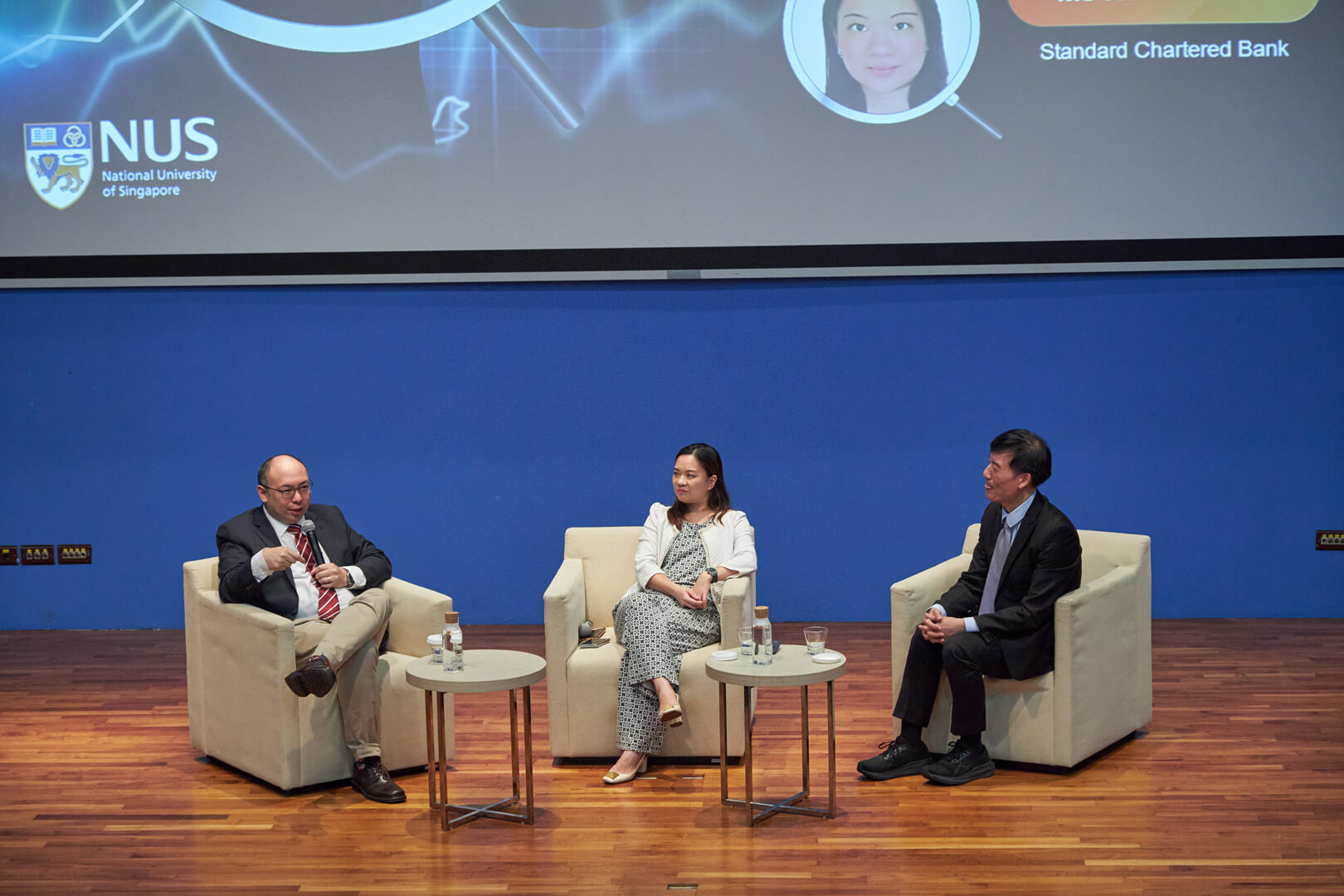 The panel discussed the evolving investment landscape, highlighting emerging sectors for investors to note.
THE SUSTAINABILITY FACTOR
A significant portion of the discussion centred on sustainability and its influence on investment trends, despite challenges posed by the current administration in the United States and a multipolar world. The panellists agreed that even though there are setbacks — such as the vacillating US stance on the Paris Agreement (an international climate treaty that the US endorsed in 2016, withdrew from in 2020, rejoined in 2021 and abandoned again this year) — firms broadly continue to lean into sustainability. This takes into consideration that ‘sustainable’ also relates to a business’ long-term viability beyond environment considerations. “It is about good corporate governance — and that is something investors should always be concerned about,” said Ms Choo.
Professor Tay noted that major financial institutions worldwide are increasingly aligning portfolios with environmental, social and governance (ESG) criteria. He added that Singapore’s ambitious Green Plan 2030 is expected to drive investment in sustainable infrastructure through green bonds and financing initiatives. “At that level, and internationally, there are more and more funds flowing into green infrastructure,” he said.
Ms Choo elaborated that sustainable investing is not merely a trend but a strategic necessity.
Many investors now prioritise companies with strong ESG credentials, as these businesses tend to be resilient to regulatory and environmental shifts. “We always advocate sustainable mandates to our clients,” she said. “We say that maintaining sustainable portfolios is important because this will preserve their capital in a more rightful manner in time to come.” She also discussed the growing appeal of AI-driven sustainability initiatives, such as predictive analytics for climate risk assessment.
Speaking broadly, Mr Lee observed that even though multilateral action has slowed, “countries had been working [until recently] in a collective spirit, and it will take a lot to undo and unravel this”. He pointed out that the momentum of history swings between integration and fragmentation over time. Consequently, regulators must work to build bridges between emerging walled gardens.
NAVIGATING MARKET VOLATILITY AND GEOPOLITICAL UNCERTAINTY
A key concern raised was the impact of geopolitical tensions, notably between the US and China, on investment strategies. Mr Lee noted that global markets are increasingly fragmented due to shifting international policies, citing recent US tariff moves and the retaliatory responses from affected countries. Investors must consider regional differences in regulatory approaches, especially in cryptocurrency and digital finance, where government positions vary widely.
Ms Choo agreed, emphasising that a diversified investment portfolio is crucial in uncertain times. She advised investors to balance high-growth, high-risk assets like AI startups and cryptocurrencies with stable, long-term holdings such as green bonds and blue-chip stocks. She also touted the strength of gold, an asset Standard Chartered has been bullish about since 2008.
 The Intellectual Insights event drew a large crowd to Shaw Foundation Alumni House.
THE INVESTMENT SKILLS NEEDED FOR THE FUTURE
The discussion concluded with insights into the skills necessary to thrive in the rapidly changing investment environment. Professor Tay urged investors and financial professionals to prioritise continuous learning and adaptability, noting that integrating AI, fintech and sustainability into mainstream finance requires a multidisciplinary approach.
Mr Lee echoed this, stating that the ability to handle cross-sector opportunities is vital. “Years ago, nobody was looking at [investment opportunities in AI]; instead everyone was talking about blockchain,” he said. “So [one needs to be] nimble enough to seize opportunities and also to understand and apply lessons [when things do not pan out] and adapt to the next situation.” He recommended industry events such as Singapore’s Fintech Festival for investors to stay ahead.
Beyond technical knowledge, investors must develop a keen sense of market psychology, Ms Choo added. Recognising consumer behaviour and technological adoption patterns can provide valuable investment insights. “I love technology and I love to drive, so I thought [self-driving cars] are not for me,” she said. “But then I read an article about AI systems being developed [by Toyota and partners] that work to prevent accidents by predicting them and taking control of the car. This might be useful even to people who like driving.”
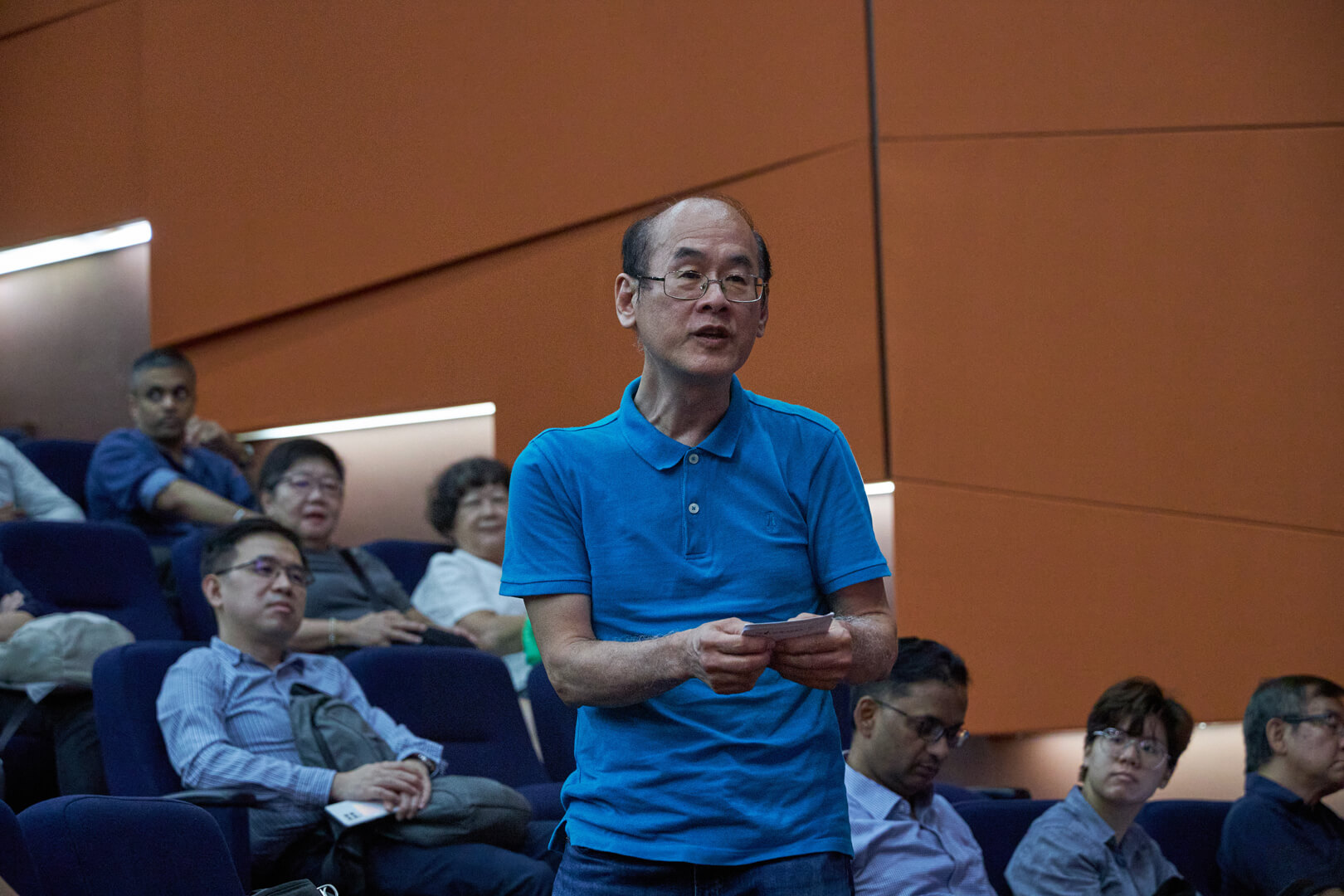 An audience member asks the panel a question.
INVESTING IN KNOWLEDGE FOR LONG-TERM SUCCESS
Wrapping up, Professor Tay reinforced the idea that investing in knowledge pays the best dividends. He encouraged attendees to embrace lifelong learning, utilise educational resources and proactively identify investment opportunities. “You invest at your own peril so [you had better] find and fill your knowledge gaps,” he said. “When you invest in yourself, you always make money.”
The panel discussion provided a thorough overview of factors shaping future markets and underscored the importance of agility, sustainability and informed decision-making. As industries evolve, insights shared by the panellists serve as a valuable guide for investors navigating tomorrow’s financial landscape.
Text by Ashok Soman. Photos by Mark Lee.