Press Enquiries
Please direct all press enquiries and image requests to museum@nus.edu.sg.
In The Spotlight
Diary of an NUS Museum Intern: Sara Lau
Diary of an NUS Museum Intern is a series of blog posts written by our interns about their experiences during the course of their internships. Working alongside their mentors, our interns have waded through tons of historical research, assisted in curatorial work, pitched in during exhibition installations and organised outreach events! If you would like to become our next intern, visit NUS Museum’s student development page for more information.
Sara Lau is a third-year Sociology student at the NUS Faculty of Arts and Social Sciences, with a second major in Southeast Asia Studies. As our Programming and Exhibition Management Intern, Sara assisted her supervisor, Siddharta Perez, in exhibitions and curatorial projects.
Venturing into the NUS Museum and this internship, I sought to reconfigure my modes of understanding and obtaining knowledge, giving attention to phenomenological experiences alongside the readings of text. I wanted to build visual and spatial literacy, to learn how space can work with objects and text to create different textures in an exhibition, and the dynamism that comes with the dialogue between different mediums. The NUS Museum was the perfect space for these encounters, considering how the museum plays heavily on the absence and presence of text in the construction of exhibitions and prep-rooms.
Radio Malaya: Abridged Conversations about Art
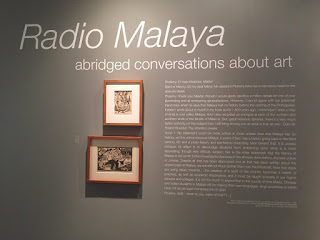
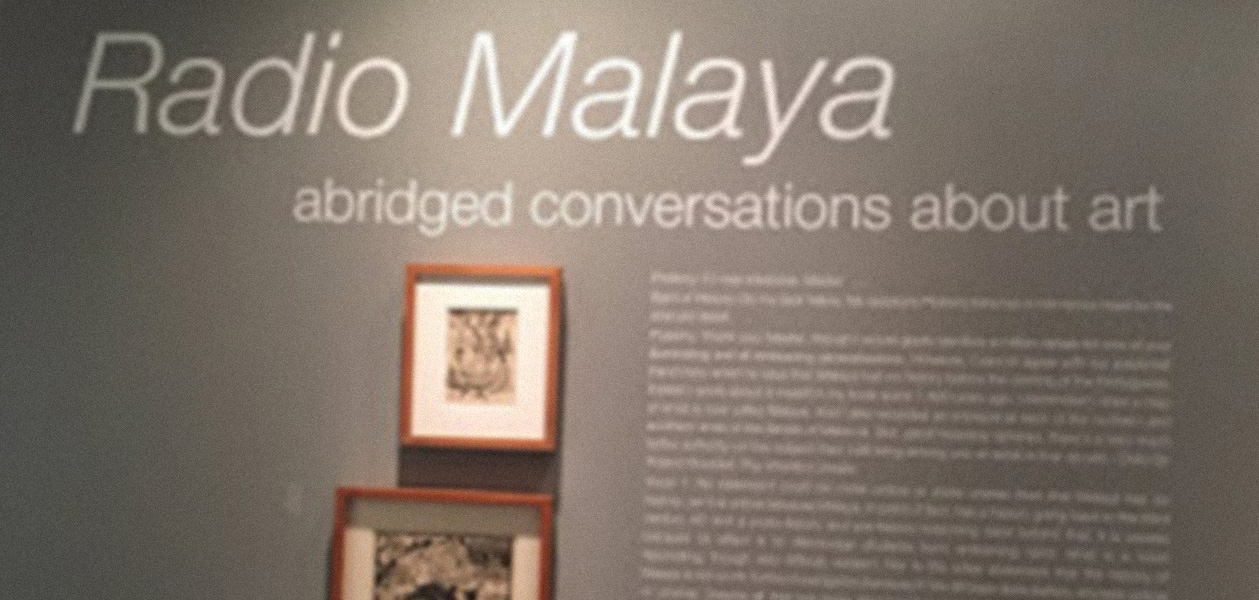
My first encounter with the museum was through this exhibition. The first thing that struck me was how heavy the whole exhibition felt, packed with artworks and artefacts with few explanatory texts to act as guides or buffers. I initially found this exhibition to be intimidating and overwhelming, and up to now, it is still challenging to talk about. There is meaning to be found in the eschewing of explanatory wall text in favour of allowing other kinds of text into the space.
The exhibition as a whole is structured around the histories that can be propagated using art and artefacts. Rather than providing a fixed and directed narrative, not including wall text allows the viewer to piece together their own version of history, while the texts on the walls and in the guides act as suggestions and possibilities, non-authoritative texts that allow the artworks and artefacts to speak for themselves, and to each other.
17 Volcanoes
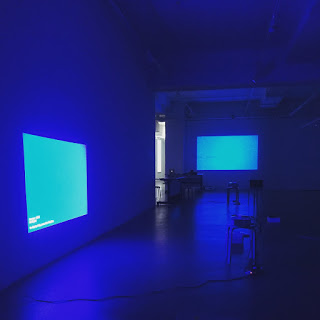
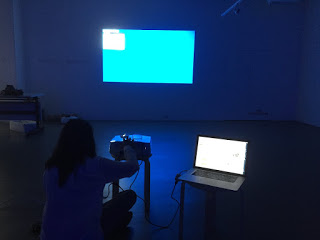
My interaction with this exhibition was rather fleeting, but what was memorable was being able to be present while the layout for the space was being discussed between the curator, Siddharta Perez, and one of the collaborators and artists, Adrienne Joergensen. Working mostly with light, rather than physical objects and artworks, provided a whole different set of challenges. I was able to witness a small part of the curatorial process, observing how Sidd and Adrienne sought to configure the projection and television displays to fill up the vast, cavernous space, while also considering the specific aesthetic of each artwork and how they would work together as a whole.
Much like Radio Malaya, extracts from Alexander von Humboldt’s Views of Nature were used in placed of wall text, providing insights into the conceptual framing for the exhibition rather than strict dictation and explanation of each individual work. These extracts also serve to act as a thread that runs through each artwork, and perhaps help the viewer to consider the individual artworks in relation to one another, and in the larger context of the expedition project.
Buaya: The Making of a Non-Myth
Consolidations and configurations
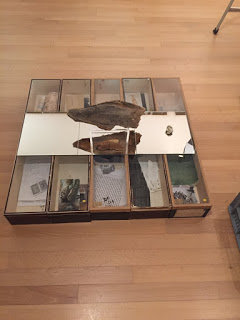
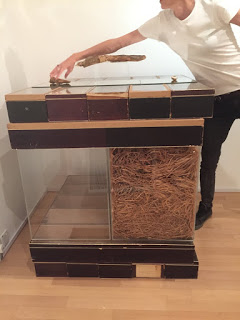
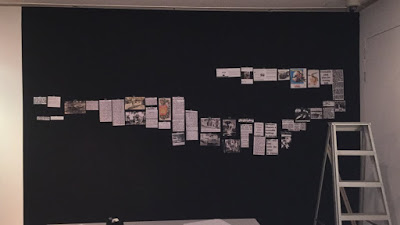
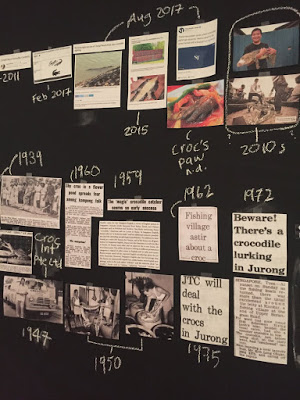
The prep-room projects I worked on allowed for more tactile experiences in handling objects and putting displays together, working alongside the artists. For Buaya, I was able to work with Kate Pocklington, an artist and conservator, in how to display various installations in her prep-room. Having to configure physical objects and also treat text as object was quite new to me, but also a healthy challenge and exercise that I believe allowed me to be more attuned to space and the aesthetics on an exhibition/artistic project. Not only did I have to think about how to best present it logistically (considering the public nature of the museum), but also conceptually, in figuring out the ways we could convey the history and the metaphorical weight of the crocodile in Singapore.
After Ballads
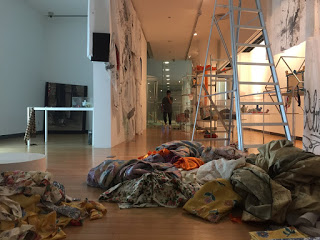
In the process of painting a space
The project that prompted me to think and write about this relationship between text and images in the museum would be artist Fyerool Darma’s After Ballads. This prep-room is both poetry and painting, a colourful confrontation of the spectres of colonial past that still haunt us. The space as a whole is visually sparse, but the individual vignettes are dense, filled with different textiles, iconography and images. Texts however, still play an integral role here, considering that the pre-cursor to the space is an extract from an autobiography by Munshi Abdullah.
The artist, Fyerool Darma, refers to a variety of literature and text in his practice, which translates in the methods in which he weaves words and text into the different assemblages that make up the prep-room. The words are there and they are essential, but ultimately what speaks are the portraits and the installations themselves. It is a reconfiguration, distortion and representation of text and its forms. His work, along with our various conversations, helped me to rethink the way in which I read art and texts, along with the complex ways they can be presented and distorted.
a personal note
Working in the museum has also challenged me to question how and where I position myself while working in the physical and psychological museum space. As an intern, I have working responsibilities and obligations, yet at the same time I am also a student with my own intellectual pursuits, and also a friend to peers, artists and curators. How do these layers of the self overlap, and often conflict? What do I owe to art, to the museum, to knowledge, to history, to people, to myself? Where do I take my stances and stake my claims, and what are the consequences in doing so? The past few months have been a whirlwind for me to navigate between these aspects and locate myself in the complex cosmology of artistic practice (and arguably of life itself). While I still am a bit lost, I am hopeful that I will one day find stable ground to walk on, no matter how uncertain the path.
I confess that coming into this internship, I was apprehensive about my contributions to the museum, considering my lack of experience. I am thankful that the experience was fulfilling and enjoyable despite my own shortcomings, and for that I am especially grateful to my most supportive and accommodating mentor, Sidd, as well to Michelle and Wardah, who provided me with insights, respite, and much-needed effervescence. I would also like to thank artists Kate Pocklington and Fyerool Darma, as well as all of the museum staff I had the pleasure to interact with. I look forward to the next few months of collaboration – thank you all for your friendship.
- Student Voices
18 November 2025
16 May 2025
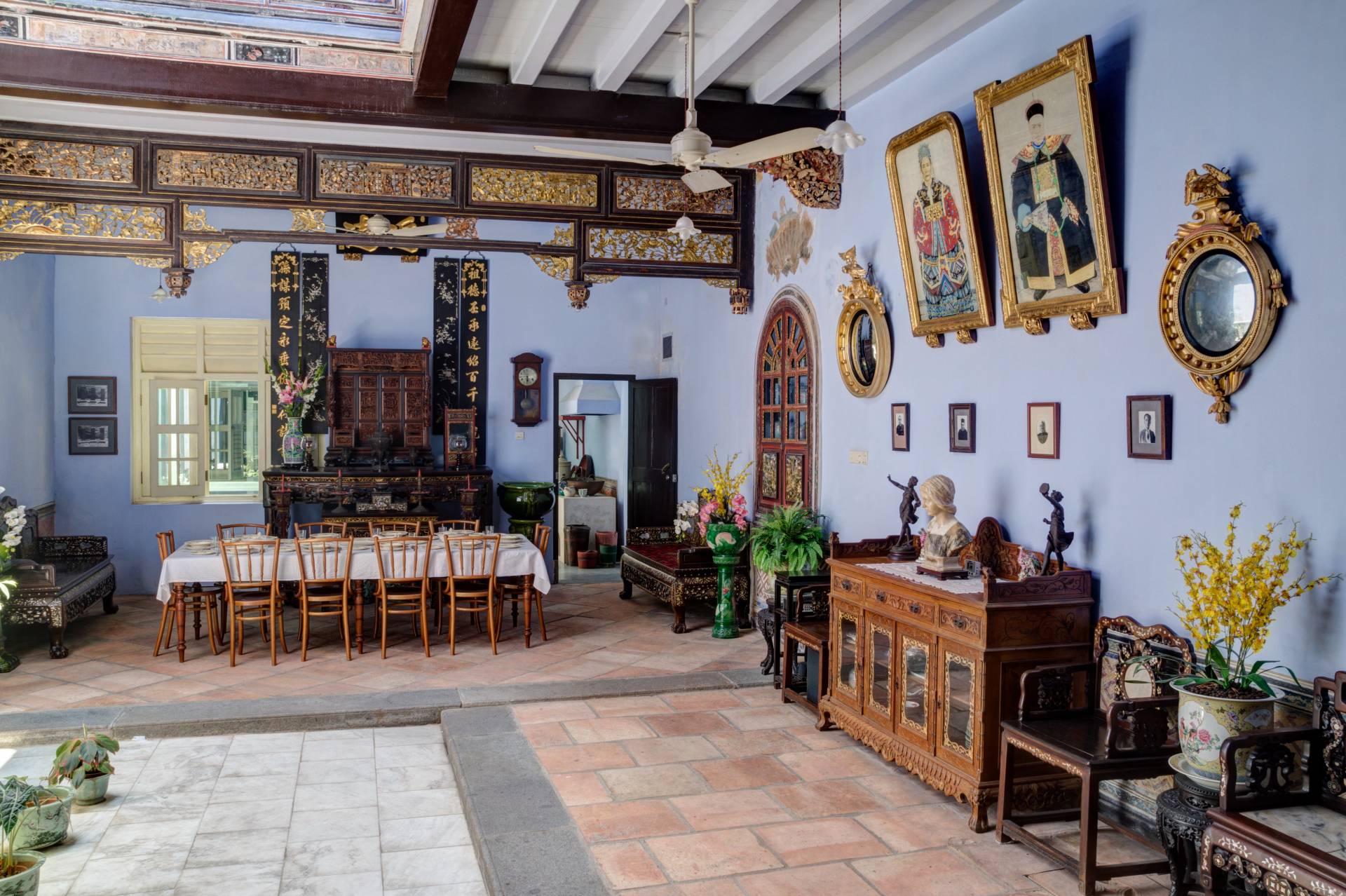
NUS Baba House to undergo two years of conservation works
Enthusiasts can look forward to a slate of programmes ahead of and during the temporary closure.
6 October 2023
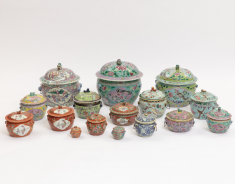
NUS Museum receives largest-ever donation of Straits Chinese artefacts
"Collected by Mrs Alice Tan over a 30-year period, the donated artefacts will contribute to a deeper study of the impact of Straits Chinese culture in Singapore and the region, and provide broadened avenues for interdisciplinary collaborations."
15 August 2023
From personal photo collection to exhibition: NUS Museum's latest showcase features visual narratives by 9 members of the NUS community
Titled Photography Journal Open Call (PJOC), the exhibition presents an eclectic collection of photographic works by nine NUS students, alumni artists and academic staff.
12 April 2021
Nurturing a creative campus through public art advocacy
The Public Art Initiative was launched to underscore NUS’ commitment to deepening the role of public art in holistic, interdisciplinary and broad-based education.

8 October 2019
October at the NUS Museum: between war and the artist, art and the tropics
This October, NUS Museum unveils two new exhibitions surveying the art historical in the region from distinct positions.

31 May 2019
New exhibition from Gilles Massot to be unveiled at NUS Museum
“…you have to lose your way to find yourself in the right place” presents the works of Singapore-based French artist, Gilles Massot. Featuring a selection of photographs, videos, sketches and writings from his extensive corpus of works.

14 February 2019
Glossaries of the Straits Chinese Homemaking
Following eleven years of giving glimpses of a Peranakan family’s domestic life in the early 20th century, NUS Baba House presents the exhibition Glossaries of the Straits Chinese Homemaking.
22 March 2018
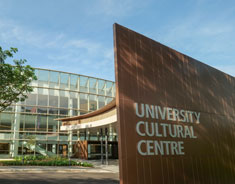
NUS' cultural icon refreshed for a new generation
The University Cultural Centre's first major renovation improves the high standard of guest comfort, efficiency and production possibilities.
3 February 2017
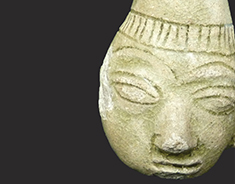
Exhibition: From the Ashes: Reviving Myanmar Celadon Ceramics
NUS Museum presents ongoing attempts to revive the technology of making ash-glazed ceramics in Myanmar.

23 November 2016
Exhibition: Between the brush lines of Lim Tze Peng
Solo exhibition at NUS Museum considers 70-year oeuvre of Singapore's oldest living artist.

1 November 2016
Book Launch: NUS Baba House launches inaugural guidebook
From architecture to social history, book reveals the myriad facets of Singapore's only restored Straits Chinese family home.
21 October 2016
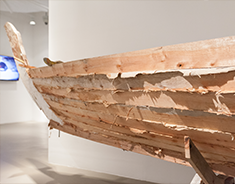
Exhibition: Looking within - What makes an exhibition?
NUS Museum presents exhibition introspecting into curatorial impulses and the exhibitionary medium.
1 July 2016
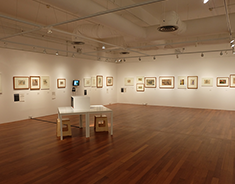
Exhibition: "Who wants to remember a war?"
NUS Museum draws on war posters, woodcuts and drawings to explore contemporary narratives of the Vietnam War.

10 May 2016
Award: NUS Museum wins inaugural award for innovative museological practice
International Committee of University Museums and Collections recognises efforts to facilitate conversation between audiences and exhibitions.
14 April 2016
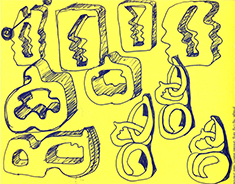
Exhibition: Figuring Ng Eng Teng
NUS Museum reveals unstudied elements and works from the late Cultural Medallion recipient’s practice.
Student Voices
Diary of an NUS Museum Intern: Sara Lau
Diary of an NUS Museum Intern is a series of blog posts written by our interns about their experiences during the course of their internships. Working alongside their mentors, our interns have waded through tons of historical research, assisted in curatorial work, pitched in during exhibition installations and organised outreach events! If you would like to become our next intern, visit NUS Museum’s student development page for more information.
Sara Lau is a third-year Sociology student at the NUS Faculty of Arts and Social Sciences, with a second major in Southeast Asia Studies. As our Programming and Exhibition Management Intern, Sara assisted her supervisor, Siddharta Perez, in exhibitions and curatorial projects.
Venturing into the NUS Museum and this internship, I sought to reconfigure my modes of understanding and obtaining knowledge, giving attention to phenomenological experiences alongside the readings of text. I wanted to build visual and spatial literacy, to learn how space can work with objects and text to create different textures in an exhibition, and the dynamism that comes with the dialogue between different mediums. The NUS Museum was the perfect space for these encounters, considering how the museum plays heavily on the absence and presence of text in the construction of exhibitions and prep-rooms.
Radio Malaya: Abridged Conversations about Art
My first encounter with the museum was through this exhibition. The first thing that struck me was how heavy the whole exhibition felt, packed with artworks and artefacts with few explanatory texts to act as guides or buffers. I initially found this exhibition to be intimidating and overwhelming, and up to now, it is still challenging to talk about. There is meaning to be found in the eschewing of explanatory wall text in favour of allowing other kinds of text into the space.
The exhibition as a whole is structured around the histories that can be propagated using art and artefacts. Rather than providing a fixed and directed narrative, not including wall text allows the viewer to piece together their own version of history, while the texts on the walls and in the guides act as suggestions and possibilities, non-authoritative texts that allow the artworks and artefacts to speak for themselves, and to each other.
17 Volcanoes
My interaction with this exhibition was rather fleeting, but what was memorable was being able to be present while the layout for the space was being discussed between the curator, Siddharta Perez, and one of the collaborators and artists, Adrienne Joergensen. Working mostly with light, rather than physical objects and artworks, provided a whole different set of challenges. I was able to witness a small part of the curatorial process, observing how Sidd and Adrienne sought to configure the projection and television displays to fill up the vast, cavernous space, while also considering the specific aesthetic of each artwork and how they would work together as a whole.
Much like Radio Malaya, extracts from Alexander von Humboldt’s Views of Nature were used in placed of wall text, providing insights into the conceptual framing for the exhibition rather than strict dictation and explanation of each individual work. These extracts also serve to act as a thread that runs through each artwork, and perhaps help the viewer to consider the individual artworks in relation to one another, and in the larger context of the expedition project.
Buaya: The Making of a Non-Myth
Consolidations and configurations
The prep-room projects I worked on allowed for more tactile experiences in handling objects and putting displays together, working alongside the artists. For Buaya, I was able to work with Kate Pocklington, an artist and conservator, in how to display various installations in her prep-room. Having to configure physical objects and also treat text as object was quite new to me, but also a healthy challenge and exercise that I believe allowed me to be more attuned to space and the aesthetics on an exhibition/artistic project. Not only did I have to think about how to best present it logistically (considering the public nature of the museum), but also conceptually, in figuring out the ways we could convey the history and the metaphorical weight of the crocodile in Singapore.
After Ballads
In the process of painting a space
The project that prompted me to think and write about this relationship between text and images in the museum would be artist Fyerool Darma’s After Ballads. This prep-room is both poetry and painting, a colourful confrontation of the spectres of colonial past that still haunt us. The space as a whole is visually sparse, but the individual vignettes are dense, filled with different textiles, iconography and images. Texts however, still play an integral role here, considering that the pre-cursor to the space is an extract from an autobiography by Munshi Abdullah.
The artist, Fyerool Darma, refers to a variety of literature and text in his practice, which translates in the methods in which he weaves words and text into the different assemblages that make up the prep-room. The words are there and they are essential, but ultimately what speaks are the portraits and the installations themselves. It is a reconfiguration, distortion and representation of text and its forms. His work, along with our various conversations, helped me to rethink the way in which I read art and texts, along with the complex ways they can be presented and distorted.
a personal note
Working in the museum has also challenged me to question how and where I position myself while working in the physical and psychological museum space. As an intern, I have working responsibilities and obligations, yet at the same time I am also a student with my own intellectual pursuits, and also a friend to peers, artists and curators. How do these layers of the self overlap, and often conflict? What do I owe to art, to the museum, to knowledge, to history, to people, to myself? Where do I take my stances and stake my claims, and what are the consequences in doing so? The past few months have been a whirlwind for me to navigate between these aspects and locate myself in the complex cosmology of artistic practice (and arguably of life itself). While I still am a bit lost, I am hopeful that I will one day find stable ground to walk on, no matter how uncertain the path.
I confess that coming into this internship, I was apprehensive about my contributions to the museum, considering my lack of experience. I am thankful that the experience was fulfilling and enjoyable despite my own shortcomings, and for that I am especially grateful to my most supportive and accommodating mentor, Sidd, as well to Michelle and Wardah, who provided me with insights, respite, and much-needed effervescence. I would also like to thank artists Kate Pocklington and Fyerool Darma, as well as all of the museum staff I had the pleasure to interact with. I look forward to the next few months of collaboration – thank you all for your friendship.
- Student Voices


News
18 November 2025
16 May 2025
NUS Baba House to undergo two years of conservation works
Enthusiasts can look forward to a slate of programmes ahead of and during the temporary closure.
6 October 2023
NUS Museum receives largest-ever donation of Straits Chinese artefacts
"Collected by Mrs Alice Tan over a 30-year period, the donated artefacts will contribute to a deeper study of the impact of Straits Chinese culture in Singapore and the region, and provide broadened avenues for interdisciplinary collaborations."
15 August 2023
From personal photo collection to exhibition: NUS Museum's latest showcase features visual narratives by 9 members of the NUS community
Titled Photography Journal Open Call (PJOC), the exhibition presents an eclectic collection of photographic works by nine NUS students, alumni artists and academic staff.
12 April 2021
Nurturing a creative campus through public art advocacy
The Public Art Initiative was launched to underscore NUS’ commitment to deepening the role of public art in holistic, interdisciplinary and broad-based education.
8 October 2019
October at the NUS Museum: between war and the artist, art and the tropics
This October, NUS Museum unveils two new exhibitions surveying the art historical in the region from distinct positions.
31 May 2019
New exhibition from Gilles Massot to be unveiled at NUS Museum
“…you have to lose your way to find yourself in the right place” presents the works of Singapore-based French artist, Gilles Massot. Featuring a selection of photographs, videos, sketches and writings from his extensive corpus of works.
14 February 2019
Glossaries of the Straits Chinese Homemaking
Following eleven years of giving glimpses of a Peranakan family’s domestic life in the early 20th century, NUS Baba House presents the exhibition Glossaries of the Straits Chinese Homemaking.
22 March 2018
NUS' cultural icon refreshed for a new generation
The University Cultural Centre's first major renovation improves the high standard of guest comfort, efficiency and production possibilities.
3 February 2017
Exhibition: From the Ashes: Reviving Myanmar Celadon Ceramics
NUS Museum presents ongoing attempts to revive the technology of making ash-glazed ceramics in Myanmar.
23 November 2016
Exhibition: Between the brush lines of Lim Tze Peng
Solo exhibition at NUS Museum considers 70-year oeuvre of Singapore's oldest living artist.
1 November 2016
Book Launch: NUS Baba House launches inaugural guidebook
From architecture to social history, book reveals the myriad facets of Singapore's only restored Straits Chinese family home.
21 October 2016
Exhibition: Looking within - What makes an exhibition?
NUS Museum presents exhibition introspecting into curatorial impulses and the exhibitionary medium.
1 July 2016
Exhibition: "Who wants to remember a war?"
NUS Museum draws on war posters, woodcuts and drawings to explore contemporary narratives of the Vietnam War.
10 May 2016
Award: NUS Museum wins inaugural award for innovative museological practice
International Committee of University Museums and Collections recognises efforts to facilitate conversation between audiences and exhibitions.
14 April 2016
Exhibition: Figuring Ng Eng Teng
NUS Museum reveals unstudied elements and works from the late Cultural Medallion recipient’s practice.
Leave a comment