Press Enquiries
Please direct all press enquiries and image requests to museum@nus.edu.sg.
In The Spotlight
Exhibitionary Eye: Viewing the tropics at the NUS Museum
By Wei Xin Tan
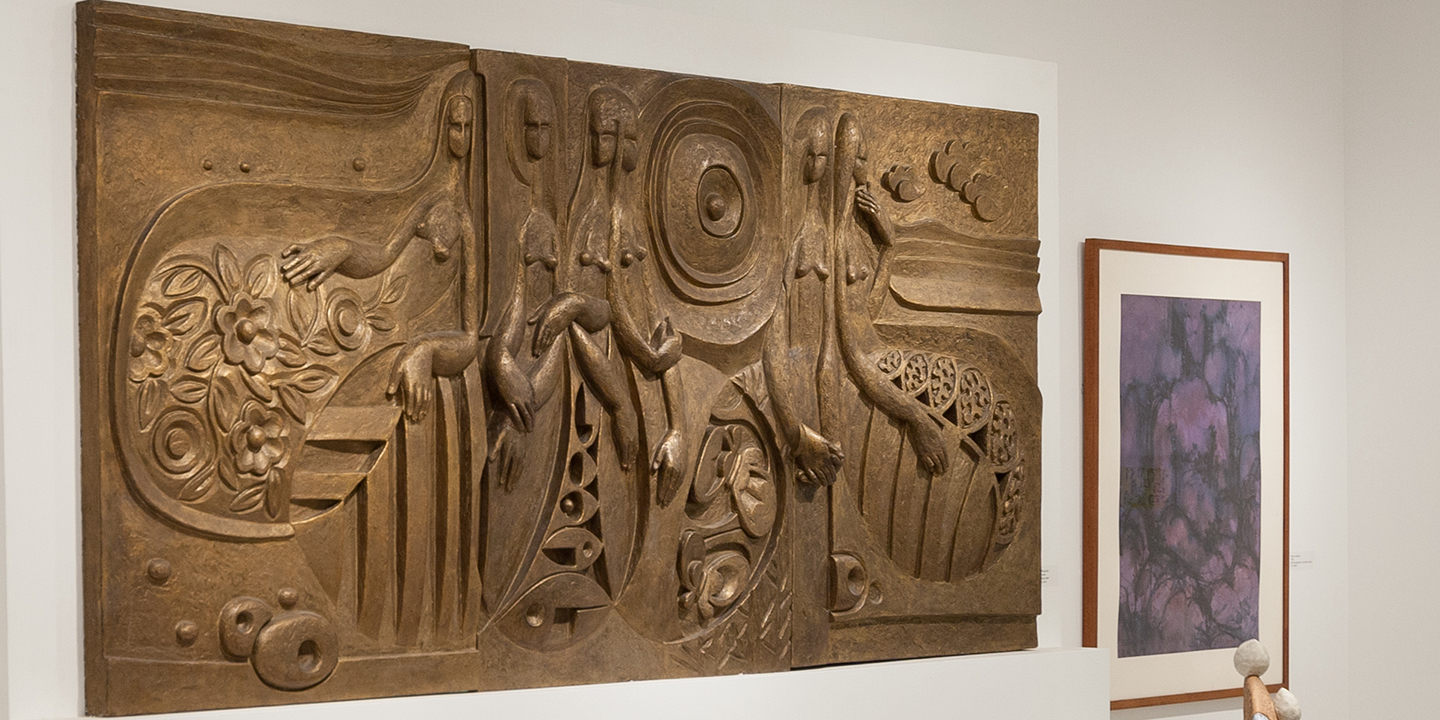
[Image: ‘Tropical Rhapsody’ (1972)]
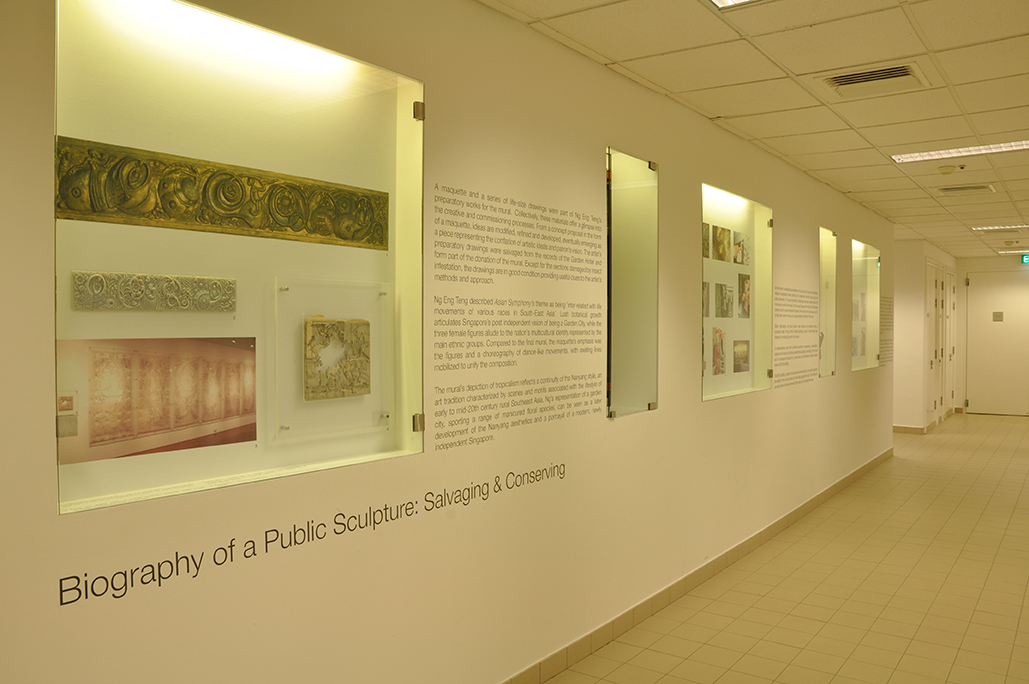
‘Tropical Rhapsody’, a sculpted mural of figurative forms intermingled with motifs of nature, is one of two tropical-themed murals by the artist Ng Eng Teng. Commissioned by the now defunct Garden Hotel in the 1970s, both of these murals – Asian Symphony and Tropical Rhapsody – were dismantled in 2010 before the demolition of the hotel and relocated to the National University Health System building and the NUS Museum respectively in a lengthy and complex process.
The two murals, now part of the museum’s extensive Ng Eng Teng Collection, speak of years of painstaking care and conservation, a process which has been documented and is now showcased along the museum’s Conservation Corridor.
As a public commission, it is paramount that this work is examined not just within Ng’s artistic oeuvre but also within the broader context of the time in which it was created. Made in 1972, the creation of this mural coincides with ongoing efforts to transform Singapore into a ‘Garden City’, offering an interpretative framework through we can read the artwork and its discursive context. [1]
This vision of Singapore as a ‘Garden City’, or more recently, a ‘City in a Garden’, is a familiar one that has its origins in the need to beautify Singapore’s physical landscape in the 1960s and 70s. At a time when industrialisation and urbanisation were moving at full speed, a comprehensive plan was announced by then Prime Minister Lee Kuan Yew with the objective of transforming Singapore into a beautiful garden city filled with abundant flowers and trees.
This involved the implementation of tree-planting exercises, creation of new parks, and campaigns to boost green-consciousness among Singaporeans. Among other reasons, this vision was conceived with the intention of transforming Singapore into an attractive place for tourism. [2]
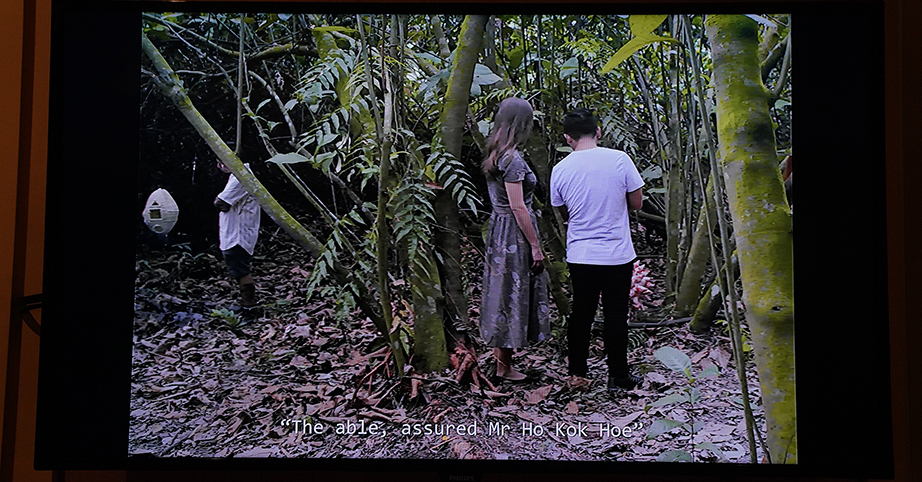
Of course, one can go further back in time to trace the imagery of Tropical Rhapsody in the works of early Nanyang artists. Adjacent to the Ng Eng Teng gallery is the exhibition tropics, a many (con)sequence, which examines the tropical imaginary through its visual tropes and aesthetics. Its central point of inquiry is Kent Chan’s film Seni, which re-imagines Ho Koe Hoe’s journey to Europe. Ho, then president of the Singapore Art Society, had brought the first exhibition of Singaporean art to the empire in 1955.
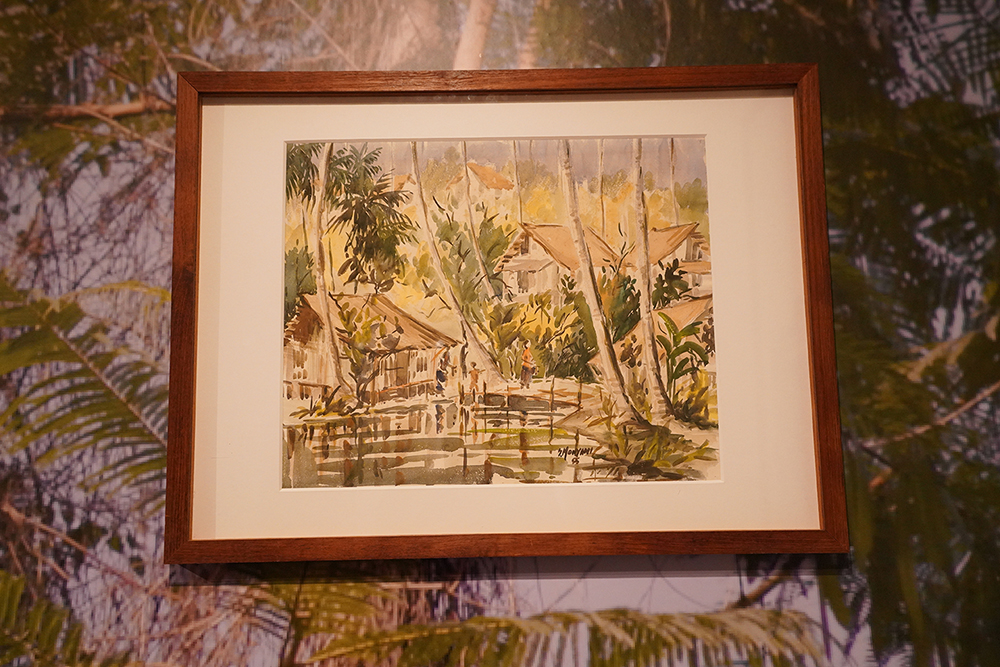
Alongside the film are several works from the NUS Museum’s collection, many of which project an aesthetic of tropical idyll in their depictions of river-scapes, fishing villages and kampung scenes. Through its examination of tropical representations and the role of the tropics in art history, the exhibition invites us to consider what it means for the tropics to be staged as an object of art and for Malayan identity to be mediated by colonial imaginings of the region.
Such an identity, rooted in the visual language of the tropics, remains enduring in the present. Today, Singapore can be considered the shining emblem of the Garden City. In the past decade, attractions such as Gardens by the Bay as well as the towering waterfall and lush greenery in Jewel Changi Airport have earned international recognition, building on this image of Singapore as a botanical haven.
Yet, as pointed out in the recently published Eating Chilli Crab in the Anthropocene, the metaphor of the garden brings to mind an “image of a manicured lawn” [3], one that is carefully curated at a cosmetic level. Troubling as it is that such representations perpetuate the tropics as a site of colonial fantasy, they become even more problematic in today’s climate crisis when one considers the capitalist impulses and economic imperatives driving them.
Returning to Tropical Rhapsody, it is interesting to note that while many early Nanyang artists often work in the traditions of the picturesque and panorama by putting the focus on the landscape, Ng’s mural stays true to his practice of working with the figurative form.
Tropical Rhapsody depicts several female figures with rotund lower bodies characteristic of Ng Eng Teng’s figurative sculptures, overlapping with each other and covered with the motifs of flowers, butterflies and fish. Instead of vacating man from the idyllic landscape, Ng positions them within it, articulating an ideal image of harmonious coexistence between humans and nature.
In an interview, curator Kenneth Tay suggests that the “ambiguous merging of bodies and man with nature [in Tropical Rhapsody] could be read as a comment on the relationship between man, as well as between man and nature”. [4]
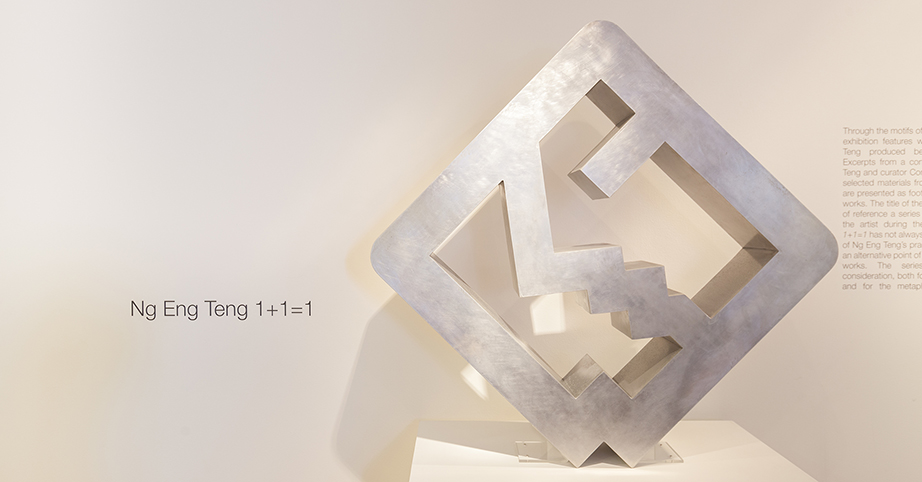
This ambiguity is perhaps indicative of Ng Eng Teng’s approach towards the human body, particularly when one considers the sculptures in the exhibition. The exhibition takes its title from Ng’s abstract geometric series 1+1=1, which consists of geometrical frames with jagged diagonal lines running across them.
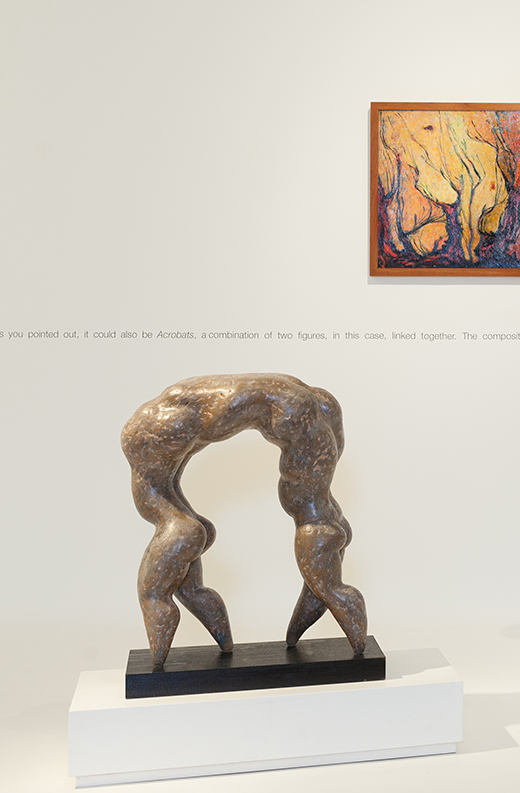
These give the appearance of two interlocking profiles coming together to form a single unit. Meanwhile, Garden of Eden, said to be inspired by the Biblical figures Adam and Eve, is composed of two figures reaching towards each other and linked together to form a whole.
One thing that emerges from these artworks is the fact that Ng is interested in relationality as much as he is concerned with the human body itself. Through this ambiguous merging of human figures or profiles, he positions these entities not as discrete, self-contained and autonomous but intimately bound to others.
Indeed, the ways in which we are mutually constituted by a shared vulnerability is now perhaps even more pertinent in light of the ongoing pandemic as well as the climate crisis. This of course applies not only to human relationships but to the ecologies that demand our care.
For a long time, Singapore’s artistic and national identities have been imbricated in the tropical imaginary. Our relationship with the environment remains largely driven by the human-centric drive towards economic development, often at the cost of environmental destruction.
Taking into account the long tradition of depicting tropical landscapes in Singapore’s modern art history and the discourses that have shaped them, it is time to renew our understanding of the nation’s identity as a Garden City and reconceive our role within it in a way that truly recognises the interconnectedness between us and the natural world.
The exhibitions tropics, a many (con)sequence | A Solo Exhibition by Kent Chan, and Ng Eng Teng: 1+1=1 as well as its adjoining work of ‘Tropical Rhapsody’ at the Conservation Corridor are up for view at the third floor of the NUS Museum.
[1] Foo Su Ling, “A Mural in the New Nation,” in Working the Tropical Garden (NUS Museum, 2010).
[2] “Singapore to become beautiful, clean city within three years,” The Straits Times, May 12, 1967, http://eresources.nlb.gov.sg/newspapers/Digitised/Article/straitstimes19670512-1.2.20.
[3] Bertrand Seah, “Another Garden City is Possible: A Plan for a Post-Carbon Singapore,” in Eating Chilli Crab in the Anthropocene: Environmental Perspectives on Life in Singapore, ed. Matthew Schneider-Mayerson (Ethos Books, 2020).
[4] Huang Lijie, “New Show of Ng Eng Teng’s work at NUS Museum,” The Straits Times, Apr. 16. 2016, https://www.straitstimes.com/lifestyle/new-show-of-ng-eng-tengs-work-at-nus-museum.
- Student Voices
18 November 2025
16 May 2025
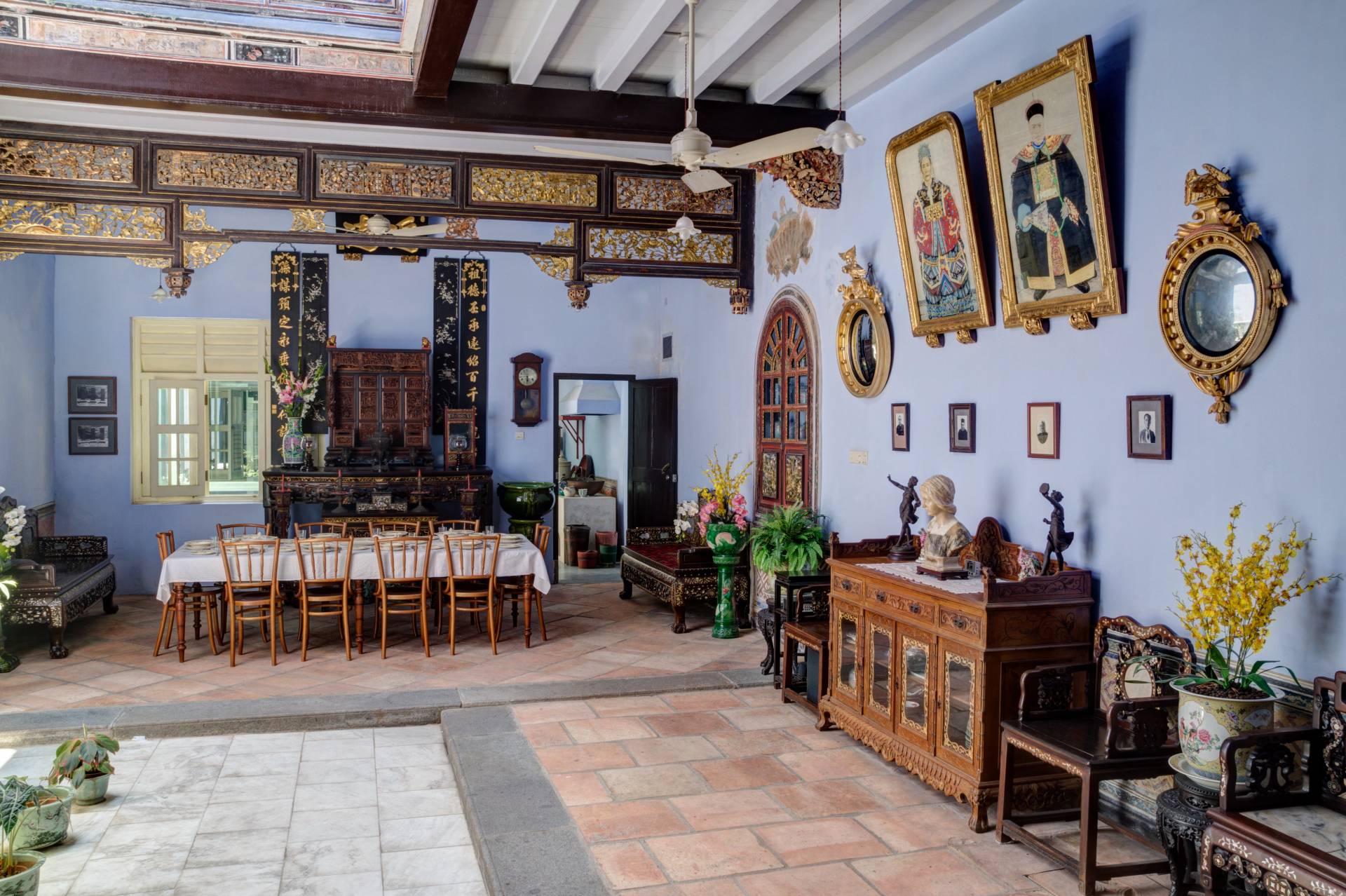
NUS Baba House to undergo two years of conservation works
Enthusiasts can look forward to a slate of programmes ahead of and during the temporary closure.
6 October 2023
NUS Museum receives largest-ever donation of Straits Chinese artefacts
"Collected by Mrs Alice Tan over a 30-year period, the donated artefacts will contribute to a deeper study of the impact of Straits Chinese culture in Singapore and the region, and provide broadened avenues for interdisciplinary collaborations."
15 August 2023
From personal photo collection to exhibition: NUS Museum's latest showcase features visual narratives by 9 members of the NUS community
Titled Photography Journal Open Call (PJOC), the exhibition presents an eclectic collection of photographic works by nine NUS students, alumni artists and academic staff.
12 April 2021
Nurturing a creative campus through public art advocacy
The Public Art Initiative was launched to underscore NUS’ commitment to deepening the role of public art in holistic, interdisciplinary and broad-based education.

8 October 2019
October at the NUS Museum: between war and the artist, art and the tropics
This October, NUS Museum unveils two new exhibitions surveying the art historical in the region from distinct positions.

31 May 2019
New exhibition from Gilles Massot to be unveiled at NUS Museum
“…you have to lose your way to find yourself in the right place” presents the works of Singapore-based French artist, Gilles Massot. Featuring a selection of photographs, videos, sketches and writings from his extensive corpus of works.

14 February 2019
Glossaries of the Straits Chinese Homemaking
Following eleven years of giving glimpses of a Peranakan family’s domestic life in the early 20th century, NUS Baba House presents the exhibition Glossaries of the Straits Chinese Homemaking.
22 March 2018
NUS' cultural icon refreshed for a new generation
The University Cultural Centre's first major renovation improves the high standard of guest comfort, efficiency and production possibilities.
3 February 2017
Exhibition: From the Ashes: Reviving Myanmar Celadon Ceramics
NUS Museum presents ongoing attempts to revive the technology of making ash-glazed ceramics in Myanmar.

23 November 2016
Exhibition: Between the brush lines of Lim Tze Peng
Solo exhibition at NUS Museum considers 70-year oeuvre of Singapore's oldest living artist.

1 November 2016
Book Launch: NUS Baba House launches inaugural guidebook
From architecture to social history, book reveals the myriad facets of Singapore's only restored Straits Chinese family home.
21 October 2016
Exhibition: Looking within - What makes an exhibition?
NUS Museum presents exhibition introspecting into curatorial impulses and the exhibitionary medium.
1 July 2016
Exhibition: "Who wants to remember a war?"
NUS Museum draws on war posters, woodcuts and drawings to explore contemporary narratives of the Vietnam War.

10 May 2016
Award: NUS Museum wins inaugural award for innovative museological practice
International Committee of University Museums and Collections recognises efforts to facilitate conversation between audiences and exhibitions.
14 April 2016
Exhibition: Figuring Ng Eng Teng
NUS Museum reveals unstudied elements and works from the late Cultural Medallion recipient’s practice.
Student Voices
Exhibitionary Eye: Viewing the tropics at the NUS Museum
By Wei Xin Tan
[Image: ‘Tropical Rhapsody’ (1972)]
‘Tropical Rhapsody’, a sculpted mural of figurative forms intermingled with motifs of nature, is one of two tropical-themed murals by the artist Ng Eng Teng. Commissioned by the now defunct Garden Hotel in the 1970s, both of these murals – Asian Symphony and Tropical Rhapsody – were dismantled in 2010 before the demolition of the hotel and relocated to the National University Health System building and the NUS Museum respectively in a lengthy and complex process.
The two murals, now part of the museum’s extensive Ng Eng Teng Collection, speak of years of painstaking care and conservation, a process which has been documented and is now showcased along the museum’s Conservation Corridor.
As a public commission, it is paramount that this work is examined not just within Ng’s artistic oeuvre but also within the broader context of the time in which it was created. Made in 1972, the creation of this mural coincides with ongoing efforts to transform Singapore into a ‘Garden City’, offering an interpretative framework through we can read the artwork and its discursive context. [1]
This vision of Singapore as a ‘Garden City’, or more recently, a ‘City in a Garden’, is a familiar one that has its origins in the need to beautify Singapore’s physical landscape in the 1960s and 70s. At a time when industrialisation and urbanisation were moving at full speed, a comprehensive plan was announced by then Prime Minister Lee Kuan Yew with the objective of transforming Singapore into a beautiful garden city filled with abundant flowers and trees.
This involved the implementation of tree-planting exercises, creation of new parks, and campaigns to boost green-consciousness among Singaporeans. Among other reasons, this vision was conceived with the intention of transforming Singapore into an attractive place for tourism. [2]
Of course, one can go further back in time to trace the imagery of Tropical Rhapsody in the works of early Nanyang artists. Adjacent to the Ng Eng Teng gallery is the exhibition tropics, a many (con)sequence, which examines the tropical imaginary through its visual tropes and aesthetics. Its central point of inquiry is Kent Chan’s film Seni, which re-imagines Ho Koe Hoe’s journey to Europe. Ho, then president of the Singapore Art Society, had brought the first exhibition of Singaporean art to the empire in 1955.
Alongside the film are several works from the NUS Museum’s collection, many of which project an aesthetic of tropical idyll in their depictions of river-scapes, fishing villages and kampung scenes. Through its examination of tropical representations and the role of the tropics in art history, the exhibition invites us to consider what it means for the tropics to be staged as an object of art and for Malayan identity to be mediated by colonial imaginings of the region.
Such an identity, rooted in the visual language of the tropics, remains enduring in the present. Today, Singapore can be considered the shining emblem of the Garden City. In the past decade, attractions such as Gardens by the Bay as well as the towering waterfall and lush greenery in Jewel Changi Airport have earned international recognition, building on this image of Singapore as a botanical haven.
Yet, as pointed out in the recently published Eating Chilli Crab in the Anthropocene, the metaphor of the garden brings to mind an “image of a manicured lawn” [3], one that is carefully curated at a cosmetic level. Troubling as it is that such representations perpetuate the tropics as a site of colonial fantasy, they become even more problematic in today’s climate crisis when one considers the capitalist impulses and economic imperatives driving them.
Returning to Tropical Rhapsody, it is interesting to note that while many early Nanyang artists often work in the traditions of the picturesque and panorama by putting the focus on the landscape, Ng’s mural stays true to his practice of working with the figurative form.
Tropical Rhapsody depicts several female figures with rotund lower bodies characteristic of Ng Eng Teng’s figurative sculptures, overlapping with each other and covered with the motifs of flowers, butterflies and fish. Instead of vacating man from the idyllic landscape, Ng positions them within it, articulating an ideal image of harmonious coexistence between humans and nature.
In an interview, curator Kenneth Tay suggests that the “ambiguous merging of bodies and man with nature [in Tropical Rhapsody] could be read as a comment on the relationship between man, as well as between man and nature”. [4]
This ambiguity is perhaps indicative of Ng Eng Teng’s approach towards the human body, particularly when one considers the sculptures in the exhibition. The exhibition takes its title from Ng’s abstract geometric series 1+1=1, which consists of geometrical frames with jagged diagonal lines running across them.
These give the appearance of two interlocking profiles coming together to form a single unit. Meanwhile, Garden of Eden, said to be inspired by the Biblical figures Adam and Eve, is composed of two figures reaching towards each other and linked together to form a whole.
One thing that emerges from these artworks is the fact that Ng is interested in relationality as much as he is concerned with the human body itself. Through this ambiguous merging of human figures or profiles, he positions these entities not as discrete, self-contained and autonomous but intimately bound to others.
Indeed, the ways in which we are mutually constituted by a shared vulnerability is now perhaps even more pertinent in light of the ongoing pandemic as well as the climate crisis. This of course applies not only to human relationships but to the ecologies that demand our care.
For a long time, Singapore’s artistic and national identities have been imbricated in the tropical imaginary. Our relationship with the environment remains largely driven by the human-centric drive towards economic development, often at the cost of environmental destruction.
Taking into account the long tradition of depicting tropical landscapes in Singapore’s modern art history and the discourses that have shaped them, it is time to renew our understanding of the nation’s identity as a Garden City and reconceive our role within it in a way that truly recognises the interconnectedness between us and the natural world.
The exhibitions tropics, a many (con)sequence | A Solo Exhibition by Kent Chan, and Ng Eng Teng: 1+1=1 as well as its adjoining work of ‘Tropical Rhapsody’ at the Conservation Corridor are up for view at the third floor of the NUS Museum.
[1] Foo Su Ling, “A Mural in the New Nation,” in Working the Tropical Garden (NUS Museum, 2010).
[2] “Singapore to become beautiful, clean city within three years,” The Straits Times, May 12, 1967, http://eresources.nlb.gov.sg/newspapers/Digitised/Article/straitstimes19670512-1.2.20.
[3] Bertrand Seah, “Another Garden City is Possible: A Plan for a Post-Carbon Singapore,” in Eating Chilli Crab in the Anthropocene: Environmental Perspectives on Life in Singapore, ed. Matthew Schneider-Mayerson (Ethos Books, 2020).
[4] Huang Lijie, “New Show of Ng Eng Teng’s work at NUS Museum,” The Straits Times, Apr. 16. 2016, https://www.straitstimes.com/lifestyle/new-show-of-ng-eng-tengs-work-at-nus-museum.
- Student Voices


News
18 November 2025
16 May 2025
NUS Baba House to undergo two years of conservation works
Enthusiasts can look forward to a slate of programmes ahead of and during the temporary closure.
6 October 2023
NUS Museum receives largest-ever donation of Straits Chinese artefacts
"Collected by Mrs Alice Tan over a 30-year period, the donated artefacts will contribute to a deeper study of the impact of Straits Chinese culture in Singapore and the region, and provide broadened avenues for interdisciplinary collaborations."
15 August 2023
From personal photo collection to exhibition: NUS Museum's latest showcase features visual narratives by 9 members of the NUS community
Titled Photography Journal Open Call (PJOC), the exhibition presents an eclectic collection of photographic works by nine NUS students, alumni artists and academic staff.
12 April 2021
Nurturing a creative campus through public art advocacy
The Public Art Initiative was launched to underscore NUS’ commitment to deepening the role of public art in holistic, interdisciplinary and broad-based education.
8 October 2019
October at the NUS Museum: between war and the artist, art and the tropics
This October, NUS Museum unveils two new exhibitions surveying the art historical in the region from distinct positions.
31 May 2019
New exhibition from Gilles Massot to be unveiled at NUS Museum
“…you have to lose your way to find yourself in the right place” presents the works of Singapore-based French artist, Gilles Massot. Featuring a selection of photographs, videos, sketches and writings from his extensive corpus of works.
14 February 2019
Glossaries of the Straits Chinese Homemaking
Following eleven years of giving glimpses of a Peranakan family’s domestic life in the early 20th century, NUS Baba House presents the exhibition Glossaries of the Straits Chinese Homemaking.
22 March 2018
NUS' cultural icon refreshed for a new generation
The University Cultural Centre's first major renovation improves the high standard of guest comfort, efficiency and production possibilities.
3 February 2017
Exhibition: From the Ashes: Reviving Myanmar Celadon Ceramics
NUS Museum presents ongoing attempts to revive the technology of making ash-glazed ceramics in Myanmar.
23 November 2016
Exhibition: Between the brush lines of Lim Tze Peng
Solo exhibition at NUS Museum considers 70-year oeuvre of Singapore's oldest living artist.
1 November 2016
Book Launch: NUS Baba House launches inaugural guidebook
From architecture to social history, book reveals the myriad facets of Singapore's only restored Straits Chinese family home.
21 October 2016
Exhibition: Looking within - What makes an exhibition?
NUS Museum presents exhibition introspecting into curatorial impulses and the exhibitionary medium.
1 July 2016
Exhibition: "Who wants to remember a war?"
NUS Museum draws on war posters, woodcuts and drawings to explore contemporary narratives of the Vietnam War.
10 May 2016
Award: NUS Museum wins inaugural award for innovative museological practice
International Committee of University Museums and Collections recognises efforts to facilitate conversation between audiences and exhibitions.
14 April 2016
Exhibition: Figuring Ng Eng Teng
NUS Museum reveals unstudied elements and works from the late Cultural Medallion recipient’s practice.
Leave a comment