
I am a Year 4 psychology student who initially took GEN2061 Support Healthy AgeingSG because I have always liked to ‘help’ people. Since I was young, I developed a keen interest in the social services sector and enjoyed interacting with the elderly. I’ve always loved their heartfelt stories – part history lesson, part comedy special, and always worth listening to.
What I thought would be just another course turned into a crash course in real-life wisdom. As it turned out, connecting with people is not about swooping in as the ‘helper’ – it is about showing up, listening, and letting them teach you. This course was not just about earning course credits; it was about gaining life lessons you cannot cram for. GEN2061 did not just educate me; it aged me (in the best way), leaving me wiser, more empathetic, and with a newfound appreciation for the seniors.
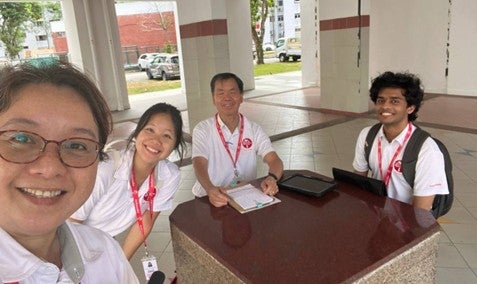
Pictured here is me with my Supervisor, Lin Na, alongside another team of fellow SGA volunteers!
Volunteering with the seniors through GEN2061 has profoundly shifted my perspective on ageing and dependency. At first, I unconsciously viewed seniors as inherently dependent, assuming a helper role while perceiving them as individuals in need. This mindset created an invisible power dynamic, placing the seniors in a position of deficit while assuming I held the tools to improve their lives. I now realise how limiting and paternalistic this mindset was. Who is to say that seniors would always in a position of needing help? It was only when I met Mr. Lee (not his real name) that this perspective began to unravel.
Mr. Lee was in his sixties and living with numerous health challenges. During a house visit, he handed me his retirement card with a twinkle in his eye and shared stories of his vibrant social life. Despite his physical ailments, he spoke with enthusiasm about his friends, his younger, active days, and the sheer joy he found in staying connected. His sense of humour and resilience were magnetic. It quickly became clear that Mr. Lee did not need any saving or fixing – he was thriving in ways I had not imagined. He exemplified how one’s life could remain undiminished even in the face of physical health challenges. His ability to find joy, connect with others, and find purpose in his day-to-day experiences helped him maintain his sense of identity and quality of life.
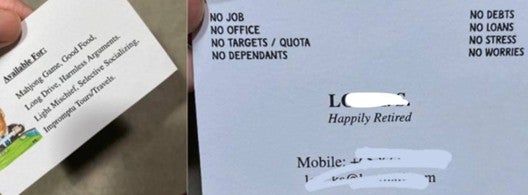
Pictures of the retirement card that Mr Lee gave to me.
Here, my understanding of ‘help’ has been redefined. ‘Helping’, in this context, is not about assuming that seniors are passive recipients, or drastically changing their environment to ‘protect’ them. Instead, it means empowering seniors to decide how they want to live, what activities they want to pursue, and who they wish to connect with. It also means validating their lived experiences, valuing their knowledge and decisions, and encouraging them to exercise control over their lives. By sharing resources and information about activities, I was not just giving them opportunities; I was giving them choices. More importantly, I was giving them the respect that comes with allowing someone to make choices for themselves.
This experience has also underscored the importance of shifting from a deficit-focused view of ageing to a strengths-based approach – one that respects the autonomy of seniors and sees them as capable individuals with agency to live the lives they desire. Supporting seniors is not about imposing our perspective of what needs fixing; it is about recognising their ability to make informed choices about their own well-being.
This does not mean ignoring genuine health concerns or encouraging unhealthy habits. Instead, it means respecting seniors’ boundaries, understanding their wishes, and enabling them to determine what brings them joy and fulfilment. Physical ailments may be part of their reality, but if they find contentment and purpose despite those challenges, then our role is to still honour that resilience and value their right to self-determination.
Overall, the prevailing narrative that frames ageing as an inevitable decline fails to capture the diverse ways in which individuals continue to adapt and thrive. GEN2061 has prompted me to reframe my understanding of what it means to grow old. Too often, society – myself included – has reduced the needs of seniors to that of healthcare and physical support. We would all benefit from a reminder that seniors, like anyone else, have a wide spectrum of desires, aspirations, and rich lives ahead of them too.
21 Lower Kent Ridge Road
Singapore 119077
+65 6516 6666