
Suhail’s story
I am Suhail, a year 4 Electrical Engineering student. While browsing the available Communities and Engagement courses to pursue, I stumbled upon GEN2006 Communications for Inter-generational Engagement. GEN2006’s focus on intergenerational communication was an aspect that I felt was crucial in today’s local context, where Singapore continues to face an increasingly ageing population. Moreover, with my grandparents having passed away early on, the void of elderly grandparents in my childhood resulted in a deep desire to interact with the elderly and forge bonds with them. This led to my decision to register for the course.
GEN2006 teaches the fundamental skills and knowledge that are vital in interacting with the elderly. These include the Humanitude approach of engagement, the Constructivist Theory of Communication and Appreciative Inquiry, contextualised for elderly engagement settings. The Constructivist Theory of Communication highlights how individuals interpret and construct their world based on their knowledge and social interactions. Appreciate Inquiry delves into a positive approach to organisational change and emphasises the need for discussion between individuals to share their perspectives for a shared vision. These theories and approaches were implemented through subsequent on-site engagement sessions at our assigned elderly homes or community hospitals. I was assigned to Yishun Community Hospital for my face-to-face sessions. Yishun Community Hospital is one of Singapore’s largest community hospitals that provides rehabilitation services for elderly patients. These patients, at times, face social isolation and have chronic conditions that make recovery a slow and tough journey. Thus, one of my team’s goals was to bring joy and encouragement to these elderly patients, filling in the role of an emotional caregiver while utilising the hospital’s plant therapy programme as a possible tool of engagement. With the large number of patients in each ward, the doctors and nurses are occupied with attending to the various needs of the patients, resulting in challenges in providing individualised comfort and support.
During one of the sessions, I engaged with an elderly Malay patient who recounted her long days running a hawker stall at Boon Lay. As a single parent who worked tirelessly to educate her children, she shared her struggles amidst reminiscing about her crowd favourite Nasi Padang, usually sold out before noon. This storytelling allowed her to relive and share her world with me which helped build a deeper connection between us. Hearing her hardships made me feel a greater sense of gratitude and reflect on the blessings I have been showered with. These narratives allow young individuals such as myself to appreciate what I have. They also act as constant reminders for me to work harder.
The nurses working in her ward, due to their immense workload and job scope of caring for the immediate needs of all the patients in the ward, might have never known of her talent in cooking Malay cuisine or her beautiful retirement home in Melaka filled with exotic fruits. Thus, befriending and indulging in plant therapy through gardening with volunteers like my teammates and I provided an additional platform to improve the emotional well-being of the patients and, in turn, expedited their recovery process.
Besides engaging with elderly patients, I extended a helping hand to the occupational therapist, who attempted to test a patient’s mobility. This patient appeared to be one of the elderly patients I engaged with. She had been turning down the therapist’s request for a couple of days. Capitalising on the bonds the patient and I had forged, I invited her to join me on a walk and to make me a cup of coffee that we could both enjoy. In the blink of an eye, she excitedly nodded, and we walked hand in hand to the hospital pantry which provided an opportunity for the occupational therapist to assess the patient’s mobility. It is indeed these strong connections that are forged in a short span of time that hold the power to reframe a bitter task into a joyful walk.
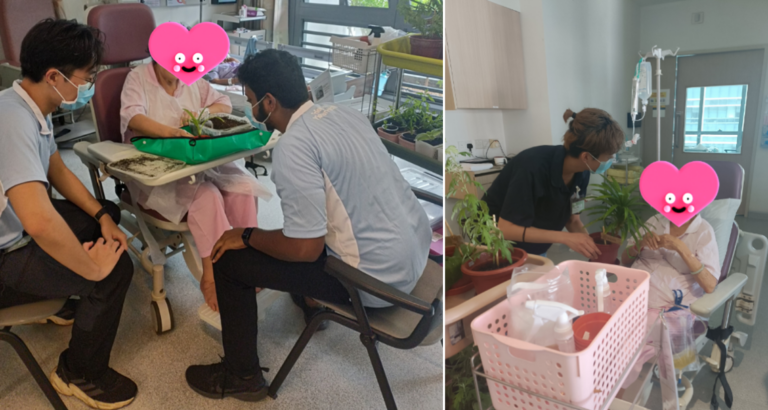
Photos: (left to right) Engagement of patients through horticulture and planting as part of Yishun Community Hospital’s Garden by the Bed program. Photography by Monica, Volunteer Management manager.
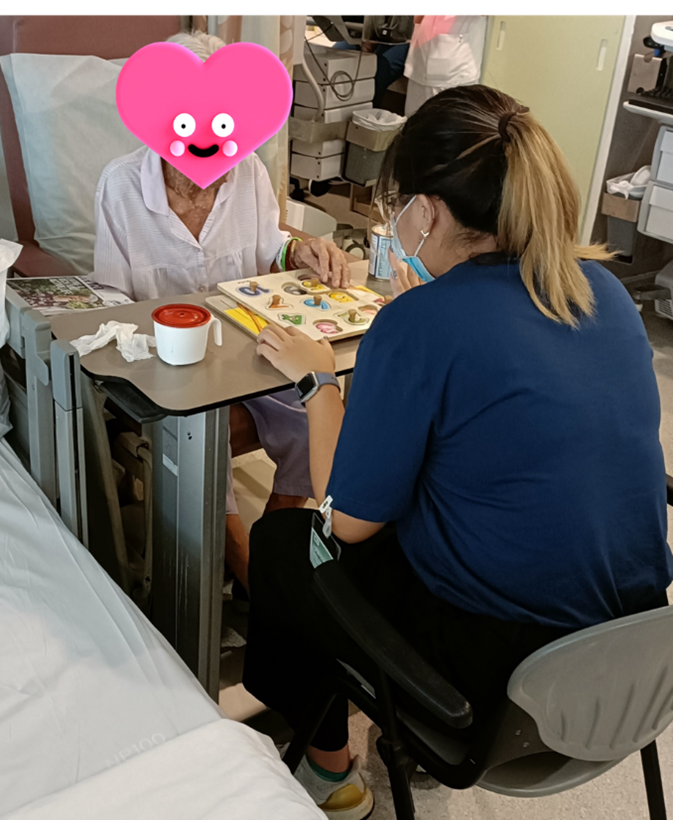
Photo: Engaging patients through other tactile games and activities. Photography by Monica, Volunteer Management manager.
Eunwoo’s story
My name is Eunwoo, and I am a final-year undergraduate majoring in Accountancy. I registered for GEN2006 Communications for Intergenerational Engagement because I have always been interested in how real-life scenarios can be understood through conceptual theories, and vice versa—how theories can be applied in practical settings. I was particularly keen on exploring the nuances of intergenerational communication and learning how to better engage with elderly individuals.
GEN2006 explores intergenerational communication through multiple frameworks. For instance, Constructivist Theory emphasizes cognitive complexity, enabling individuals to adapt their communication based on others’ perspectives. Humanitude Care Methodology focuses on person-centered engagement through eye contact, verbal communication, touch, and mobility support to uphold dignity and emotional connection. Appreciative Inquiry adopts a strengths-based approach, fostering positive engagement by recognizing individuals’ capabilities and validating their experiences. Together, these frameworks provide a structured approach to building meaningful and respectful interactions with the elderly. The course provided both theoretical foundations and hands-on experiences, including lectures from industry professionals and in-person sessions at St. Luke’s ElderCare Centre, where I had the opportunity to apply these frameworks in real-world contexts. St. Luke’s ElderCare Centre is a community-based eldercare facility in Singapore that provides day care, rehabilitation, and wellness programs for seniors, particularly those with chronic illnesses or mobility challenges. The centre aims to enhance the quality of life of elderly individuals by providing a supportive and stimulating environment where they can engage in social activities, cognitive exercises, and physical therapy.
One of the most challenging experiences was engaging with elderly individuals who were resistant to receiving help. They perceived my offers of assistance as undermining their independence, which made interactions difficult at first. To address this, I applied cognitive complexity from Constructivist theory, adjusting my approach by reframing interactions as dialogues rather than acts of caregiving. Instead of offering unsolicited help, I engaged in open-ended conversations about their experiences, which fostered mutual respect and transformed our interactions into meaningful discussions rather than perceived acts of charity.
Another significant challenge was language barrier. As an international student unfamiliar with local dialects, I initially struggled to communicate effectively. However, I reframed this challenge as an opportunity for shared learning. By actively participating in daily Mandarin sessions alongside the elderly and seeking their guidance on pronunciation, I positioned myself as a learner rather than a caregiver. This approach, inspired by Appreciative Inquiry, empowered the elderly by validating their expertise and fostering a reciprocal learning environment, ultimately strengthening our connections.
This course has profoundly shaped my perspective on elderly engagement. I have developed greater empathy, adaptability, and communication skills, which extend beyond this experience into broader social and professional settings. It has reinforced the importance of non-verbal communication, active listening, and respect for autonomy in fostering meaningful intergenerational relationships.
For juniors considering GEN2006, my advice is to approach the course with an open mind and a willingness to adapt. Not every interaction will go as expected, but each challenge presents an opportunity to grow and learn. Be patient, actively listen, and use the frameworks and approaches taught in class to engage rather than assist—focusing on building relationships rather than simply providing support. Most importantly, cherish the stories, wisdom, and experiences shared by the elderly—these lessons are invaluable and extend far beyond the classroom.
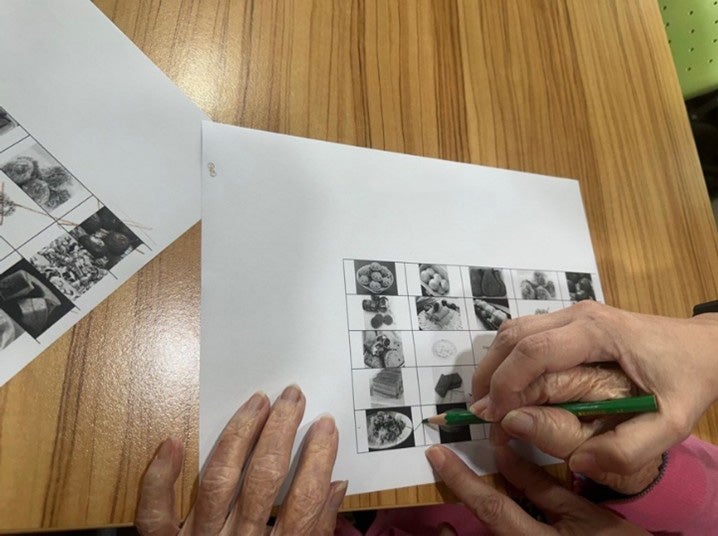
Photo: Bingo session at St. Luke’s ElderCare Centre, Clementi, fostering engagement and interaction among elderly participants. Photography by AY24/25 S1 GEN2006 Group.
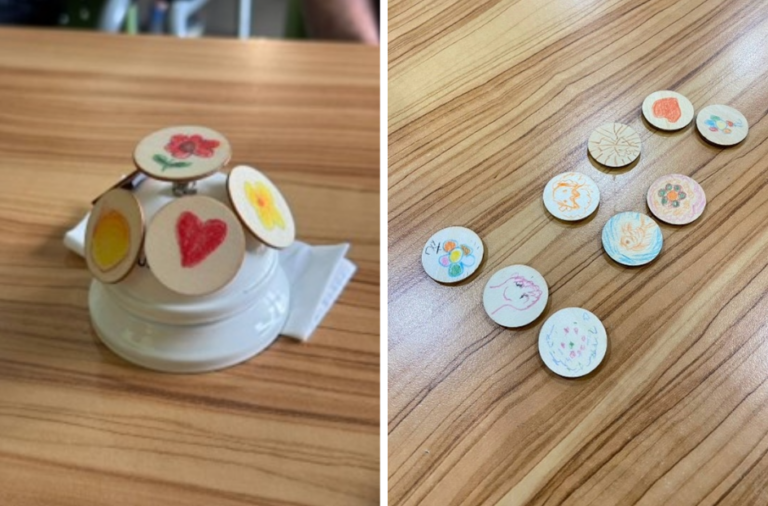
Photo: Arts and craft activity at St. Luke’s ElderCare Centre, Clementi. Photography by AY24/25 S1 GEN2006 Group.
21 Lower Kent Ridge Road
Singapore 119077
+65 6516 6666