
As a third-year finance student in NUS Business, my academic journey has predominantly revolved around finance and management principles. However, recognising the urgent need to engage with global environmental issues, I made a conscious choice to diversify my learning experience through taking the module Green Communities in Action: Climate, Species, Crisis (GEN2004). GEN2004 focuses on one of the most critical issues facing humanity: the global environmental crisis. This is done through synthesising the efforts of green communities in Singapore and exploring cultural, political, and literary narratives while emphasising ecocritical textual analysis. Through a blend of lectures, readings, fieldwork as well as talks from guest speakers, the course focuses on how literature can help us understand and address environmental issues. Key learning outcomes include heightened awareness of the environmental crisis in Singapore through interactions with specific green communities, critical examination of strategies adopted by these green communities based on the frameworks developed by scholars in Environmental Humanities, as well as learning how to think critically about green issues. Overall, GEN2004 aims to empower students to actively engage with environmental challenges and contribute to sustainable solutions through interdisciplinary approaches and practical experiences.
The decision to enrol in GEN2004 stemmed from a personal aspiration to broaden my understanding of sustainability and environmental conservation beyond traditional business frameworks, where sustainability is becoming an important topic in the world today. The incorporation of literature into the environment played a part in my decision to take up this course as well, as I felt it offered an interesting perspective that is different from traditional modules that focuses solely on the environment.
One particularly memorable experience from the course was the fieldwork session organised by NUS Toddycats. Engaging in a habitat enhancement project at Rail Corridor South allowed me to witness firsthand the tangible impact of environmental conservation efforts. The objective of the project was to restore and enhance natural habitats to foster a conducive environment for wildlife by reintroducing native forest plant species. More specifically, I was part of the Sapling Protection Action, where the aim was to increase survivability of saplings previously planted. I had the chance to use many tools that I had no prior knowledge of before, such as changkuls (a hand tool for loosening soil or removing weeds) to push back vegetation encroachment and secateurs to cut creepers that had grown around the sapling. I met many regular volunteers as well, and they taught me many interesting facts about the saplings we were protecting, such as how to identify the Gelam (tea tree) and Assam tree. From clearing vegetation encroachment to replenishing mulch around the sapling, every action taken during the session taught me the significance of individual contributions to preserving biodiversity.
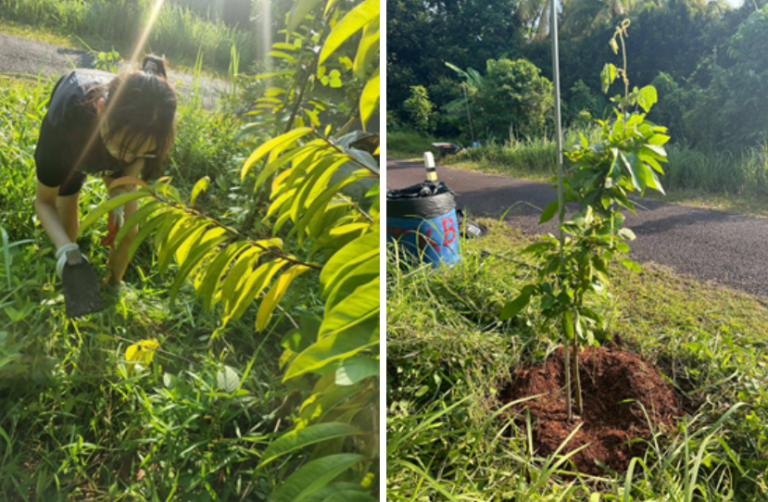
Photos (left to right): Pushing back vegetation, Finished Sapling. Photography by Gerrell TAN.
Another interesting aspect of the course was preparing the final presentation on our fieldwork experience with NUS Toddycats, and how it linked with the theoretical concepts taught in lectures. Assembling our findings and insights into a coherent narrative was both challenging and rewarding. It required us to reflect critically on our fieldwork experiences, analyse the practical implications of our actions, and connect them to the broader themes discussed in class. We synthesised our fieldwork observations with theoretical frameworks such as ecocriticism, gender and the environment, and the climate crisis. The process not only deepened our understanding of the course material, but also fostered teamwork and communication skills and gave us a chance to interact with our peers and engage in environmental discourse.
GEN2004 has profoundly impacted my perspective on environmental conservation. Beyond imparting theoretical knowledge, it instilled in me a sense of responsibility and urgency towards addressing environmental challenges. Through hands-on engagement and interdisciplinary learning, I gained a deeper understanding of the interconnections within natural ecosystems and the role of community-driven initiatives in effecting positive change. Furthermore, the course provided many supplementary readings and even videos, such as David Attenborough’s Netflix documentary, “A Life on Our Planet”, which I found very educational and thoroughly enjoyed watching. I felt that the documentary, backed by powerful imagery and a call-to action, served as a wake-up call and sparked a renewed commitment to advocating for sustainable practices and fostering environmental stewardship.
For juniors considering enrolling in GEN2004, I highly recommend embracing the course with an open mind and a willingness to engage actively. Though it may sound unfamiliar and daunting to engage with literature and the environment together, it’s important to recognise this as an opportunity for personal growth and exploration. Take inspiration from the narratives shared in the course and use them as catalysts for meaningful action, whether through advocacy, community engagement, or personal lifestyle changes. Furthermore, it’s important to take advantage of the fieldwork opportunity to immerse yourself in real-world conservation efforts. Approach GEN2004 with a commitment to learning and contributing to environmental stewardship, and you’ll emerge with a newfound appreciation for the intersection of humanity and the natural world.
21 Lower Kent Ridge Road
Singapore 119077
+65 6516 6666