
GEN2001 Theatre and Community Engagement introduces theatre as a powerful medium for community engagement and involvement. It encourages students to harness theatre’s collaborative and experiential nature, and apply it creatively in community engagement. The first half of the course aims to shape our perspectives on community and our individual roles within it through interactive workshop activities.
During one such activity, we were asked a couple of introspective questions – “What is love?” and “What are your hobbies?” – and told to write our responses on coloured paper cut into the shapes of branches, leaves, and apples. We then assembled a symbolic house using these pieces. Although we initially questioned the purpose of this workshop activity, we eventually learnt that it was to encourage self-reflection, highlight the diversity of personal experiences, and demonstrate how individual perspectives can come together.
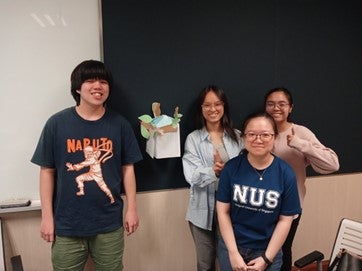
Photo: Self reflection workshop activity with group members.
Photography by course instructor, A/P Robin Loon.
In the second half of the course, the focus shifts to developing and pitching a theatre-based community engagement project. I initially assumed that the final pitch would be a straightforward task: observe a community as instructed, identify a problem, and provide a solution, integrating theatrical elements taught in lectures. However, it became clear that it was not so straightforward.
After being tasked with conducting a silent observation of any community, our group went down to Admiralty MRT station to observe the community during evening peak hour on a Friday. We observed two wheelchair tissue peddlers holding out a tissue packet to passers-by. We would often see passers-by give them a wide berth. Meanwhile, interactions between buyers and the tissue peddlers were brief and transactional at most, and others who did not directly interact with the tissue peddlers blatantly avoided eye-contact, directing their gazes away. There was coldness and a lack of genuine human connection between the tissue peddlers and the public, as well as an overarching theme of invisibility or being unseen. This was made more apparent when we recreated the scene during the “Tableau” activity in one of the workshops.
One of the more fun and memorable activities from the course, “Tableau”, is a common drama exercise where participants use their bodies to act out a frozen scenario or “tableau” to convey a story without the use of dialogue. While the onsite observation of the community provided us with some insight, recreating the original scene from our observation through a tableau helped to filter out the “noise” and focus on the core interactions. Under the guidance of our tutor, we created additional tableaus of our intended intervention to engage wheelchair tissue peddlers and the outcome we wished to derive from the intervention. The tableaus also helped us outline the change we wished to effect – increased warmth in interactions, and less aversion and awkwardness towards wheelchair tissue peddlers. We wanted our target community to be seen as individuals of the community and interacted with as such.
During one of our group discussions, my fellow groupmate shared a video of the wheelchair dance group, D’passion, performing at the National Day Parade 2008. The liveliness and collaborative aspect of the performance inspired our group to base our pitch around some form of wheelchair dance performance. This led to our group eventually settling on the idea of a musical – one that would show the audience the lives of wheelchair tissue peddlers outside of selling tissues, and that these individuals are capable of putting on a show, and so much more. Empower the target community and directly challenge stereotypes the audience might have of them. Additionally, the song and dance elements of the musical would excite them and provide them with more enjoyment, and the final performance would give them something to work towards and look forward to.
Aside from the challenges we faced, and lessons learnt while designing the pitch, I also learnt plenty of valuable lessons from the lectures. For example, do what we can with who and what we have in front of us. We may not be able to change the system, but we can change what is within our means. From this, I learnt to keep a narrow scope on the target community I wish to engage and manage expectations of the final product. Should there be any task that requires deeper expertise, I should look for help from external parties – such as drama companies – who have more experience in the selected form of theatre engagement. This mindset of asking for help and finding means of collaborating allows one to go bigger with their pitch.
The completion of the GEN2001 pitch creation granted me immense satisfaction and I could not help but feel proud about my group’s work. In our final pitch, we broke down the following: our chosen target community for engagement, the rationale behind choosing said community, our intervention (a musical integrated with wheelchair dance performances), potential third parties who we can collaborate with, the intended outcome and effect on the community and public. In my opinion, our pitch was novel, and that by collaborating with the right people, it had the potential to become a recurring event, highly anticipated by the wheelchair tissue peddlers, other participants, and the general public.
My advice to juniors who intend to take this course is if you can change the mindset of however few individuals – let’s say, participants in a workshop – that is already considered effecting change. Work with who you have and what you have, before considering the possibility of scaling.
With engaging communities, it always starts with building relationships – in the context of the project, focus on creating relationships for the duration of the engagement or longer. This is because a project is successful when the individuals involved find a stronger sense of belonging in the community.
To juniors who intend on enrolling in the course, come to lectures and tutorials with an open mind, and be prepared for the course to shape your morals and train you to remove assumptions and bias from your perspective of the community we live in and the different groups of people around us.
My experience in GEN2001 highlighted my own tendency to project my worldview onto others. I learned about the power of theatre to effect change through shared experience, kinaesthetic empathy, and emotional connection. I gained practical skills in community profiling, stakeholder analysis, and project evaluation, and explored various theatrical forms suitable for community engagement. I hope to one day participate in a real-world community theatre project.
21 Lower Kent Ridge Road
Singapore 119077
+65 6516 6666