Devise a course collaboration
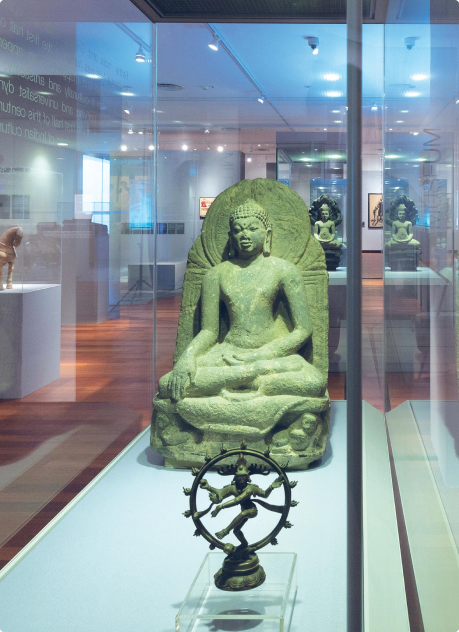
Faculty members are invited to explore how the Museum and its collections may be utilised as a curricular resource and integrated into academic coursework. Museum staff will work with faculty to plan the visit, provide access to the collection and consult on class assignments.
[ TO EDIT ] Visages Villages
If chance and coincidence appear to feature heavily in Tati’s PlayTime, as catalysts for ‘arriving at the right place’, they take centre stage in Varda and JR’s documentary film Visages Villages (2017). In the film, Varda expresses her fondness for chance, calling it ‘her best assistant’, and it is to chance which she attributes the meeting of the many faces in the many places they visit in rural France. In their roving photo booth truck, Varda and JR embark on a spontaneous, unplanned photo trip, documenting the personal histories of people they meet along the way, from residents in an old mining town, to farmers, and dockworkers and their wives. Chance, it seems, not only drives the duo’s artistic enterprise, but the documentary’s narrative itself. The expected climax of the film (when Varda and JR were to meet Varda’s contemporary and friend, Jean-Luc Godard) never materialises; the elusive Godard is nowhere to be found, leaving only an impersonal, scathing notice written in marker on his glass front door. As JR consoles Varda, he suggests that Godard’s rejection may have been a challenge to the film’s narrative structure, and it is that very encounter which then leads to the film’s true, bittersweet climax. In that climax, Visages Villages arrived at its conclusion, after the drift(s) found in the duo’s travels.
Parallels can also be drawn between Visages Villages and Massot’s art practice, both involving photography and photojournalism. As Tom White (freelance photographer and instructor at Yale-NUS College) said in the film’s pre-screening address, it is the telling of social stories which lies at the heart of his photo-work, as it does with Varda and JR’s project, and with Massot in his desire to make sense of his identities.
Conversations on the Travelogue: Meeting in Macau and Nocturne Indien
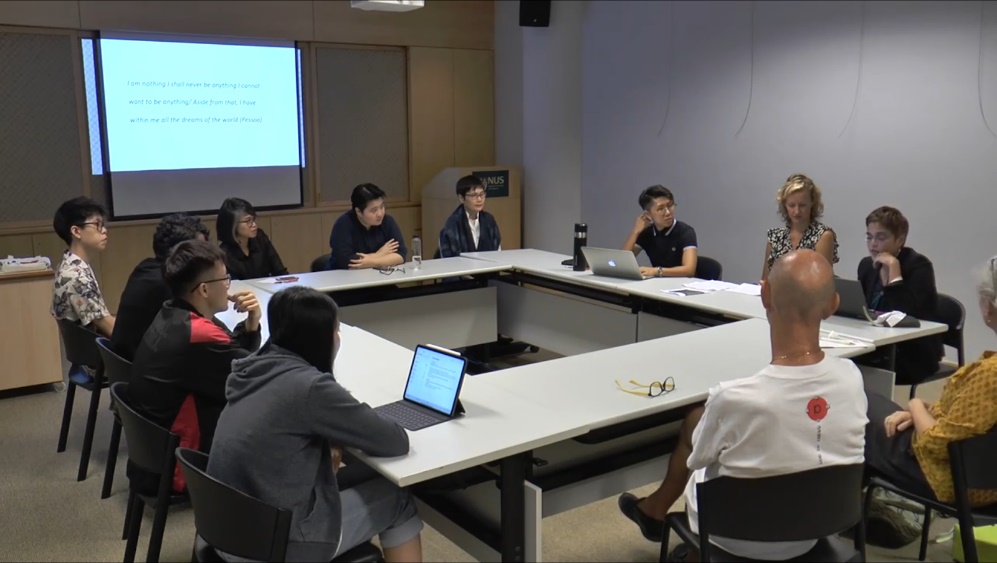
The Dériver / Arrivée film series continued with a roundtable discussion on the travelogue, which drew on Massot’s Meeting in Macau (2019) and Corneau’s Nocturne Indien (1989), as well as Tabucchi’s Indian Nocturne (1984) – the novella which the film is an adaptation of. Moderated by academics Dr Tania Roy and Dr Anne Thell (faculty members from the NUS English Language and Literature department) and NUS Museum Curator Dr Hsu Fang-Tze, the roundtable involved NUS students and NUS Museum staff alike, as well as the artist Gilles Massot himself. The meeting of these various perspectives created a polyphonic, dialogic space which resulted in fruitful discussion on the issues to do with the travelogue genre, transposed in the media of video art, film and literature.
The subjectivities of travel and travel writing arose as a topic that was germane and central to both Dériver / Arrivée and “…you have to lose your way”. In Nocturne Indien, we follow a Frenchman, Rossignol, who travels to India in search of his lost friend, Xavier. This undertaking brings Rossignol across India as he finds people who can provide whatever little information they may know of Xavier – from a prostitute in Bombay, to a fortune-teller at a bus stop between Madras and Goa, to a schoolgirl on Calangute Beach. A sense of foreignness persists throughout the film, and may be attributed to the irreconcilability of geography, language and culture. More than that, we come to realise that the film, as travelogue, is intrinsically solipsistic; it is impossible to distinguish between memory and imagination, narration and fabrication. Instead, the travelogue facilitates a recapitulation of the self – quoting Jonathan Swift, Dr Thell pointed out the travelogue genre’s onanistic, self-gratifying tendencies, as a travelogue ultimately fulfils its author’s egoistic desires. This is deftly shown through the filmic narrative, which concludes with Rossignol’s realisation that he is who he is looking for.
As Blum-Reid (2015) proposes, the traveller in Nocturne Indien, despite ‘getting lost’ in India, possibly never loses his European way, instead bringing with him his cultural baggage. Can a voyager, then, really lose his way? Is the resolving of our identities and finding ourselves in the right place contingent on said identities in the first place, which entails that we are never truly ‘lost’ in the first place? In response, Massot declared: ‘There is no coincidence, only narrative’. His work In the Footsteps of Jules Itier (2014) comes to mind – Massot’s recreation of Jules Itier’s daguerreotypes in Asia, a photographer with whom Massot shares many connections with. Here, Massot speaks about the significance of maps in a journey, and how they only become signifiers of the journey and their cultural images after the journey is concluded; before the trip, they mean nothing. Extending the metaphor, narrative may be the compass which helps us to locate ourselves. Like Massot’s work on Itier, recognising our personal biographies and how they are intertwined with broader histories and cultural narratives may be useful in understanding who we are.
Gaston Méliès and His Wandering Star Film Company
The ideas of dériver / arrivée and the voyage are perhaps most readily expressed in the film programme’s final screening: Raphael Millet’s Gaston Méliès and His Wandering Star Film Company (2015). Transit and transience undergird the documentary film’s portrayal of the eponymous filmmaker as he travelled in search of ‘authenticity’ – initially westward in the USA for his Westerns, and later to Asia-Pacific to produce films which were a blend of documentary and fiction (many of which have been destroyed by the passage of time), where he adopted an almost ethnographic approach in casting natives as actors, rare for his time. This hybridity – not only in genre but in the films’ contexts of production – raises a salient question which may likewise be asked of Massot’s art practice: are Méliès’ ‘around-the-world’ films really ‘French films’? Or are they Tahitian, Javanese, Singaporean? As artist-curator Woon Tien Wei asks, does the transnationality, collaboration and the interdisciplinary nature of Massot’s work make it ‘incuratable’ vis-à-vis the current lexicon of art in Singapore?
On another note, Blum-Reid (2015, p. 166-168) points out that ports, as places of passage, are designed for the very purpose of dérive. They are inherently transient places and are characterised by the drifting of ships out to, or from the sea. That Gaston Méliès is organised by the routes of sea travel that Méliès takes, both to and from various ports, makes it a distinctively transitory film. Even when Méliès arrives and settles, we never get the sense that he has come to his true or final destination. Similarly, identity for the traveller may never be stable or singular, but rather constantly remade through hybridisation, transnationality and transculturality. Yet, returning home is a part of the voyage as well – as the narrator in Gaston Méliès reads from his diary, ‘I cannot keep wandering around the world forever … one day I will have to stop’.
Returning to the series’ title, ‘A Century of Travel in French Cinema’ implies a period that has passed, and which can be clearly delineated by time. Yet we have seen how that century continues to have a bearing on us today; the films’ themes and narratives remain relevant, not only to Massot’s exhibition but to our own understandings of voyage. While the series (and this review) may seem to lack a definite point of closure, raising more questions than it provides answers, perhaps the conclusion of the series, instead of arriving at a destination, allows for the continuation of an on-going discussion. And that may be what the series needed to do, allowing each of us, as travellers, to engage with dériver / arrive on our own terms.
~
“…you have to lose your way to find yourself in the right place” closes on 13 June 2020. NUS Museum’s next film series will accompany the ongoing exhibition tropics, a many (con)sequence | an exhibition with Kent Chan, as well as the prep-room Sites, Stories & Subsequence, which focuses on the heritage and history of Singapore’s Southern Islands.