Diary of an NUS Museum Intern is a series of blog posts written by our interns about their experiences during the course of their internships. Working alongside their mentors, our interns have waded through tons of historical research, assisted in curatorial work, pitched in during exhibition installations and organised outreach events! If you would like to become our next intern, visit NUS Museum’s student development page for more information.
Guo Xiu Jin is a third-year Architecture student at the NUS School of Design & Environment. As our Collections Intern, Jin worked on exploring possible improvements to Collections Online, which is NUS Museum’s online database of artefacts.
It all began with the question ‘what is a museum?’. What happens in a museum? What should happen in a museum? As an architecture student, I’ve been challenged to design museums before. My research came with the realisation that they housed all these wonderful exhibitions, but I had no idea how they came to be. The inner workings of a museum were opaque to me, someone on the outside. So, I applied.
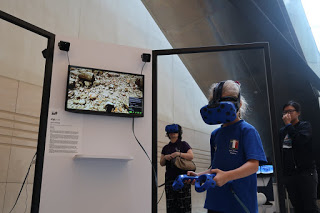
My very first task was to attend Digital Conversations, a series of talks by the National Museum of Singapore on the topic of Virtual Reality (VR). I cannot underscore how much of an eye-opening experience it was. This was my first taste of VR and without trying it yourself, I cannot sufficiently describe the experience. It was a new medium that artists were exploring – were museums of today equipped to exhibit their works?
Imagine if, in the future, you could rebuild it yourself, brick by brick. This could help build national identity, reconnect with people with their heritage. Isn’t that the role of a museum?
Later, we would visit NUS Museum. Despite its smaller size, there are uniquely fascinating spaces that I have never seen before in another museum. The prep-rooms are experimental spaces for artists and curators to explore different ideas and are actually open to public. Not only do they pull back the curtain on their thoughts and work, the public can even contribute and interact with the works.
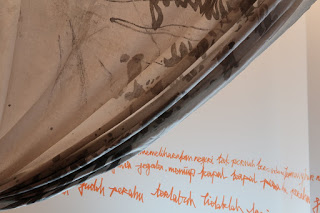
This prep-room features various explorations by artist Fyerool Darma. It highlights how the thoughts and creative energies that artists have goes beyond simply providing a backdrop for a painting. It might be a fabric from the ceiling, or spilling onto the walls.
We also had a behind-the-scenes introduction to the work by conservators at NUS Museum. I could make an entire blog post about this. Their workspaces, their work in restoration, the ethical dilemmas that they have to be considerate of – there are so many things to talk about, such as how do you preserve temporary artworks? What if, by exhibiting the artwork, it decayed? They navigate these delicate issues which, when done well, are invisible to the audience at an exhibition.
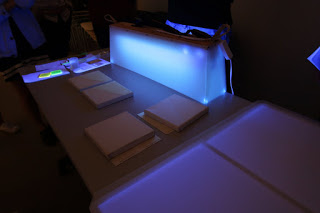
Depending on the make-up of the paint, white paint to the naked eye will look different under UV light. This helps conservators identify the type of paint used, and possibly the period when the painting was made.
NUS Museum is staffed by a group of dedicated and passionate people. One meeting with the curator Su Ling sticks in my mind. A petite woman, it was not her stature but her use of language that impresses. Simple and direct. I remember a quiet realisation at how much it revealed the organised and insightful mind behind it. I gained a newfound respect at the scope that the staff at NUS Museum considers. The order of exhibits, the logic, spatial arrangement, humidity, lighting, pests. The tangible and intangible. Each one brimming with questions.
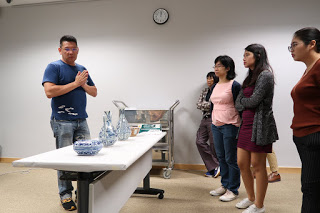
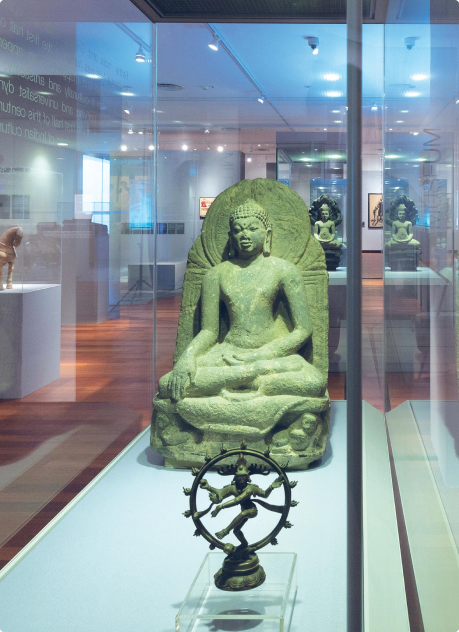
This exercise let us handle some artefacts in person. The inside of my gloves were slick with sweat. If I dropped and broke one, that was it. They were genuine artefacts. Fun fact: The museum stripped out a section of floor tiles because they were too bumpy for trolleys.
Every intern were given artworks to research and write about. As a ‘non-art person’, writing about art is not something I had ever done before. It wasn’t uncommon to get lost in jargon while reading texts, or in conversations, prompting more research. Yet, I was surprised to find a small pleasure in the research. Why did he do this? What was the inspiration? Is he alive? From a stranger, the artist turns into someone you have a connection with. There was a weird excitement when I found out that the artist was indeed alive and in touch with NUS Museum.