Beyond bedside care: Nursing, research and the art of innovation
Reina Cheong
Senior Staff Nurse, Singapore General Hospital
Alumna, Alice Lee Centre for Nursing Studies, NUS Yong Loo Lin School of Medicine
The direct impact of care
For 26-year-old Reina Cheong, her path to nursing wasn’t marked by a dramatic turning point, but by a series of small, meaningful steps. In secondary school, she left the concert band and joined the Red Cross Youth, which gave her a first glimpse into nursing. Continuing in this vein, she then did extensive volunteer work as part of her co-curricular activities in junior college. “I realised I was drawn to healthcare because I enjoyed connecting with people and making a direct impact,” the NUS Nursing alumna and current Senior Staff Nurse at Singapore General Hospital (SGH) shares. The nursing profession stood out to her as a hands-on, versatile career that offered both stability and lifelong learning.
Uncertainty, not incapability
When it came time for Reina to choose a higher education path, NUS Nursing was an easy decision. “Being ranked 8th in the world gave me confidence,” she shares. Her time at NUS was packed with milestones, from the Silent Mentor Programme, where she learned anatomy through body donors, to Objective Structured Clinical Examinations that simulated real-life clinical scenarios. “They were nerve-wracking,” she admits, “but they pushed me to think on my feet, which is exactly what we face in practice.”
Reina’s growth at NUS wasn’t just academic: it was also personal. “I still feel fear when I step into something new,” she confesses. “But through my experiences at NUS, I’ve learned that fear usually comes from uncertainty, not incapability. Each time I face it, I grow.” That mindset helped her navigate the later chaos of hospital life, which she once imagined as a series of never-ending emergencies. “Yes, it can look like that,” she says, “but there’s actually a rhythm hidden in the noise. Nurses are often at the centre of it. We coordinate, advocate and notice subtle changes.”
Peerless support, unflagging help
Of the courses she most enjoyed at NUS, Reina cites the Pharmacology, Pathophysiology and Nursing Practice classes taken in her first three years. She explains: “They were very foundational and are highly relevant in my work today. Having that knowledge gives me the confidence to raise safety concerns, advocate for patients and understand the clinical reasoning behind what we do.” Her advice to future NUS Nursing students? “Don’t just memorise, understand. You’ll forget half the drug names after exams, but if you know why something is done, that insight becomes your strongest tool for patient safety and harm prevention.”
But her NUS Nursing peers were her true anchors. They were generous with their knowledge, frequently sharing notes and providing emotional support. “We survived the tough parts together, the exams, internships, night postings and thesis struggles. There was no gatekeeping, just a genuine willingness to help,” she recalls warmly.
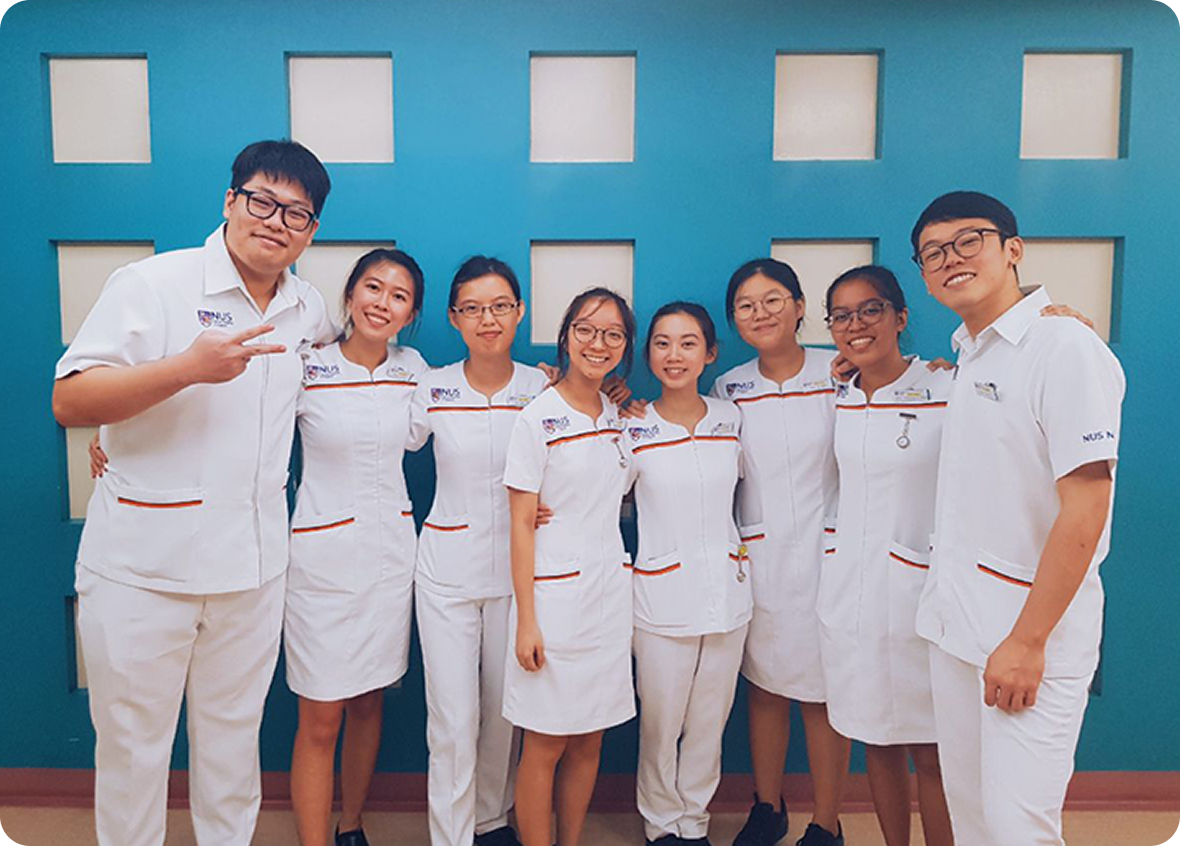
Reina (second from left) was deeply thankful for her NUS Nursing batchmates, some of whom are now her current colleagues, whose unwavering support and camaraderie continue to this day.
The support of her peers didn’t end after graduation either. “At the start of my career, I sometimes felt inadequate, and it was a fellow NUS batchmate who reminded me, ‘It’s not incompetence, it’s just inexperience.’” Another batchmate later helped Reina transition into the same ward in SGH where she had been working. “It felt like I was returning to a place I already belonged.”
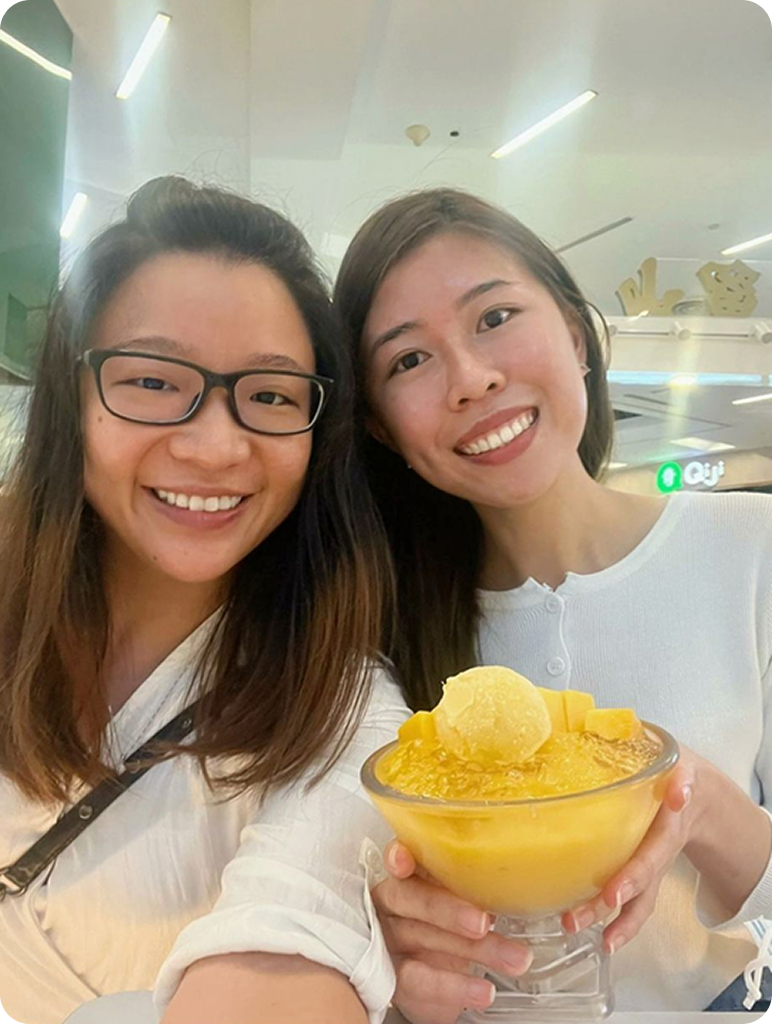
Reina (right) sharing a dessert with Nurse Clinician Tricia Lang, her former clinical preceptor during her NUS Nursing internship, who is now her colleague.
From pandemic to possibility
Reina’s idea for her honours thesis didn’t come from a lesson in a classroom. Instead, it took root in the chaos of the COVID-19 pandemic. “Most of the focus was on point-of-care testing,” she recalls, “but I started wondering if there were more subtle physiological changes that could signal infection even before a test was done.” That curiosity led her to research how digital tools could enhance patient safety and nursing efficiency. “Technology is no longer a side note in healthcare, it’s at the centre of how we deliver care, from electronic health records to wearables and apps. With the right foundation, we could not only use these tools better but also take part in how they’re built and applied,” she opines.
“Researching digital technology and wearables for my thesis was a turning point. It helped me see nursing as more than a profession. I realised it could also be a platform to combine clinical practice, research evidence and innovation to improve care.” This pivotal experience would later set her on the Nursing Research and Innovation track at SGH, where she currently balances three days of research and innovation work with two days of clinical practice, and enjoys “the best of all worlds.”
An intersection of three loves
What excites Reina about blending clinical work, research, and innovation is how the three parts intersect meaningfully. “My clinical days keep me grounded in the realities of care, such as the policies, procedures and small frustrations that often don’t get voiced. That naturally feeds into the research side, where I can explore these issues more systematically, look at evidence, and understand the bigger picture. And when existing solutions don’t quite fit, that’s where innovation comes in,” she explains. Clinical practice gives her insight, research yields evidence, while innovation provides the chance to create change. “Being able to move between them makes the work dynamic, and it motivates me to keep asking how things can be done better,” she beams.
Her drive to improve patient care through innovation is evident in her serial participation in competitions at SGH. “It’s a running joke. Whenever a new competition is announced, my colleagues ask if I've already signed up—because chances are, I have!” For her, these competitions are a playground to test her ideas. “They’re grounded in what I notice from routine work, the things patients point out in passing or the frustrations that nurses quietly grumble about but put up with. They are like pebbles in your shoe. One pebble does not stop you from walking, but if you ignore it long enough, it wears you down. Those are often the most telling signs of where change is needed.”
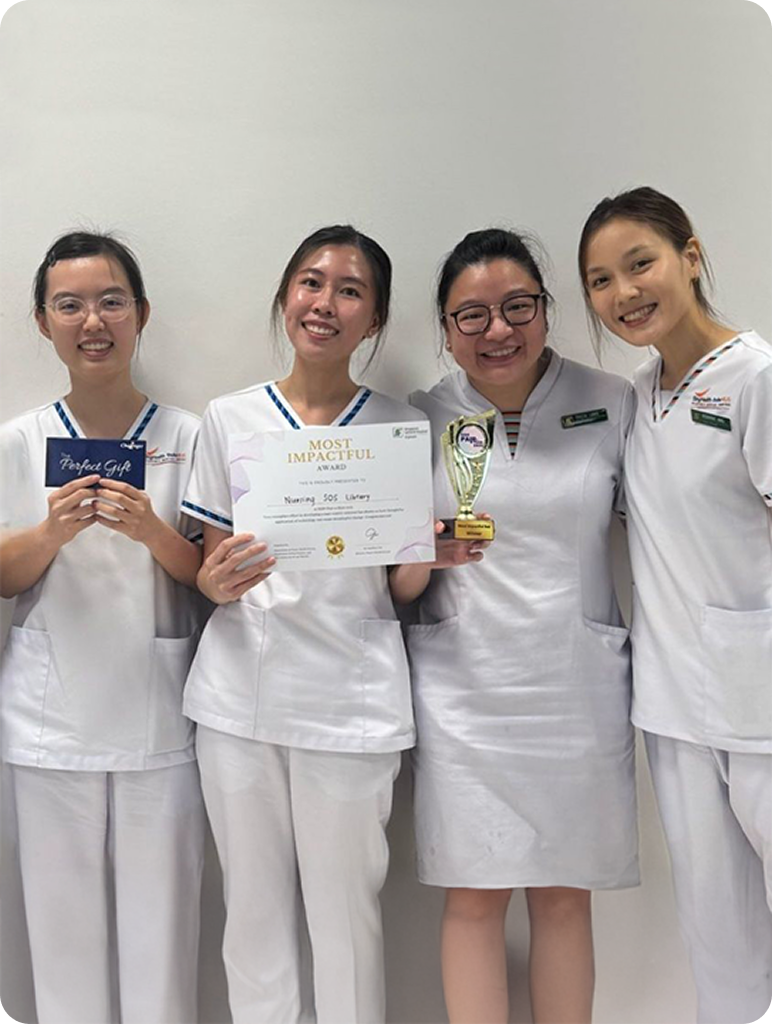
At the inaugural SGH Pair-a-thon: AI Assistant Contest in 2025, Reina (second from left) led the creation of an AI-powered nurse assistant, with her team winning an award for the Most Impactful Pair Assistant.
She traces her interest in innovation competitions back to her days at NUS, when she participated in Beyond Health Hack and worked with friends from Pharmacy, Law, Computer Science and Business. That experience equipped her with key insights into how each discipline approached the same problem differently, even as they worked collaboratively. “NUS gave me exposure not just to clinical skills, but to research, innovation and even glimpses of policy and teamwork,” Reina reflects. “I started with the idea that nursing was just clinical care, but NUS showed me that there is so much more.”
Empathy, compassion and critical thinking
Her clinical work is just as important to her as her drive to innovate. Described by peers as “motivated, dependable, and inquisitive,” Reina is the kind of nurse who doesn’t just show up — she shows up fast. “Patients say I’m like the wind,” she laughs. “I arrive so quickly they feel a gust when I enter the room.” It’s a testament to her responsiveness and drive. “I value being task-oriented and showing up fast when someone needs help.”
Reina’s nursing philosophy is rooted in empathy, critical thinking and compassion: three key traits she thinks nurses should possess, which are highly evident among her nursing colleagues. “I see a mosaic of humanity built from every colleague, patient, and family I meet,” she reflects. “I carry those fragments of their kindness and resilience within me, so that I can reflect that same light for someone else when they need it.” This is exemplified in her peers: “I’ve seen colleagues walk with patients from admission to discharge, sometimes even attending their funerals,” she says. “To go the extra mile for a stranger, and give so much of yourself unconditionally — that’s the kind of compassion that moves me.”
Choice architecture
Currently pursuing her Master of Science in Behavioural and Implementation Sciences in Health at NUS Medicine, the budding innovator and researcher hopes that by understanding behaviour and the barriers people face, she can create changes that make it easier for healthcare teams to implement solutions in real settings.
“In healthcare, a good idea does not always lead to a good outcome. If people do not adopt it, or if the context does not support it, even the best-designed solution can fail. On the other hand, a program that may not look impressive on paper can succeed if it is simple, easy to use, and reinforced by behavioural strategies. Drugs only work if patients actually take them, and in the same way, innovations or workflows only work if people follow through.”
Small tweaks, big differences
Her advice to future nurses? Don’t be afraid to speak up. She wants the next generation to know that their observations matter, their ideas are valid, and their voices can shape the future of care. “Healthcare is teamwork, and nurses play a critical role in patient safety,” she explains. "We are the frontline advocates whose assessments uncover hidden risks. For example, a patient's refusal of medication is not just non-compliance. It might reveal a deeper issue, such as difficulty swallowing, prompting a switch to an alternative drug form. Similarly, noticing a patient coughing while eating can trigger a timely speech therapy referral, preventing a serious aspiration risk. Nursing is therefore not simply about carrying out orders. It is about being a partner in care and preventing harm."
For her, innovation is more about thoughtful tweaks that make a big difference. “Innovation is not about reinventing the wheel, often it is just tweaking it so it rolls smoother for everyone” she says. “It can be as simple as rethinking a process or making information easier to access.” She’s especially excited about the rise of AI and biomedical informatics in healthcare. “With tools like AI becoming more common, I’d love to see younger nurses use these to amplify their voices and ideas.”
Reina’s work is a reminder that nursing is not just a profession — it’s a platform. She elaborates: “If my work helps prevent harm, makes life easier for patients and colleagues, and inspires others to improve the system too, then I feel I am exactly where I should be.”