Fighting infectious diseases, one microbe at a time
Sruthi Annamalai
Year 4, NUS Faculty of Science
The building blocks of curiosity
Sruthi Annamalai’s fascination with science was first kindled during childhood sleepovers at her grandmother’s home. “My grandma, a healthcare assistant at Singapore General Hospital, would role-play doctor-patient games with me by using real medications as props to explain their uses – from respiratory treatments to common pills,” she recounts. These playful yet educational moments laid the foundation for her curiosity surrounding all things scientific.
This early exposure evolved into a deeper interest in genetics and microbiology during her days in school. Sruthi vividly recalls learning about Mendelian genetics and drawing punnet squares, an experience that stuck with her and later expanded into drawing complex trihybrid crosses at NUS. “Learning about Mendelian genetics back then, when it was just simple monohybrid and dihybrid crosses in pea plants, and epistasis was the toughest thing to understand – those days were what sparked my early interest in genetics,” she reflects fondly.
Off the textbooks into real life
While her intrigue with bacteria and viruses also began in secondary school, it was the COVID-19 pandemic that turned mere textbook theory into a visceral lived reality for the 22-year-old. Born during the 2003 SARS outbreak, Sruthi had only heard stories from her mother about the SARS epidemic – until COVID-19 made the impact of infectious diseases both personal and urgent.
Now a Year 4 Life Sciences student at the NUS Faculty of Science (FoS), Sruthi is also exploring a minor in Psychology at the NUS Faculty of Arts and Social Sciences; her passions are rooted in both formative childhood memories and real-world experiences. “What I lived through motivated me to shift my research focus to something that would make a tangible impact on people in the arena of infectious diseases and microbiology,” she shares.
Unsurprisingly, she chose to research dengue for her Undergraduate Research Opportunities Programme in Science (UROPS), venturing beyond conventional inactivated viral vaccines to explore emerging approaches like mosquito salivary protein vaccines. Currently, she is embarking on a Final Year Project investigating dormancy in the malaria-causing Plasmodium falciparum to better understand how it evades drug treatment. “These projects have given me a deeper appreciation for the research I’m doing – it may seem upstream, but eventually it’s going to help millions, even billions, of lives worldwide.”
A welcoming diversity
Characterising FoS as “extremely welcoming and encouraging of students’ passions”, Sruthi is confident that any student can find their niche, thanks to the sheer diversity of the Faculty. Lest you think she refers to only its curriculum, the extrovert points to a myriad of extracurriculars FoS offers: every major has their own student society, not to mention student interest groups like astronomy, cooking, baking, board games, puzzles and various sports to explore. The best way to find out if Science is your thing? “Just come for the Open House, talk to seniors, build connections and see what NUS has to offer, because there’s really so much variety – there definitely will be something that caters to your interests!” she laughs.
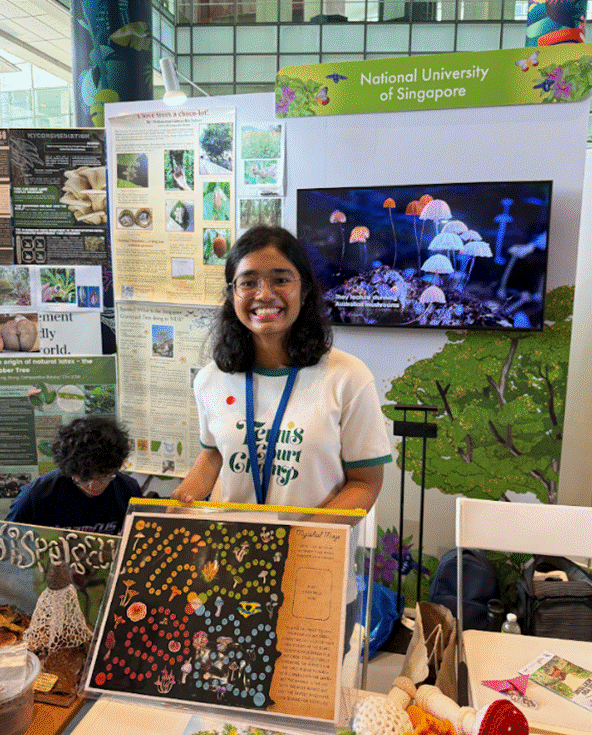
Sruthi created Mycelial Maze, a board game to educate the general public on fungi, as part of the Life Sciences course, LSM3259: Fungal Biology, and showcased her project at the NUS booth at the Festival of Biodiversity 2025.
As for her favourite FoS courses, she lights up when recalling LSM3228: Microbiomes and Biofilms, taught by Senior Lecturer Dr Ch'ng Jun Hong, whose emphasis on process over results gave her a glimpse into the life of a researcher. Instead of standard laboratory practicals, he tasked each group to come up with their own microbiome intervention and ensured there were funds for the groups to buy the products needed. Another standout experience for her was LSM2107: Evolutionary Biology, as she relished Assistant Professor Nalini Puniamoorthy’s use of simple yet effective props like little paper cut-outs to model different evolutionary forces like selection and genetic drift.
Academics aside, Sruthi counts her two years in the NUS Life Sciences Society (LSS) as her most life-changing NUS experience. Starting as an executive, she learnt the ropes of organising events before stepping up to be its Academic Affairs Director. “That opened my eyes to the bigger picture of what LSS is about. It taught me collaboration, mentorship, strategic decision-making, effective communication and people-centred leadership. Overall, I have grown to be a visionary leader who works closely with her team,” she reflects.
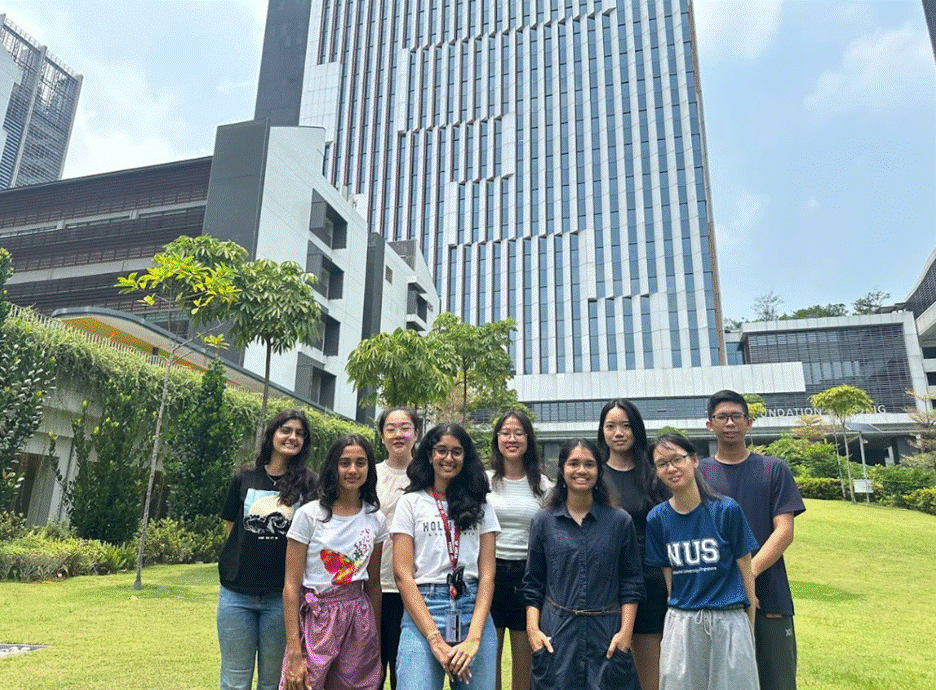
Sruthi (first row, second from right) with the NUS Life Sciences Society’s Academic Affairs department at the NUS Faculty of Science.
Widening perspectives
Sruthi’s journey into Psychology began with a desire to explore disciplines outside the Life Sciences, such as Economics and Philosophy, through unrestricted elective courses as part of her NUS degree requirement. But it was the course PL1101E: Introduction to Psychology that truly resonated, sparking her interest in human behaviour and the workings of the brain – especially in the arena of Social Psychology. Sruthi also tags PL3103: Cognitive Psychology as a standout for her as it delves into neural networks, explores different types of modelling and demonstrates the importance of modelling. “Psychology has taught me a lot about who we are as humans,” she reflects. Sruthi doesn’t see her Life Science major and Psychology minor as being two completely separate fields. “I wanted to learn more about the brain and neuroscience, but not just from the Life Science perspective, which is more chemistry-based. Psychology gives me another perspective on the brain.”
She was also able to pursue her passion for interdisciplinary learning through the College of Humanities and Sciences (CHS) common curriculum, which is offered to all FoS students. “The CHS common curriculum courses in social cognition, data science, and digital literacy have taught me skills like statistical analysis and coding – critical for us science students!”
She particularly enjoyed the CHS common curriculum course DTK1234: Design Thinking, where students unlock their creative potential and reframe problems as opportunities for human-centred design. “Two of my key takeaways are learning the importance of brainstorming ideas and building low or high-fidelity prototypes depending on what is needed – it's not always necessary to build something physical that represents what you are trying to create. The Post-it ideas generation exercise we did on the MIRO visual workspace is a handy tool I still use for any project I do today, as is the memorable Wizard-of-Oz prototype we learnt in class for testing concepts,” she reflects.
Where camera meets books
Sruthi’s lifelong passion is books. Her love of reading and libraries, a cornerstone of her childhood, was nurtured when she was a little girl. Her mother, a former primary school teacher, co-created a handmade book with her – a formative experience that blossomed into Sruthi’s present-day passion project: running her own Instagram account that documents all the books she has read. “Reading is a form of escape for me,” Sruthi confesses, “while content creation grants me the freedom of expression beyond the confines of academic writing. Listing science fiction, mysteries and thrillers as some of her favourite genres, she explains that science fiction fuels her imagination about genetic possibilities and ethical dilemmas, while thrillers and mysteries sharpen her analytical thinking and problem-solving – skills she translates into her lab experiments.”
Gearing up for graduation, Sruthi has started a personal project to celebrate her love for libraries and photography to mark the end of her four years in NUS. “The Medicine+Science Library and the Central Library are a large part of my campus life! I want to capture these memories before I graduate as a loving homage to the spaces that have shaped my academic life,” she enthuses.
Those who can, teach
Sruthi is lucky to have been shaped by inspiring mentors throughout her life. She is grateful for her mother’s tireless energy that often turned at-home math lessons into fun-filled treasure hunts and obstacle courses. “That joy of discovery is something I carry with me even today, especially when I’m stressed or bogged down by assignments,” she recalls with fondness.
At NUS, Sruthi has been taught by many professors who have made an impact on her, such as Dr Ch’ng and Associate Professor Chew Fook Tim. However, she cites Associate Professor Wu Jinlu as her biggest inspiration: “Prof Wu’s humility and creative use of models in teaching, for example, using buckyballs to build viral structures in LSM3227: General Virology, inspire me to connect deeply with students. He’s truly passionate about education and always strives to improve. I’m so grateful to have taught alongside him at the Chemistry of Life summer camp!”
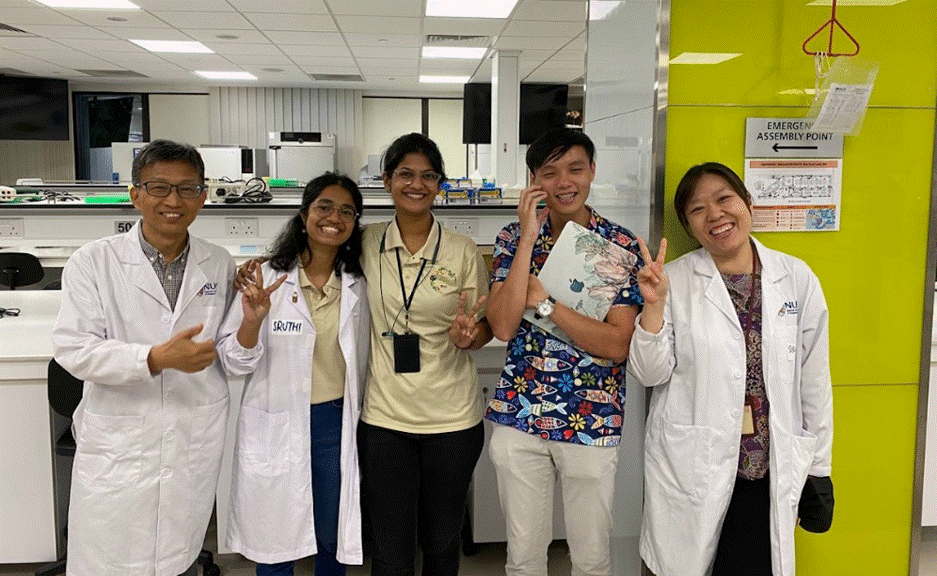
Sruthi (second from left) with Assoc Prof Wu (first from left), PhD students Rutuparna and Amos, as well as Instructor Ms Sylvia Law at the Chemistry of Life summer camp.
Now, Sruthi embraces teaching through multiple roles – a door of opportunity that first opened to her, thanks to Scientific Manager Dr Lim Kim Yong and Senior Scientific Officer Ms Ng Mei Ting. "They offered me a part-time internship during my summer break in 2024, where I got to teach many more workshops and even international students! I even got to revamp the Neuroscience workshop with material from my psychology course and lead the workshop during our annual summer camp!" says Sruthi.
As a Senior Facilitator with FoS’ Young Educators in Science (YES), she has led over 100 hours of workshops, designing materials for students from primary to polytechnic levels. She also tutors under the Undergraduate Teaching Opportunities Programme in Science (UTOS) initiative and is affectionately known as “TA Sruthi” among her peers for her guidance in LSM2191: Laboratory Techniques in Life Sciences. “Once a TA, always a TA,” she laughs.
The science of education, the art of research
Sruthi aspires to transform global public health through groundbreaking research in microbiology and vector-borne diseases. “I hope my research can contribute fresh perspectives and innovative solutions,” she says, envisioning a future where molecular techniques unlock new pathways to understanding host-pathogen-vector interactions.
In five years, she hopes to obtain a PhD, becoming a science educator who inspires the next generation of students, and eventually a professor. Her dream? “To make education more accessible, engaging, and enjoyable for everyone.” Through volunteering, teaching and mentoring, she’s already shaping that future. Her advice to the next generation of young women in STEM like herself is equally bold and empowering: “Learn to connect your personality and passions to your research; it will help motivate you when the research process gets hard and tiring. Seize whatever opportunities come knocking, be curious and dream big!”