Currents of change: Bridging conservation practices across Southeast Asia
Chee Koi Jun
Year 4, NUS College, NUS Faculty of Science
An affinity for nature
Chee Koi Jun's love for animals didn't begin in a lab – it started in the aisles of Popular bookstore, and on the couch watching National Geographic Wild and Animal Planet. "I blame the animal books and documentaries," he laughs. "I've always had a strong affinity for nature." His childhood was filled with thick biology tomes and encyclopedias brimming with animal facts, as well as the occasional guppy or arowana in his dad's aquarium. But unlike most kids who begged for pets, Koi preferred observing animals in the wild. "I just want to see them, work with them, study them," he says. "Not own them."
That fascination matured into a passion for conservation and animal behaviour. Jeremy Wade, Steve Irwin, David Attenborough and even the Mythbusters cast were early influences, but it was the creatures themselves – camouflaged frogfishes, flamboyant nudibranchs and elusive snakes – that truly captured his imagination.
A tale of two obsessions
Ask Koi Jun to describe himself and he'll say: "Driven, crazy and fun." For the Year 4 Life Sciences student with a minor in Aquatic Ecology, "crazy" means wandering for four hours straight with his photography gear around Mandai and MacRitchie in the middle of the night in search of Wagler's pit vipers and Sambar deers, or making trips across Southeast Asia in search of frogfishes. "I do things people don't normally do," he grins. "But I think it's fun."
But his night-time roamings have a purpose: they're part of how he learns to think like the creatures he studies. "Photography taught me patience: waiting for the rhythm of nature to play out instead of rushing for the shot." One thing Koi wants everyone to know: studying animal behaviour isn't just about photographing cute animals. "Sorry to burst the bubble but behavioural science is actually super mathy," he says. "You have to define behaviours in a way others can recognise, recording them frame by frame, and analyse these sequences. It's very quantitative, but that doesn't take away the joy."
Although his nickname "Koi" started as a simple abbreviation of his name in primary school, it's now a perfect reflection of his dual obsessions: tea and aquatic life. Around campus, he's known as either "the tea guy" or "the animal-loving photographer." And he wears both titles proudly.
Tea isn't just a beverage for Koi, it's a way of life. From tea sessions at NUSC Brewcaff in Years 1 and 2 to developing his own kombucha recipes, he's constantly brewing something new. His current experiments include pineapple, green apple and muscat grape, and red apple kombucha. Cooking is another way Koi unwinds after long days in the field or lab: "It's not about fancy confectionery," he says. "Just informal get-togethers with friends to learn how to cook."
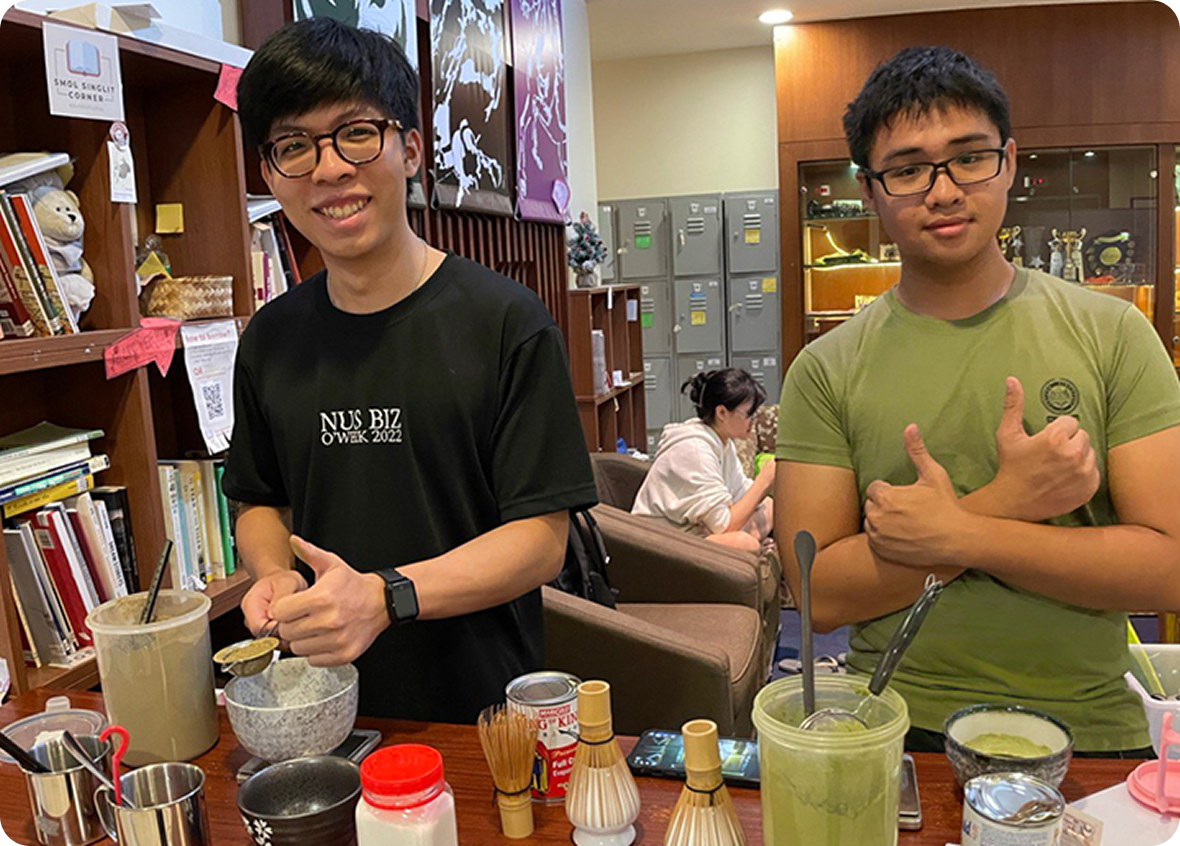
Koi (right) brewing matcha for NUSC Brewcaff.
NUSC: Eclectic, beautiful magic
As a student at NUS College (NUSC), Koi appreciates the multifaceted and engaging curriculum it offers. "If I could sum up the NUSC experience to a stranger, I would say it is an interdisciplinary community full of opportunities both local and global, but also rigorous and demanding in approaches and learning."
One of Koi's favourite NUSC courses was NST2007: Biodiversity and Natural History in Singapore. "We got to observe insects and do overnight fieldwork at St John's Island," he says. "There was so much freedom to play with ideas! Someone even ran an insect removal service for the building, collecting these insects as part of their project, which they went on to present at a conference. I myself did a short series on the sounds various animals, such as frogs, birds, insects, and even fish made, introducing people to the natural soundscapes of Singapore!" Ever the avid biologist, he says that if he had the power to add more courses to the curriculum, it would be about deep ocean biology and energy cycles: topics he feels are underexplored, but rich with potential.
Living on campus at University Town (UTown) has also been a game-changer for Koi. "The late-night events, common room discussions until 4 am, and interest groups like NUSC Brewcaff helped me explore my passions," he says. And the culture at NUSC? "Highly creative and hardworking," he says. "You learn to work across disciplines: Life Sciences, Law, PPE, Linguistics, CS. It's messy on paper but beautiful in practice." He shares that the seminar-style classes, which host some 15 to 25 students, offer personalised learning and opportunities for discussion and ideation. His advice to prospective students? "Be unafraid of interdisciplinary work. That's where the magic happens."
Standing on the shoulders of giants
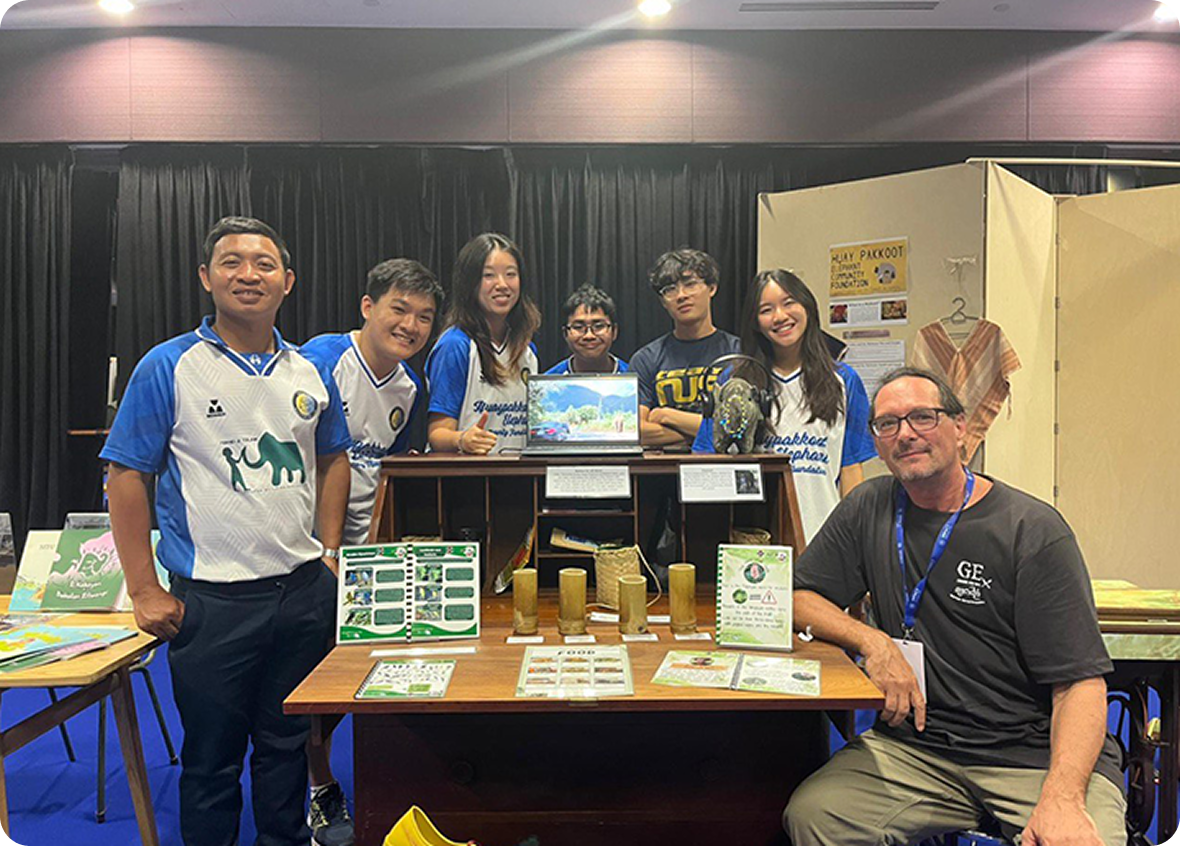
Koi (centre) with his Impact Experience team and Assoc Prof Peter Vail (right) and Satit Trachookwamdee (first from left), their IEX community partner, at the NUSC Impact Experience Festival.
Three people have shaped Koi's NUS journey profoundly: Associate Professor Philip Johns – who introduced him to urban wildlife studies and diverse methodologies of studying wildlife biology such as DNA, behaviour, sound analysis as part of his Undergraduate Research Opportunities Programme in Science (UROPS) project at the Faculty of Science (FoS) – as well as Associate Professor Peter Thomas Vail and Instructor Ms Sam Shu Qin. "Collectively, they have guided me and developed me as a researcher, leader and critical thinker. I would say they were instrumental throughout my NUS journey," he opines.
Assoc Prof Vail, his NUSC Impact Experience (IEx) supervisor, taught him how to ask the right questions and manage ambitious projects. Koi's team worked to boost ecotourism in the Karen village of Huay Pakkoot, Thailand, known for its connections to a community of over 40 elephants. They quickly built biodiversity records, signboards and even produced three documentary episodes that boosted local tourism footfall. "The connection with the villagers was the most satisfying part," Koi enthuses. "We've gone back four times over two years. They were initially hesitant, but are so welcoming now."
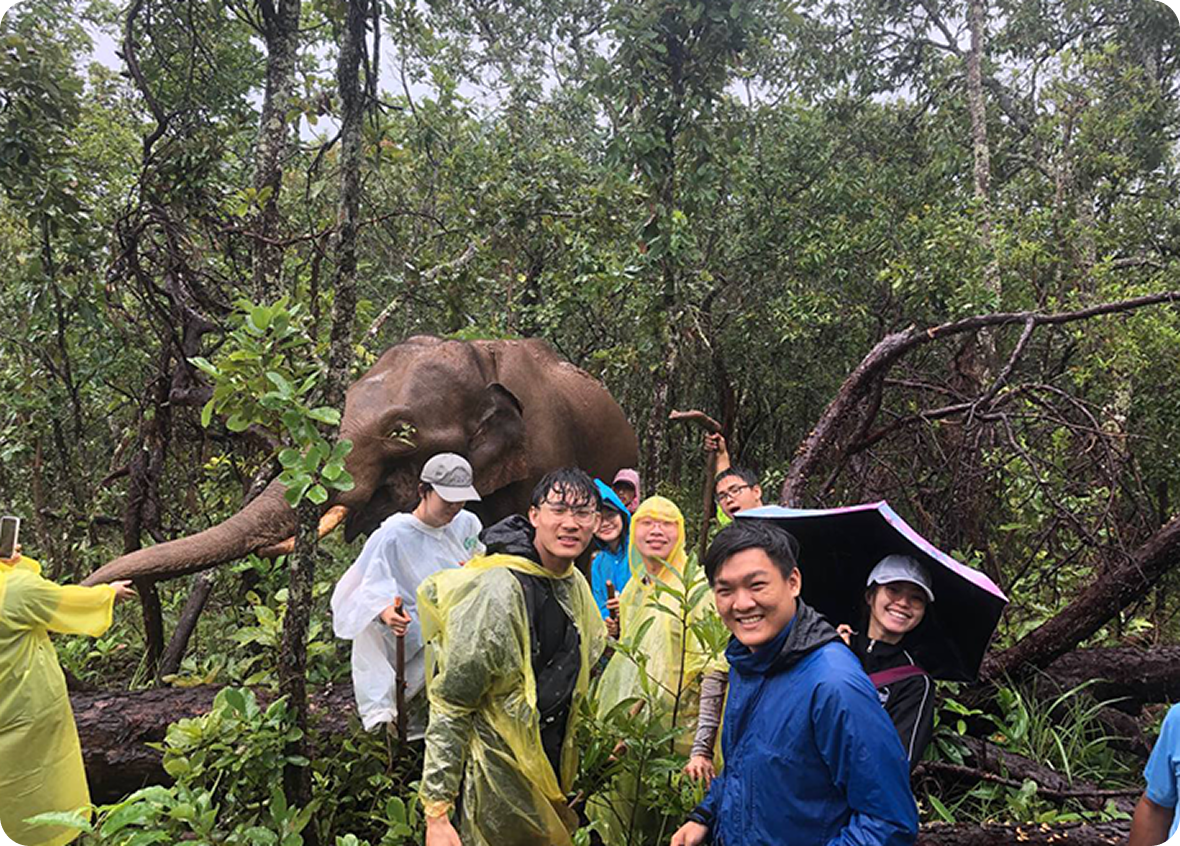
Koi (back row, holding on to a branch) with fellow NUSC Impact Experience coursemates meeting an elephant in the Karen Village of Huay Pakkoot, Thailand.
His team members, with majors ranging from Chemistry and Environmental Studies to Law and Philosophy, interviewed monks, mahouts (elephant caretakers), farmers and village elders and worked alongside them to create real change. "Each discipline brought its own curiosity to the mix as we witnessed wide capabilities and different perspectives," he recalls. "We asked members of the local community, including farmers and mahouts, questions like 'How do you feel about losing the forests?'" he notes. The mahouts were also asked to reflect on what they loved and cherished about their elephants, which have unique personalities and are regarded as cherished members of the family. "We asked them, 'Would you have chosen a different elephant if you could?' to understand what they missed most about their elephants."
Ms Sam Shu Qin, currently one of his FoS Final Year Project (FYP) co-supervisors, was a pivotal figure in his journey. Initially his instructor for the NUSC Global Experience Course (GEx) project in Bali and Lombok during his summer break between Years 2 and 3, she piqued his interest in marine conservation and connected him to local non-government organisations, where he studied the wide range of artisanal fishing methods. Eventually, he became invested in working closely with these local communities and delving into community-based conservation management.
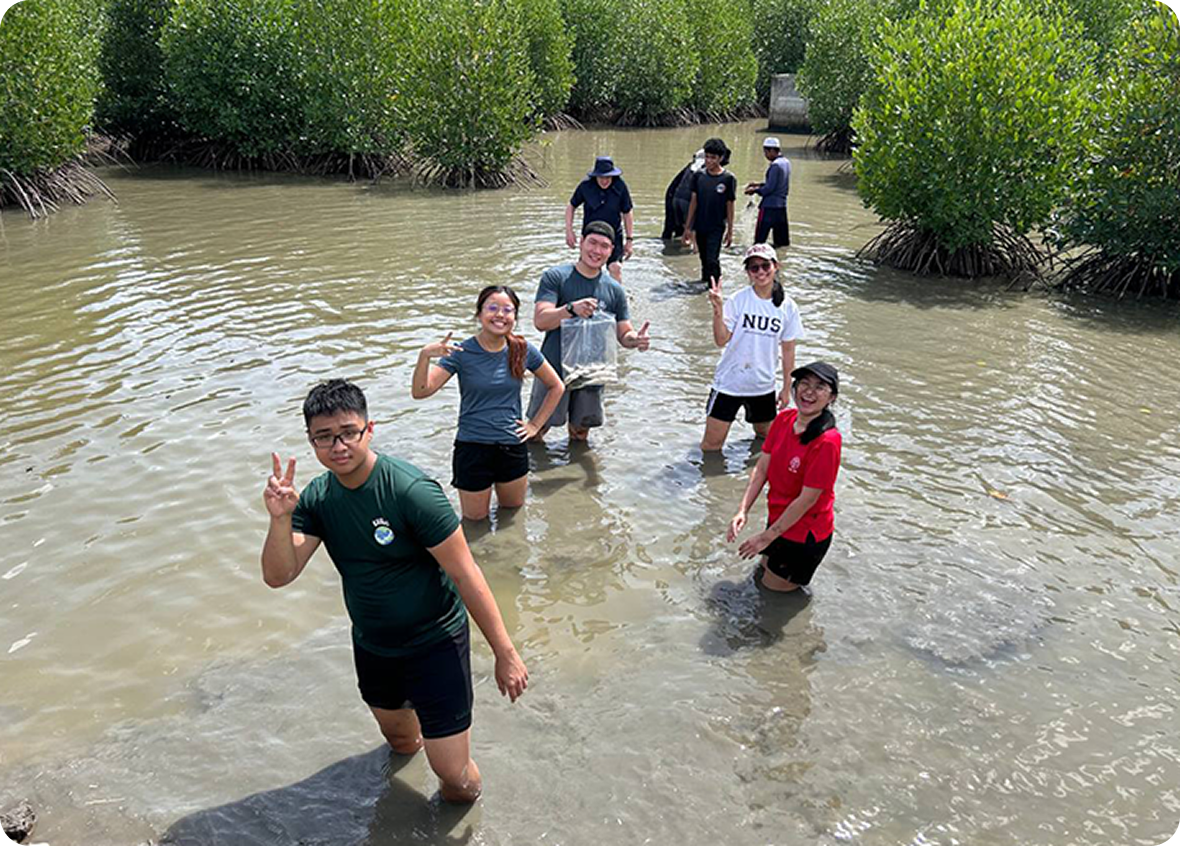
Koi, first from left, with fellow NUSC GEx coursemates in Lombok, Indonesia, working with researchers from the University of Mataram to incorporate mangrove trees into milkfish aquaculture.
Working closely with local communities in Bali, Lombok and West Sumbawa quickly revealed the harsh realities of livelihoods tied to nature: "Seeing a fisherman suffer decompression sickness after compressor diving was sobering," he shares. "It's not just about protecting animals for their sake," he says. "It's about how they impact humans, and how working with people can incentivise communities to protect nature."
Global experiences, local impact
Koi is now set on pursuing postgraduate studies focused on community-based fisheries management in Southeast Asia. His dream? To compare top-down and bottom-up approaches across countries like Indonesia, the Philippines and Timor Leste. "I want to understand what makes conservation work or fail in different contexts," he says. He's especially passionate about bottom-up solutions, where villages patrol and protect their own waters. "It's customisable, empowering and often more effective than government mandates."
From planting mangroves at the Young Southeast Asian Leaders Initiative's Blue Economy workshop to meeting deep-sea fish in New Zealand, Koi's other global experiences have also enriched his life as a thalassophile and shaped his worldview. In New Zealand, as part of his FoS Student Exchange Programme, Koi studied marine policy and management, with courses on Applied Marine Biology, Introductory Marine Biology, and the history and geology of Antarctica at Victoria University of Wellington. He was taught how to dissect fishes like the ratfish and flathead to study their internal organs, and made friends through adventures with local trekking clubs. "I went to Christchurch not for tourist sights, but to photograph birds," he laughs. Listing cormorants, oystercatchers, and terns as some of the seabirds he snapped, he adds: "I even saw a royal albatross colony at Harrington Point!"
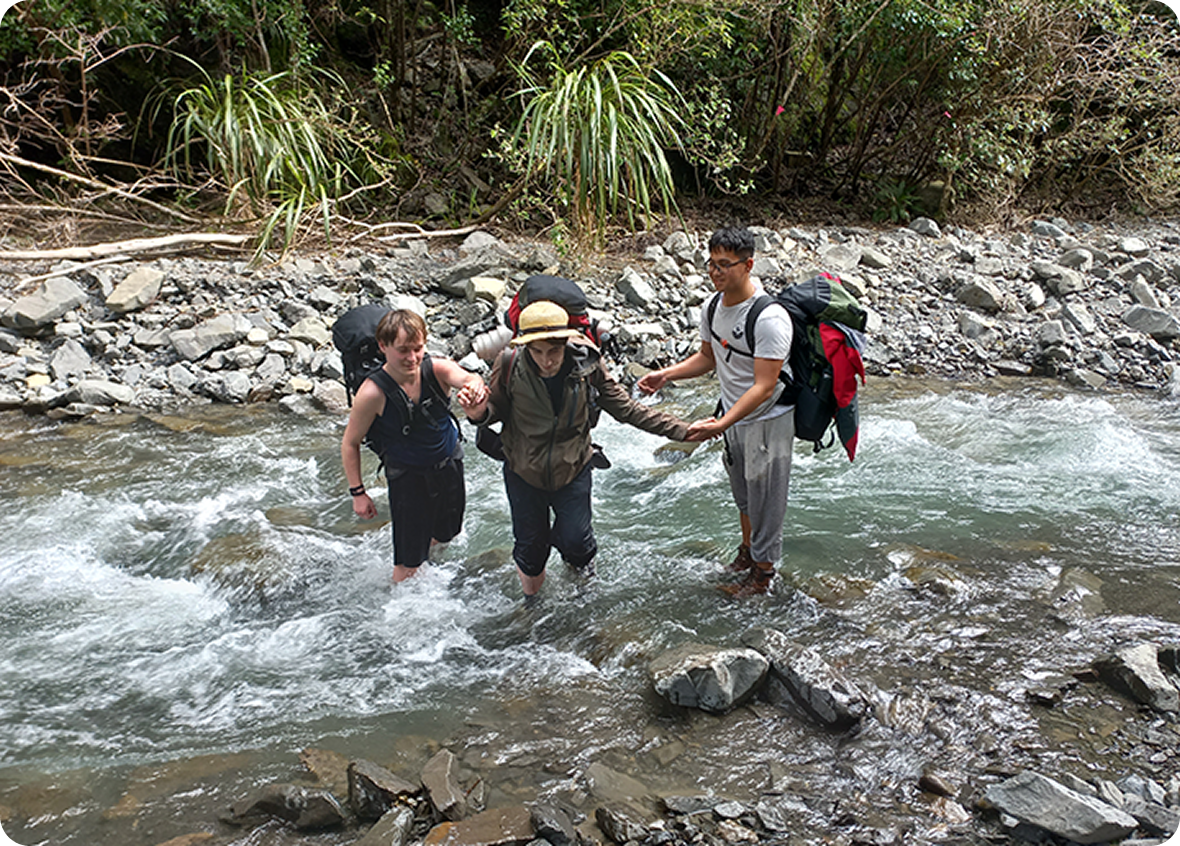
Koi (first from right) helping his new friend from Victoria University of Wellington, Justin Atkinson, across the Orongorongo River in the Remutaka Forest, New Zealand during a trekking trip.
A wild heart with big dreams
One of Koi's biggest goals is to foster more cooperative and inclusive conservation practices across Southeast Asia. "There's too much gatekeeping of data," he says. "Language barriers, local dialects and geopolitical disputes make collaboration hard." He believes universities can play a key role in bridging these gaps. "We need interchangeable flows of information, not silos," he says. "Knowledge, when shared, becomes our most powerful tool to protect what matters most in our oceans."
Koi jokes about winning a Nobel Prize someday, but his real ambition is to leave a lasting impact on the relationship between marine environments and coastal communities. With the guidance of his FYP co-supervisors, Ms Sam Shu Qin and Dr Theresa Su, Koi hopes that his research will encourage Singaporeans to engage with local marine parks and spaces more, and ultimately foster a deeper appreciation for nature across Singaporeans of all ages.
"I want to understand how Singaporeans imagine their marine parks – what they value, hope for, and want to improve – to inform the management and planning of such spaces, blending science, community, and conservation, that truly belong to everyone."
For students passionate about nature but unsure of the path, Koi offers this: "Conservation is becoming more mainstream. There's funding, opportunities, and growing demand. Whether it's environmental impact assessment, restoration, or research, it's up to you to make something of it. Just try your best!"