Hustle and flow: Resetting the social media game
Sindhu Mohan
Co-founder, Snowball
Alumna, NUS Business School, NUS Overseas Colleges
A road less trodden
To pursue a Bachelor of Business Administration (BBA) with a specialisation in Innovation & Entrepreneurship (I&E) at the NUS Business School was not exactly the expected academic path for someone like Sindhu Mohan, who hailed from the NUS High School of Math and Science. Reading a full slate of subjects related to science, technology, engineering, and mathematics (STEM), it gradually dawned upon the then-17-year-old that the sciences and mathematics were not exactly subjects she was passionate about. "Basically, I had an existential crisis," joked Sindhu, realising that a career in STEM wasn't what she wanted for her future.
Bootstrapping from the ground up
But the determined and confident teenager did not resign herself to fate, instead getting to work charting a new path for her future. At the time, Singapore was deep in the throes of the COVID-19 pandemic circuit breaker. The budding entrepreneur recounts, "That became the most opportune downtime to experiment with low-cost business ideas. I tried my hand at a gamut of stuff – from T-shirt printing [and] drop-shipping, to blogging and social media marketing."
Sindhu began her personal blog from scratch, teaching herself everything from web design and Search Engine Optimization (SEO) to social media marketing in a bid to drive traffic. Through this experience, she discovered that her true passion lay in marketing rather than writing. With her natural aptitude for marketing, she noticed how many small businesses online didn't market themselves effectively, and realised she could help them improve their strategies in a way that would lead to tangible results. This led her to invest in a $1,000 online coaching course – the first major step in building her business of coaching companies to enhance their social media marketing. She worked for free to build a portfolio and crafted her own framework, teaching what she loved for several months before matriculating at NUS in 2021.
The go-getter then grew her solo hustle into a profitable marketing agency during her freshman year at NUS, eventually carving out a niche for herself in the world of TikTok content strategy. "As TikTok surged in popularity, I began posting content and quickly grew my account to 10,000 followers. Many of my clients found me through the platform, requesting help with content creation and marketing," Sindhu shares.
A running mate, not a competitor
When it came to choosing a degree, Sindhu knew exactly what she didn't want: anything too technical. With her hands full from running her own social media marketing business, she wanted a course that would add fuel to her grind, not compete with it. "A Business degree was great for this phase of my life because it's so important to explore as many things as possible at this age," she explains.
Covering the basics helped Sindhu gain clarity and confidence in choosing a specialisation to fast-track her entrepreneurial journey. "I initially thought I would be specialising in marketing, given my track record. But returning to Singapore after my NUS Overseas Colleges (NOC) stint, I pivoted to specialise in I&E instead. I'm very thankful for that option as it aligns much better with my interests, which have evolved over my years in NUS," she shares.
Strictly business: No fluff, real stuff
As for the stereotype that studying Business is "fluff", Sindhu is more than happy to dispel that myth. "It's what you make of it. You can't just rely on what was taught in class – you need to apply it too. BSP1702: Legal Environment of Business, for instance, was memorable precisely because I was applying it to my agency work then."
As a young entrepreneur, courses like BSN3701: Technological Innovation also gave her the opportunity to exchange ideas with founders whose start-up stories had deeply inspired her. "I constantly think about how to apply what I learn to my own start-up."
Ultimately, the Business course at the top of her list was BSN3703: Entrepreneurial Strategy, a hands-on, project-based entrepreneurship class by Adjunct Associate Professor Shivendu Nadkarni, who brought in guest speakers throughout the semester. "I appreciated learning with such a hands-on approach, being exposed to a spectrum of perspectives, and the direct application of coursework to my own start-up and class project – beyond theory and frameworks. It was a win-win – I got to work on my own start-up while clearing academic requirements, and even scored an A+!"
Deeming the culture at NUS Business a vibrant and diverse melting pot, she offers: "You'll meet people on all kinds of paths. Be open, learn from one another and get inspired." Her advice to prospective students? "Don't pick a major just based on your grades. Think long-term. Business is great because you only specialise in Year 3; the first two years offer a broad knowledge base so you can take your time to find your forte. By Year 3 or 4, it is best to get your end-game clear and ruthlessly prioritise what you have committed to. Be a master in one thing, not a jack-of-all-trades," she cautions.
The right house
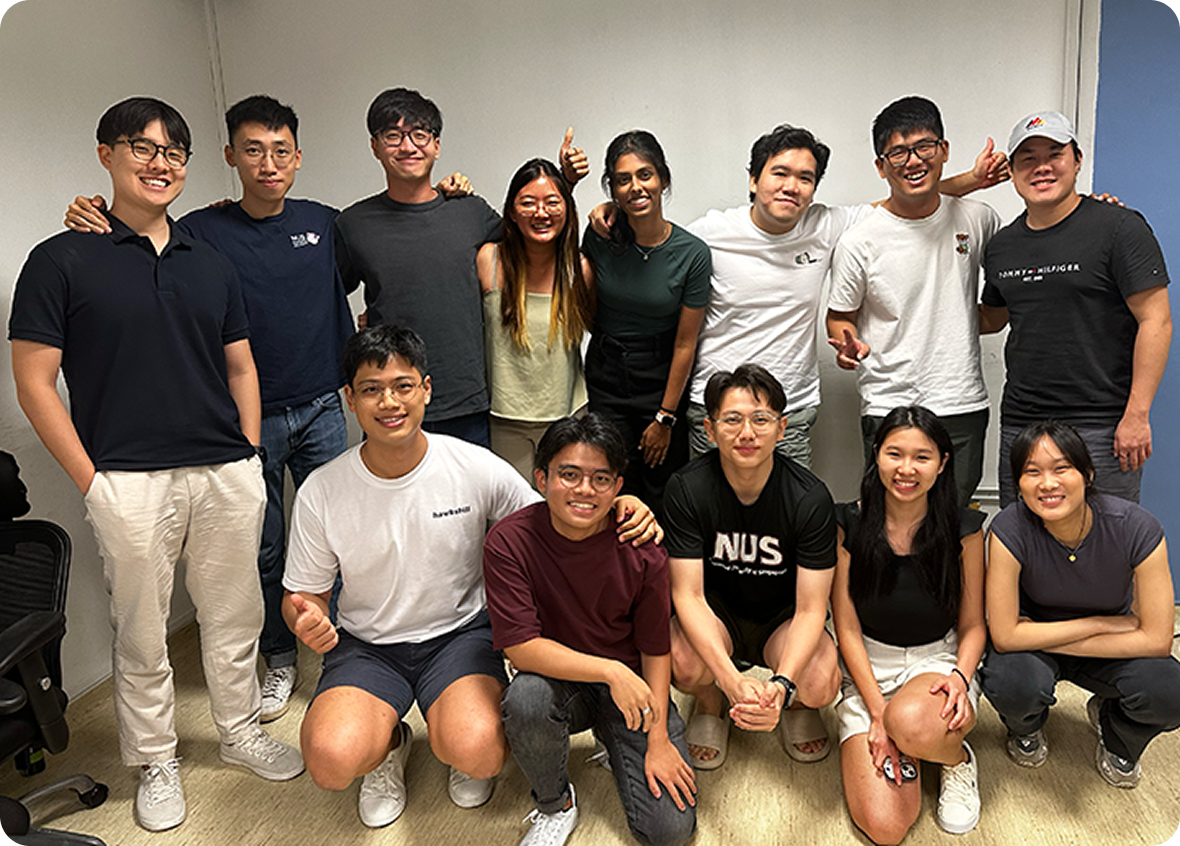
Sindhu (second row, fourth from right) and her team organised the final session of the N-House N-Acceler8 programme, which helped aspiring founders to bring their startup to the next level through mentorship by industry experts.
While Sindhu relished the experience of living on campus away from home, keeping her spot at Temasek Hall after her freshman year proved to be no easy task. By a stroke of serendipity, she met a Year 4 senior staying at ENterprise House (N-House) after her NOC stint and found out that N-House residency could also be granted to non-NOC graduates who qualified as start-up founders. She applied immediately.
Her time in N-House proved to be nothing short of life-changing. "From Year 2, I started living in N-House. The crowd I hung out with, mostly NOC alumni themselves, would later influence me to apply for NOC. There is a strong culture of collaboration and mentorship within N-House. It's always bustling with pitch events and networking sessions too. Until today, I still keep in touch with the folks from NOC, N-House, and Temasek Hall," she shares with fondness.
Dreaming bigger, living harder
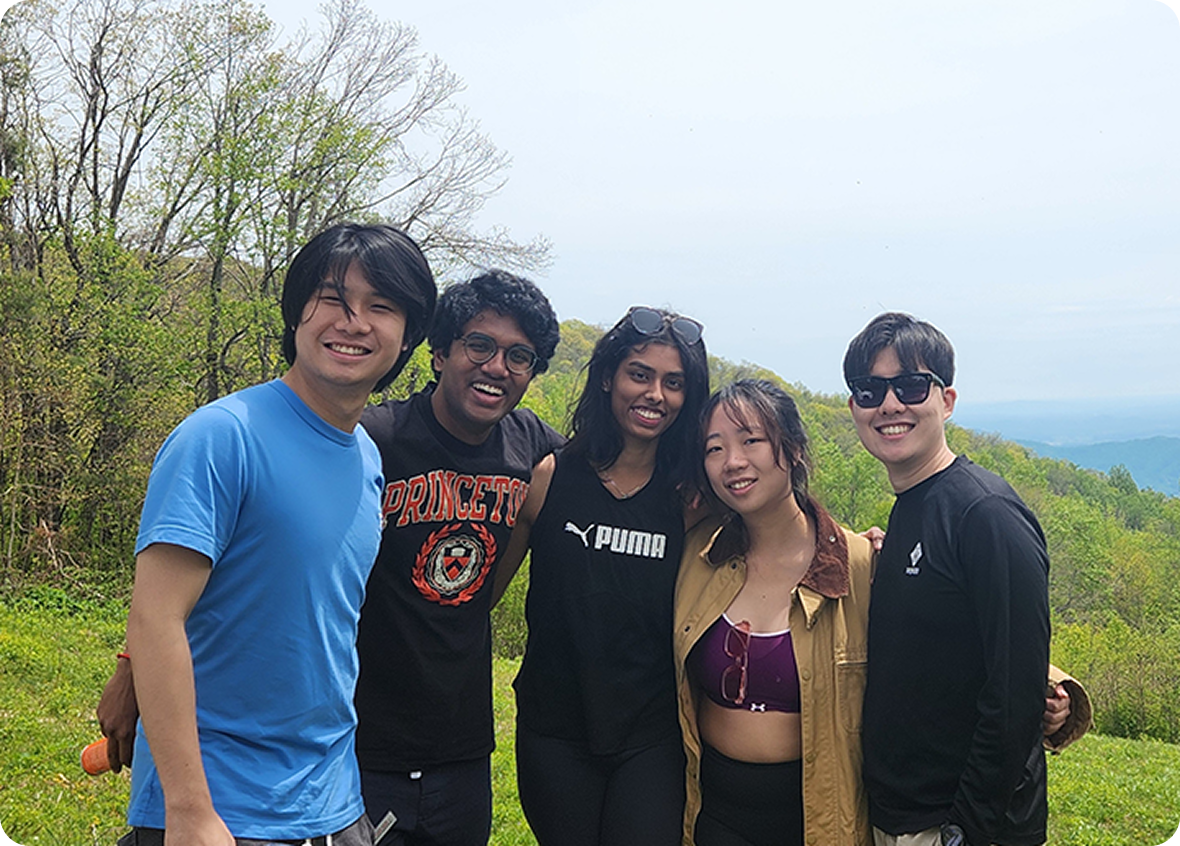
Sindhu (centre) with her NOC New York batchmates taking a celebratory photo at Shenandoah National Park in Virginia, on their first weekend road trip!
Sindhu's NOC New York stint was a game-changer as it was an eye-opening dive into the vibrant start-up culture in the heart of the Big Apple. New York has long been a capital of consumption – where new products, styles, and experiences constantly drive the city's rhythm – and this was perfect for Sindhu's passion for marketing. Spurred by the advice from NOC alumni, she was thankful she chose the one-year NOC programme over the six-month option.
Over the course of the programme, she threw herself into course projects, networking events and co-working spaces buzzing with founders. The project for an NOC course, TR4049: Seminars in Entrepreneurship - Lean Startup: Market Validation, was a crash course in real-world validation. "We literally accosted strangers on the streets of Manhattan for interviews to validate both the problem and our solution!" she laughs. Living among New Yorkers, she realised something powerful: "In Singapore, I felt different – like an outlier. But in New York, everyone was blazing trails and doing something different. It made me dream bigger. Their drive, their ideas, their energy – it's contagious."

Sindhu (third from left) with local start-up founders at the Google office in New York.
During NOC, she also cut her teeth on multiple hackathons, which became her sandbox for exploring entrepreneurial ideas. This included travelling across the Hudson River to compete in The College of New Jersey's hackathon, HackTCNJ. Sindhu's team won Best Design for HOBBI, a hobby marketplace app that was conceptualised during the NOC course TR3201N: Entrepreneurship Practicum. Then came The University of Pennsylvania's PennApps XXIV in Philadelphia– the world's original college hackathon– where her team clinched a prize for the Best Use of Aleo, a blockchain-based tool, which they employed to allow users to apply for financial aid. "Hackathons taught me how to perform under pressure," she reflects. "It's not just about building a prototype, it's about solving the right problem, pitching it well with the right hook and moving fast. I also overcame a self-imposed limitation – I can contribute to a coding project even if I can't code!"
Sindhu also met her future co-founder Vishnu Sundaresan, then an NUS Computer Science student, during NOC, where they lived together as housemates for a year. Though they started as close friends, their clashing personalities – his emotion versus her pragmatism – led to tension mid-year. But through conflict, she learned crucial soft skills of empathy and communication. "A co-founder can't be a yes-man," she concluded. Vishnu's ability to challenge Sindhu humbled her and helped her grow. "Beyond being an exceptional coder, he's hardworking, passionate, and thrives under pressure – qualities that shone during the 48-hour hackathons we tackled together," she adds, crediting him as the person who most impacted her during her NUS years. Their friendship became the precursor and foundation of a strong working partnership. "If you can survive a road trip with someone, you can probably build a start-up with them!" she laughs.
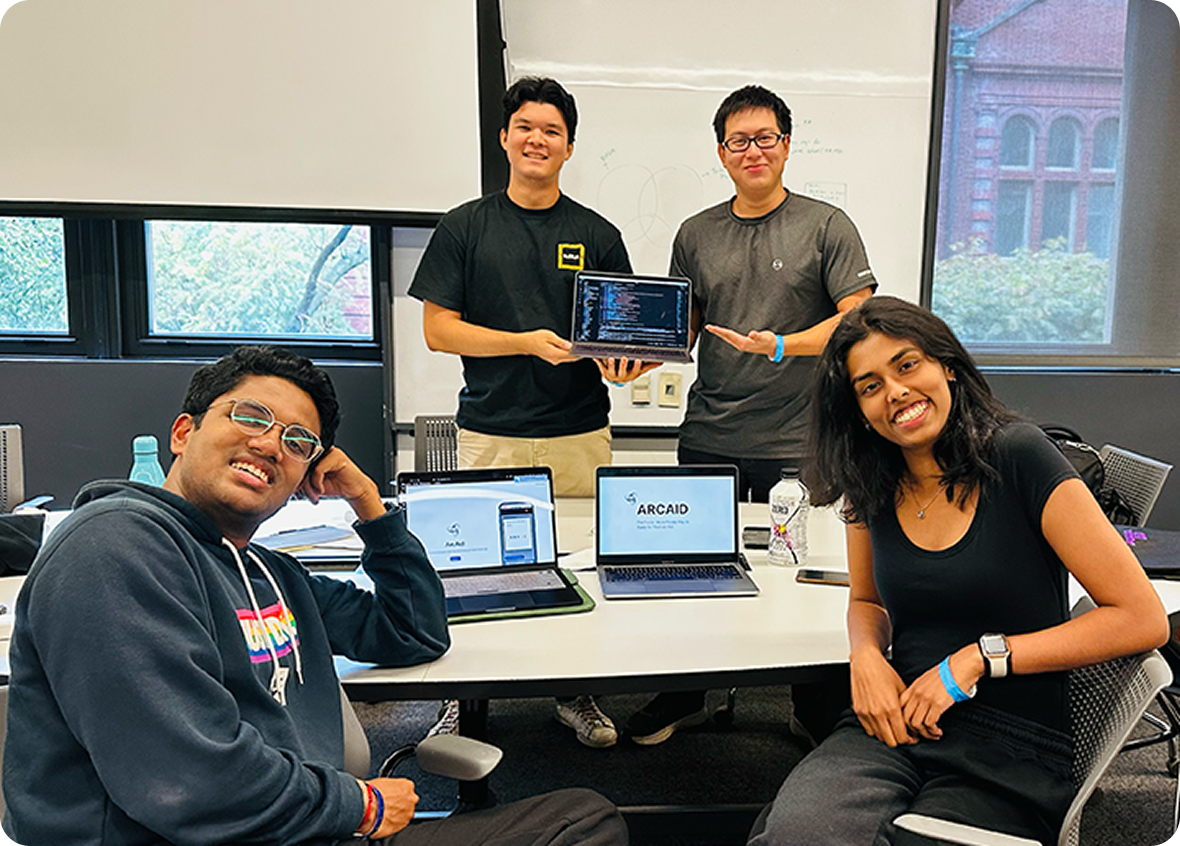
Sindhu, (first row, right) together with her co-founder Vishnu (first row, left), and their team mates competing at PennApps XXIV, the world's original college hackathon, where they clinched a prize.
Snowballing me-time
Their collaborative partnership also culminated in their current project – Snowball. Snowball began as a simple idea during Sindhu and Vishnu's NOC journey: how does one manage time meaningfully in a world full of distractions? What started as an Artificial Intelligence productivity assistant idea that was created for a project during the NOC course TR3201N: Entrepreneurship Practicum evolved into Snowball – a social networking app designed to help users log and celebrate personal "wins" like hobbies, habits and goals.
Unlike traditional social platforms, Snowball encourages users to get off their phones and engage in real-world activities, then log their progress to reflect and share. The app draws inspiration from Duolingo and Instagram but flips the script – its goal is to reduce screen time, not increase it. Snowball also delivers personalised insights that keep track of how a user is evolving, like "You read 23 per cent more than last month" or "You logged pickleball for the first time this month", motivating users to build better habits with their free time as well as create stronger self-awareness of how they actually use their time on themselves, not just their work hours. "In the rush of life, we tend to forget what we do outside of work. Logging onto Snowball helps curate that identity of who you really are based on what you do, for you. So, you can look back and understand more about what you have been doing or how you have been evolving." Sindhu elaborates, adding on, "I want people to go to bed feeling fulfilled, not drained from doom-scrolling!"
After returning to Singapore in 2024, the team secured a S$10,000 grant from the NUS Venture Initiation Programme (VIP) and soft-launched Snowball in April 2025. Since gaining over 100 beta users, they've moved their base from The Hangar by NUS Enterprise to The Furnace at NUS Computing, while remaining integrated in the start-up ecosystems of both programmes.
Reshaping identity
Today, the NUS alumna aspires to transform Snowball into more than just an app – to Sindhu, it's part of a mindfulness movement to redefine productivity, identity and joy outside of work. As she puts it, "You actually recharge when you do something for you, be it running, meditating or reading. Scrolling your feed to vicariously live through what others are doing in their lives, does not. Tennis resets me. TikTok doesn't."
As someone who walks the talk, Sindhu destresses by hanging out with friends for a meal or watching a film in the cinema. The nature lover also relaxes by hiking, walking and assisting her dad with gardening. Her new, enlightened philosophy? "My relationship with time is much healthier now. I used to get really stressed whenever I felt I was wasting time. But as I've learned more about productivity, I've come to see the value of taking breaks. By allowing myself to rest, I've put myself in a better position to be my best self."