Where law meets lore: Fighting for humanity in every realm
Mohamed Sarhan s/o Mohamed Ikhbar
Public Defender, Public Defender’s Office, Ministry of Law
Alumnus, NUS Faculty of Law
Of fictional narratives and real people
Mohamed Sarhan s/o Mohamed Ikhbar has always loved a good story,
particularly ones about underdogs or those which muse on what it
means to be human. Narratives like those in Spider-Man, Full Metal
Alchemist, Dungeons & Dragons (D&D) or Red Dead Redemption
are more than mere popular movies, anime or games to him; they
were powerful lessons about sacrifice, redemption and identity,
and shaped his emotional compass.
But somewhere between polytechnic and
NUS Law, he
realised these stories he loved weren’t just fiction. They were
real, and unfolding in courtrooms every day. “Every case is a
human story,” he empathises.
Now that he works in criminal law as a Public Defender, he
realises how tightly the media he consumed as a child is tied to
his work. “What I didn’t initially realise was how this love for
human stories, like being able to craft narratives in D&D as
the Dungeon Master, would connect so perfectly with my work in
criminal law, where every case involves real people with complex
circumstances and motivations.”
Fuelled by doubt, driven by purpose
Sarhan didn’t set out to become a Public Defender, but when he
first came across Temasek Polytechnic’s Diploma in Law &
Management at 16, something about it resonated deeply. “It just
felt right,” he recalls. “Even now, 13 years on, I can’t fully
explain it, but I’m glad I trusted that instinct.”
Looking back, Sarhan suspects his early brushes with unfairness
shaped his sense of justice. In secondary school, he found himself
punished for things he hadn’t done – experiences that left a mark.
“I realised how powerless it feels when no one listens,” he says.
“That stuck with me and made me want to be someone who
does listen.”
The day he decided to pursue law, a teacher told him he wasn’t cut
out for it. His grades weren’t the best then, but instead of
discouraging him, that moment crystallised his resolve. “It was a
turning point,” he says. “I knew I had to prove to myself most of
all that I could do it.”
He went on to excel in his O-Levels, earned a place at Temasek
Polytechnic, and eventually NUS Law. “Every doubt I’ve faced has
only made me work harder,” he says. “That’s how I approach my work
even today – with something to prove, and something to protect.”
From black and white, to shades of grey
NUS Law was transformative for the young law student. Sarhan
entered with a rigid black-and-white view of justice: if you break
the law, you face your punishment – end of story. He initially
aspired to be a Public Prosecutor, believing in strict
accountability, but as he progressed through law school, his
perspective evolved; criminal law began to stand out because it
took into account nuances and raw humanity. “It’s about real
people making real choices. What’s right or wrong isn’t always
clear,” he says. “It depends on someone’s motivations and
circumstances.” His lifelong curiosity about people and history
deepened his interest, even as criminal law courses helped him see
the law not as just a series of rules, but as reflections of
society.
Defining what justice means to him, Sarhan shares: “To me, it
means giving people a fair chance in court and ensuring they get
appropriate representation. This evolution made me realise I was
actually more suited to defence work. Some offenders have never
had anyone on their side. I realised I wanted to be the one
providing that crucial legal advocacy within our justice system,”
he shares.
At NUS Law, that initial interest grew into a firm passion for
criminal law. An introductory course,
LC1001: Criminal Law, laid the foundation, while
LL4067: Comparative Criminal Law
in his final year expanded his perspective across cultures. He
also loved
LL4044V: Mediation, which honed his oral and empathetic skills, and
LL4277V: Medical Law and Ethics
and
LL4318V: Public Health Law and Regulation
– subjects that cycled back to his early interest in science and
ethics. If given the choice of adding one class to his wishlist,
he would choose sentencing in criminal law: a practical area often
overlooked, but vital for aspiring criminal lawyers.
Being a voice for the voiceless
Throughout his time at Asia’s leading law school, Sarhan immersed
himself in the pro bono work and legal initiatives open to
students, serving as President of the
NUS Criminal Justice Club (CJC)
as well as interning with Pro Bono SG and private firms. His
involvement in the CJC’s
Legal Assistance Scheme for Capital Offences (LASCO)
and
The Recourse Initiative (TRI)
reinforced his conviction to stand for those facing the harshest
penalties, especially when assisting with appeals for capital and
post-conviction cases. A conversation with a death row inmate, who
had staunch faith that TRI could help him by reviewing his case
carefully, turned into a defining moment that helped him
crystallise his purpose. Sarhan reflects: “That conversation
showed me that a lawyer's job is to help others with competent
legal representation, ensuring everyone receives thorough
advocacy.”
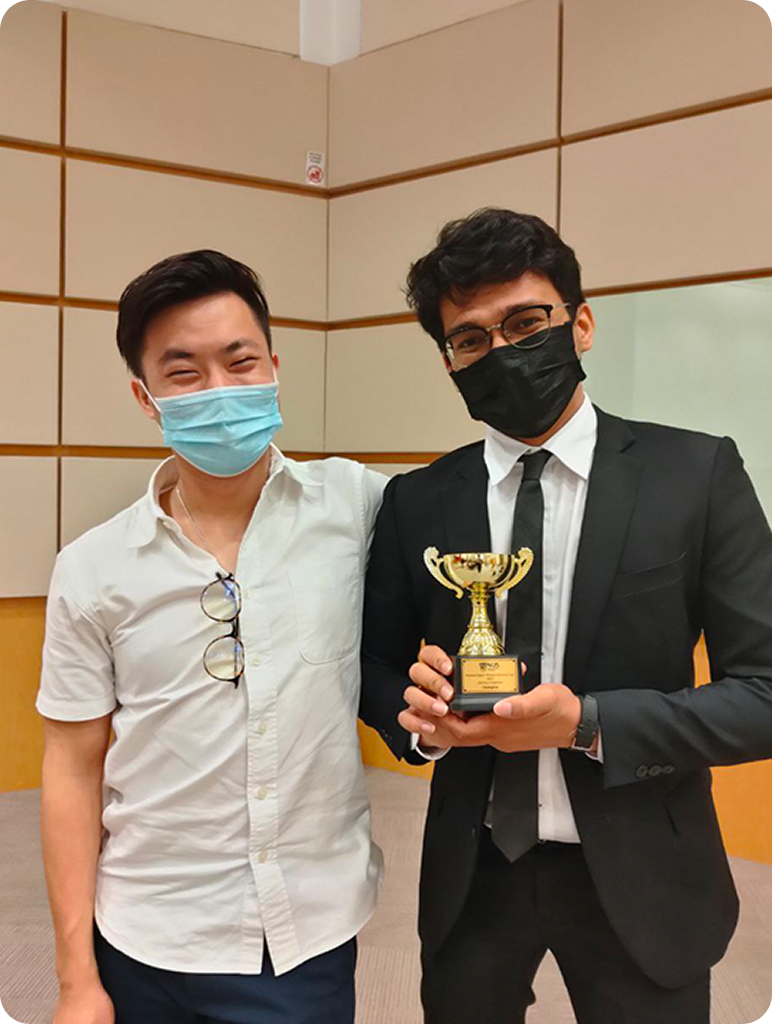
Sarhan (right) celebrates with Mitchell Leon, head of The
Recourse Initiative, after winning a criminal forensic advocacy
competition in 2022.
Today, the 29-year-old is a Public Defender with the Ministry of
Law’s Public Defender’s Office (PDO), part of its pioneering team
formed in 2022. In this role, he champions those facing criminal
charges who would otherwise go unrepresented. To Sarhan, access to
justice means making sure no one gets left behind in the
courtroom; he lives by the ethos that “justice isn’t just for
those who can afford it.” Many of his clients are overwhelmed,
unsure how to speak up or navigate the legal maze. That’s where he
steps in – translating legalese, building their case and making
sure their voices are heard when it matters most.

Sarhan (second from left) is grateful for the support of his
NUS law batchmates, who are now also his colleagues at the
Ministry of Law’s Public Defender’s Office.
Self-discovery: The hero’s journey
Sarhan credits NUS with shaping him into a better lawyer – and a
better person. While the intellectually rigorous and stimulating
environment in NUS Law challenged him, the strong support from
professors, alumni and student mentors as well as peers made all
the difference. “Be prepared to work hard but know that you are
not going through that journey alone. Your professors will be
happy to give you all the help you need, so don’t be afraid to
apply!” Study groups, shared notes and open conversations with his
coursemates also helped him thrive in the supportive community.
What surprised Sarhan most about studying law at NUS wasn’t just
the rigour, but also the personal reflection it demanded. Once
impatient and hard on himself, he learned to temper judgement with
empathy in others and in himself. When contemplating his personal
growth, he often returned to his favourite quote from the TV show
Doctor Who: “We all change when you think about it. We are all
different people all through our lives and that's okay – so long
as you remember all the people that you used to be.” Those words
remind him to be grateful for being in a kinder place while
looking back on his old self with compassion.
He expresses gratitude for many professors who guided him with
generosity, and cites Criminal Law Associate Professor Cheah Wui
Ling as the person who made the deepest impact on him. Spotting
his potential early on, she invited him to be her research
assistant. “Over three years, my research work with her allowed me
to hone my critical thinking skills while also further solidifying
my interest in criminal law and criminal history.”
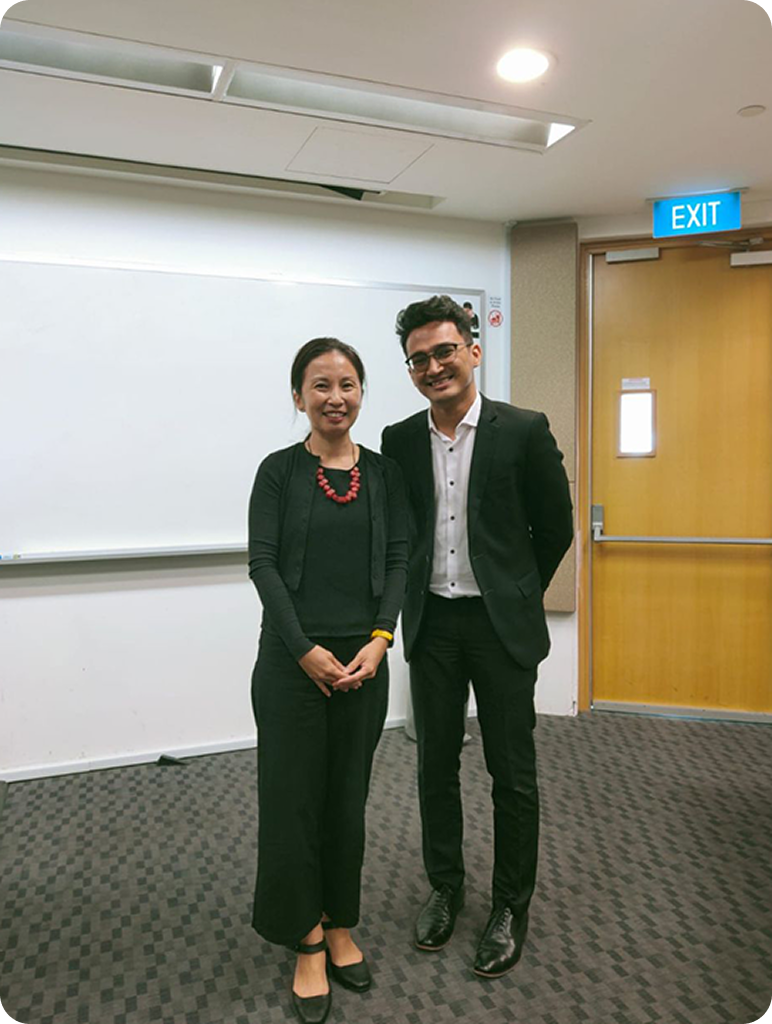
Sarhan (right) treasured his classes with Associate Professor
Cheah, who always believed in his potential.
Her teaching style — marked by thoughtful discussions of real-life cases and hypothetical scenarios, and an endless patience — awakened in Sarhan a genuine love for teaching. “She answered every question I had,” he recalls. “And if she didn’t know, she’d find out and tell me the next week.” Inspired by her example, Sarhan now pays it forward, mentoring PDO interns and sharing his experiences with NUS students as a Law alumnus. His advice? “Don’t rush. Find your own pace. Protect your mental wellness and schedule time off for recovery. You don’t have to chase every internship. Just enjoy your journey!”
The spirit, not the letter, of the law
One misconception Sarhan is keen to dispel is needing a perfect
memory to study law. “It’s not about memorisation,” he says. “It’s
about understanding and application. If you understand the law,
you’ll remember it.”
With great power comes great responsibility, and Sarhan hopes to
get the opportunity to shape the next generation by teaching
criminal law. He shares: “I’d like to be a mentor or teacher at
Temasek Polytechnic and eventually at NUS. My hope is that
students come to see that anyone can break the law, yet everyone
deserves guidance and support, no matter their offence.
Ultimately, I hope to be remembered as someone who tried his best
at every turn, and never hesitated to extend a hand.”