Shaping a cyber guardian, byte by byte
Justin Soh
Alumnus, NUS School of Computing, NUS Overseas Colleges
Sparking a passion
If you met Justin Soh Jun Hao today, you'd probably be surprised to find out that the hardworking NUS School of Computing (SoC) alumnus who specialised in Information Security is actually older than most of his fellow peers at 28.
Justin's early school days weren't exactly stellar. He spent more time on the basketball court than in the classroom until a teacher's dismissive comment about his grades in Secondary 2 lit a fire in him. Fuelled by this newfound motivation, he studied hard for his Physics and Chemistry tests – and topped the class. That moment of triumph ignited a love for the sciences and set him on the Direct-Entry-Scheme to Polytechnic Programme (DPP) to study cybersecurity, first in ITE and later at Nanyang Polytechnic.
But the road wasn't smooth. The cybersecurity course in ITE did not come with the benefit of skipping a year to move straight to Year 2 when he progressed to the polytechnic portion of the DPP. As such, this meant watching many of his DDP peers from other courses move on to Year 2 while he rebuilt his academic footing, starting from Year 1. "It was stressful to watch my social systems collapse then," he admits, "but in retrospect, I now realise I have accrued social capital: my friends from polytechnic and ITE who started working in the industry before me are the very same connections I tap on for help today. The security industry is small, and I met people from different walks of life at various events. That diversity became my strength."
Challenges ahead
Getting into NUS was a milestone – he was the first in his family to do so. While the school fees were a challenge, he was thankfully able to rely on financial aid like the NUS Higher Education Bursary and Quantedge Foundation to ease his burden. His message to students who took a non-traditional path? "It may take longer," he says, "but there are benefits you may not see right now. Trust yourself. Above all, finances should never be the barrier to your dreams."
Pursuing the NUS path, however, came with its own challenges. The more mature Computing freshman missed orientation and struggled to find friends. "Most of my NUS peers were younger than me, and my polytechnic friends were already working. It was an awkward space to exist in; I had no one to rely on."
His first semester ended with a CAP of 3.6, and a particularly brutal algorithm exam left him feeling defeated. "I was then one hour into the test, but only three-quarters through the first question. Another student had already successfully solved all the questions and submitted his paper by then. It was crushing."
To go far, go together
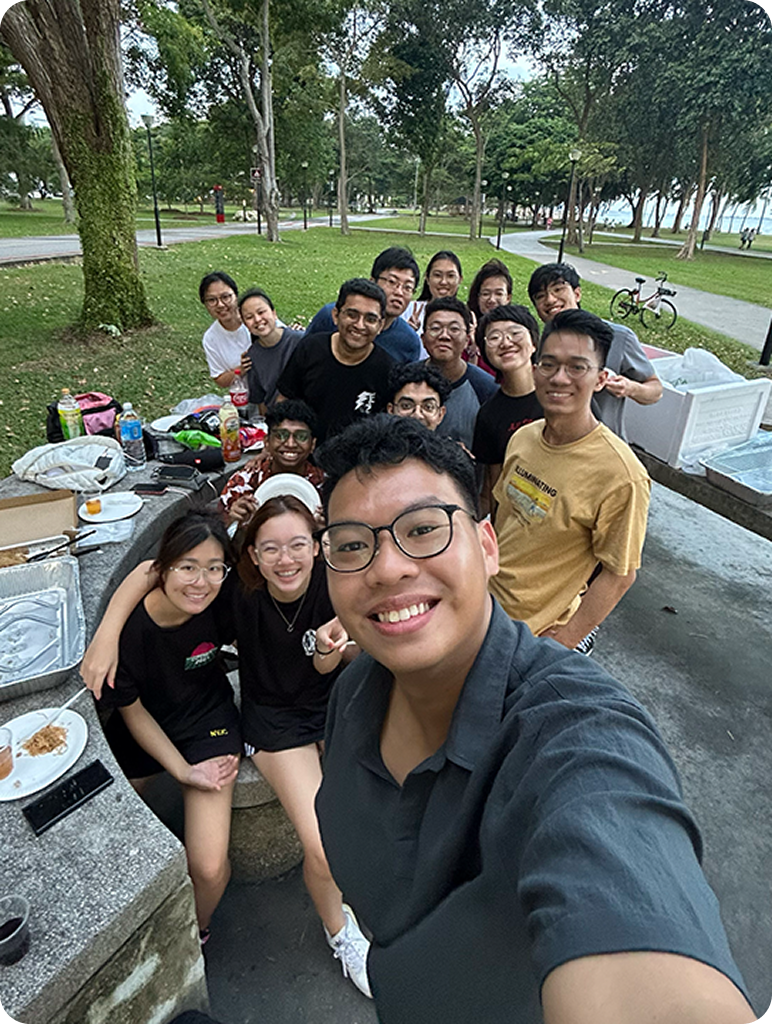
Justin (front) enjoying a barbeque party with the SoC Freshmen Finale Camp Organising Committee at East Coast Park.
But Justin didn't give up. Instead, he leaned into his strengths – the ability to connect with people and his relentless work ethic.
Justin rallied fellow cybersecurity students who were friends from his National Service days to form a study group – sharing notes, ideas, and support that helped them all grow and improve their grades together. Taking initiative, he also signed up to be the Programme Director of the SoC Freshmen Finale Camp, despite not knowing a single person on the committee. Through organising the camp, he not only helped fumbling freshmen find their footing, but built friendships with others and gained the confidence to navigate NUS socially.
Later, Justin joined NUS Dragon Boat, training five times a week while juggling school and internships. Although he was eventually forced to step away from training due to injuries, the experience taught him discipline and camaraderie. "My teammates supported me when I had no bandwidth – sharing notes, checking in and reminding me about work assignments. That's the kind of friendship that pulls me through and makes NUS special."

Justin (second from left) supporting his former NUS Dragon Boat teammates at the Singapore Dragonboat Festival 2024 Prime Minister's Cup.
He also learned the value of asking for help – a lesson that proved invaluable. He credits lecturers like Associate Professor Steven Halim (CS2040: Data Structures and Algorithms), whose simple card-sorting demonstration made complex algorithms clear, and CCAs like NUS Greyhats, which offered hands-on experiences on ethical hacking and cybersecurity throughout the semester.
By Year 2, things began to click for Justin with greater ease. And by Year 3, he was off to Paris on the highly sought-after NUS Overseas Colleges (NOC) programme.
Serendipity
Although keen to experience studying abroad, NOC Paris wasn't part of his original plan. One day over lunch, a friend who had been to NOC Silicon Valley, suggested he apply to NOC and pushed him to think bigger when it came to internships and career progression. "He shaped how I use my time. I started doing more, trying more."
Convinced by the pep talk, Justin applied, got in and found himself facing an even more daunting task. "Getting into NOC was the easy part, being accepted for [an] internship at a French firm is the tough part," he shares with a laugh. Taking advice from his aunt, a HR recruiter, Justin filmed 15 creative video CVs to land the all-important internship. "I knew I had to stand out. I couldn't speak French, so I made customised pitch videos explaining why I was a good fit, and sent these YouTube links to their LinkedIn accounts. Only three firms replied, but one of them was the CTO who gave me a shot."

Justin (left) with NOC and NUS Computing friends Gerald, Quc Duc and Shawn, travelling to Iceland during a break while on NOC Paris.
In Paris, Justin interned at YesWeHack, a tech start-up that connected ethical hackers with clients. "If the hacker succeeds, they get a payout. It was fascinating to see how cybersecurity could be monetised ethically," he marvels. As part of ETP3204S: Innovation and Enterprise Internship Practicum, an NOC course at PSL, Justin's team pitched an eatery recommendation app for their Final Presentation and earned the Best New Venture Team Award. This experience taught Justin a valuable lesson in entrepreneurship: "A good idea isn't enough. You need a solid business model."
Community, chicken rice and coffee
Justin describes SoC as engaging and supportive – especially if you're willing to ask for help. "Don't be stubborn. Theory isn't my forte, but once I started asking for help, things got easier."
He loved CS2101: Effective Communication for Computing Professionals, a public speaking module tailored for SoC students. "It was refreshing; interactive, like a business school class." Not every module was a hit; he found Descriptive Mathematics baffling but ultimately rewarding – when he finally grasped the subject. And if you think computing students are all introverted coders? Justin's here to bust that myth. "Correction: we're not just keyboard warriors. We're creative, collaborative and fun folks," he reassures with a grin.
Outside of academics, Justin is known for his light-hearted nature and love for coffee. What started out as casual coffee runs with colleagues from ByteDance turned into a hobby–tasting nutty notes, exploring robust blends and geeking out over machines at his friend's place.
Ask Justin what he'll miss most about NUS, and he'll say the chicken rice stall at SOC's canteen, The Terrace@COM3. "It's my favourite hangout. I love working next door at COM1 and bumping into friends." He also appreciates having Wednesday afternoons off, thanks to NUSOne, which gave him time to rest, intern and reflect. "Use that time wisely," he advises incoming students. "Try something new, meet people or just recharge."
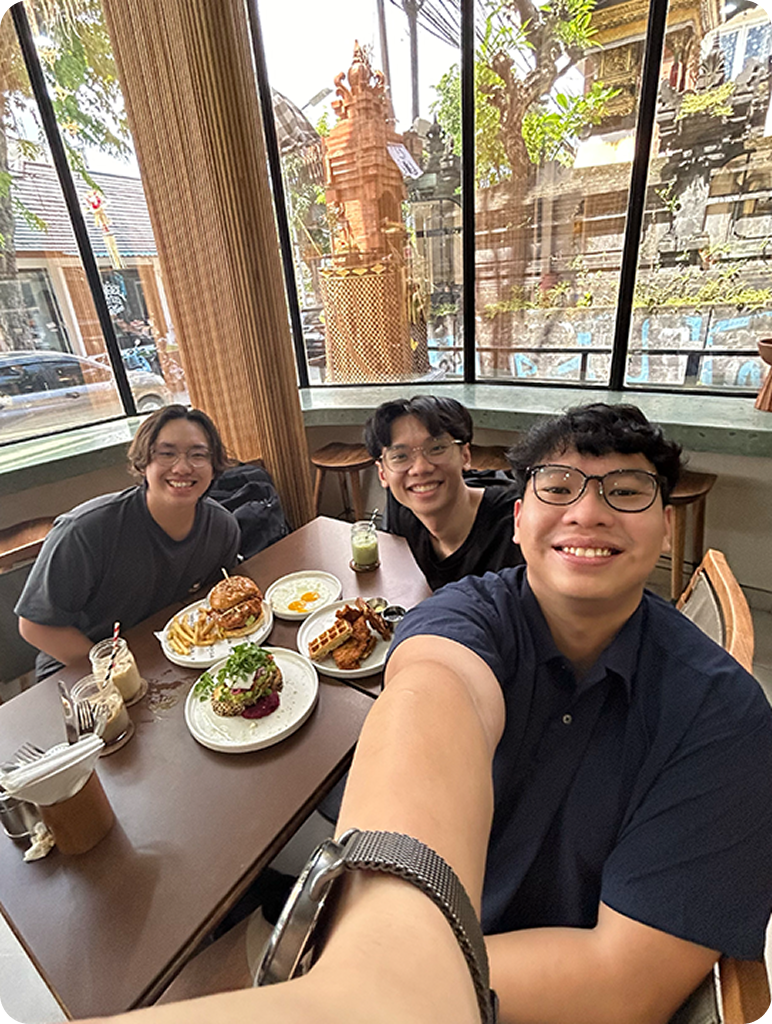
Justin (right) with SoC study buddies Joshua and Vernon on their graduation trip to Bali.
Shaping the future – one hack at a time
Now interning at ByteDance, Justin is immersed in a fast-paced, high-stakes environment. "Even my grandma is on TikTok," he jokes, "so the influence of the company is massive." What drew him to ByteDance wasn't just the brand – it was the culture. "They live by the mantra 'Always Day One'," he says, referring to the philosophy popularised by Amazon founder Jeff Bezos in which companies strive to operate with the nimbleness, agility and innovative spirit of a start-up regardless of how large they've grown. "You have to be agile to thrive in that VUCA [volatility, uncertainty, complexity and ambiguity] landscape."
AI, he believes, is both a tool and a test. "It's definitely necessary in my line of work. The good thing is it frees up your time to do the important stuff. The scary part? You have got to be good at doing the important stuff." That is why Justin is now focused on upskilling, particularly in the field of AI security, aiming to improve his capabilities in guarding against threats such as AI jailbreaking, where hackers exploit vulnerabilities in AI systems. "Securing AI models is the future."
Shaping the future of cybersecurity isn't just about patching vulnerabilities – it's about staying one step ahead in a world that's constantly evolving. "I test and find holes, and patch them before other people find them," he says with a grin. But behind that simplicity lies a deep commitment to ethical tech, digital trust and the human side of information security. He wants to solve impact-driven problems, especially for disadvantaged communities. With his internship turning into a full-time position in February 2026, Justin is excited to grow at ByteDance, deepening his expertise and eventually leading projects that protect people from digital threats.