From campus to cosmos: Trailblazing to the stars
Tristan Voon
Year 4, NUS College of Design and Engineering
Dreams of flight
For Tristan Voon, a Year 4 NUS Mechanical Engineering student and Phillip Yeo Innovation Fellow, his fascination with flight began early. His father worked for Singapore Airlines and was able to take young Tristan on free flights thanks to the perks of the job. Tristan would often snag a window seat just to watch the wing surfaces move. “I think I enjoyed flying as much as the destination,” he laughs. That love for the skies led him to Singapore Polytechnic, where he studied Aeronautical Engineering and built one of the only supersonic wind tunnels in the country – accelerating air to Mach 1.4 (1.4 times the speed of sound), faster than a commercial airliner.
But Tristan’s engineering journey didn’t start in a lab. At 14, he was already experimenting at home with household appliances and materials after reading about metal enrichment and trying out basic electrochemical reactions on his own. “It smelled awful,” he admits, “but I did make a chemical.” As an only child adept at self-entertainment, that same curiosity saw him dismantling electrical equipment (and occasionally blowing them up) – all in the name of learning.
Satellites, missiles and stealth fighters
While most teens were into sci-fi, Tristan was watching news headlines about anti-ballistic missiles and stealth technology, and wondering: How do you take down a missile? His own curious nature aside, he also credits his secondary school Physics teacher and Math tutor for nurturing his passion. While preparing for the Junior Olympiad, his Physics teacher introduced the space geek to advanced concepts such as quantum state transitions and fluid dynamics. His Math tutor even gifted him a university-level flight dynamics textbook at 16, a gesture that Tristan calls “life-changing.”
Tristan’s first real exposure to the aerospace industry when he was a student came in 2019, via the Global Space Technology Convention & Exhibition held in Singapore, where his team signed up for the Singapore Space Challenge to design satellites for orbital debris cleanup and humanitarian disaster response. “I used to think I’d have to leave Singapore to pursue aerospace,” Tristan says. “But we actually have a thriving deep tech ecosystem here.” Tristan believes Singapore punches above its weight in the deep tech sector, and he’s determined to be part of that movement.
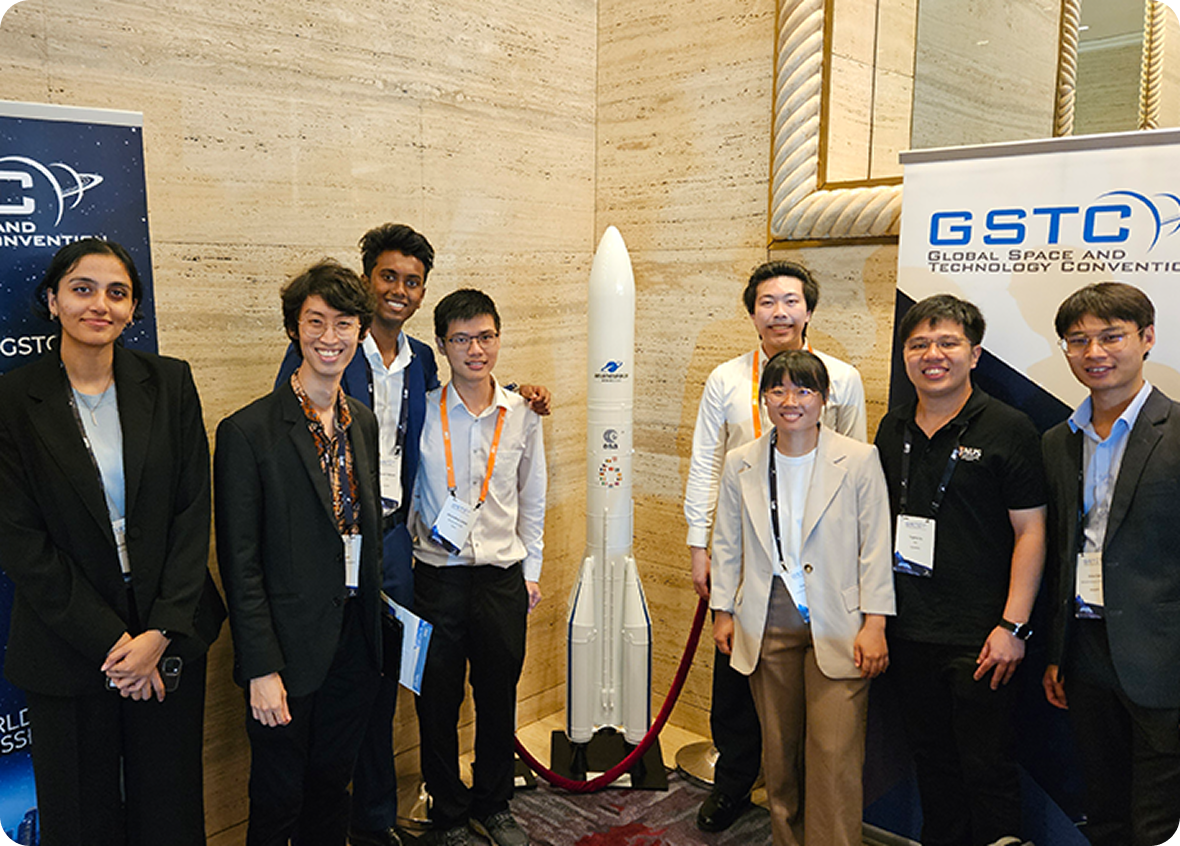
Tristan (second from left) with Mr Eugene Ee (second from right) and NUS’ Team Galassia at the Global Space Technology Convention & Exhibition in 2024 in Singapore.
From sketch to space: Origins of the Galassia-5 mission
Tristan’s decision to pursue his studies at NUS was guided by more than just rankings alone. While waiting for his National Service posting, Tristan embarked on a year-long internship at the National Research Foundation’s research and innovation hub CREATE, housed at NUS University Town. He’d already explored the campus, peeked into labs and seen satellite facilities up close. “I knew what NUS could offer!” he says.
Transitioning from polytechnic to the College of Design and Engineering (CDE) at NUS wasn’t a breeze. “The pace is faster, and you’re surrounded by top performers,” Tristan recalls. But he leaned into his strengths: practical skills like computer-aided design and hands-on problem solving. His advice to polytechnic graduates? “Play to your strengths. Use your project experience to unlock doors.” He also urges students to build a support network early, “Singapore’s culture is competitive. It’s not just about time management, it’s about your mindset. You need to shift from having the fear of missing out to focusing on what truly matters. That’s your North Star.”
At NUS, Tristan also optimises his commitments: By integrating his courses – making sure that an area in one course supports another area in a different course – as well as overlapping project teams and merging social circles with work groups. “It’s like building an ecosystem with the economies of scale,” he explains. “Everything feeds into everything else.”
In Year 1, he had a wild idea: send something into space before graduation. That dream led him to CDE’s Engineering Design Innovation Centre (EDIC), where he spearheaded the project as the student lead for the design and development of the Galassia-5 cube satellite, together with nine passionate peers. “First, you need a mission,” Tristan explains. “Then you sketch out what components the satellite should have: an AI processor, camera, radio, etc. If you don’t have the parts, you design, manufacture or buy them. Then comes assembly, integration, environmental qualification and finally, delivery to the people who can launch it to space.”
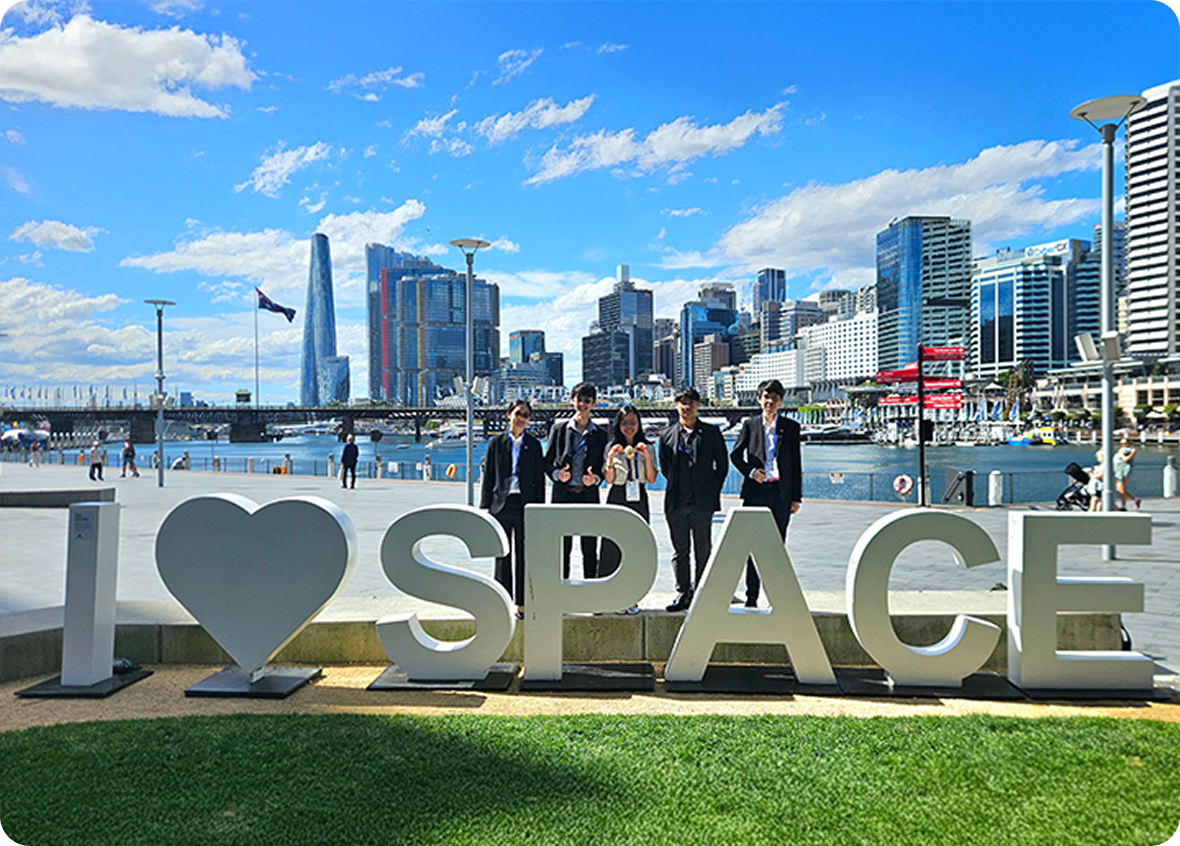
Tristan (second from left) with Galassia-5 teammates Grace Ng, Victor Soh, David Woodside, and Jacinth Lau at the International Astronautical Congress in Sydney.
Curiosity, communication and the right questions
CDE’s EDIC is home to the Innovation & Design Programme (iDP), which trains undergraduates hailing from different disciplines to use their knowledge and skills to design new and innovative products. “It was the launchpad for our satellite mission,” he shares. “It’s one of the few ways for students to get hands-on experience building and launching a satellite.”
Working across disciplines wasn’t always smooth sailing. “Communication is key, and the biggest challenge,” Tristan admits. “You have to explain your expertise in a way others can understand. For example, boosting our AI coprocessor’s computing power creates heat, which in turn gives the mechanical team headaches as they may have to adjust their thermal control hardware to keep the cube satellite at a stable operational temperature.” He credits patience and genuine curiosity to learn about other people’s responsibilities as the secret to successful interdisciplinary collaboration.
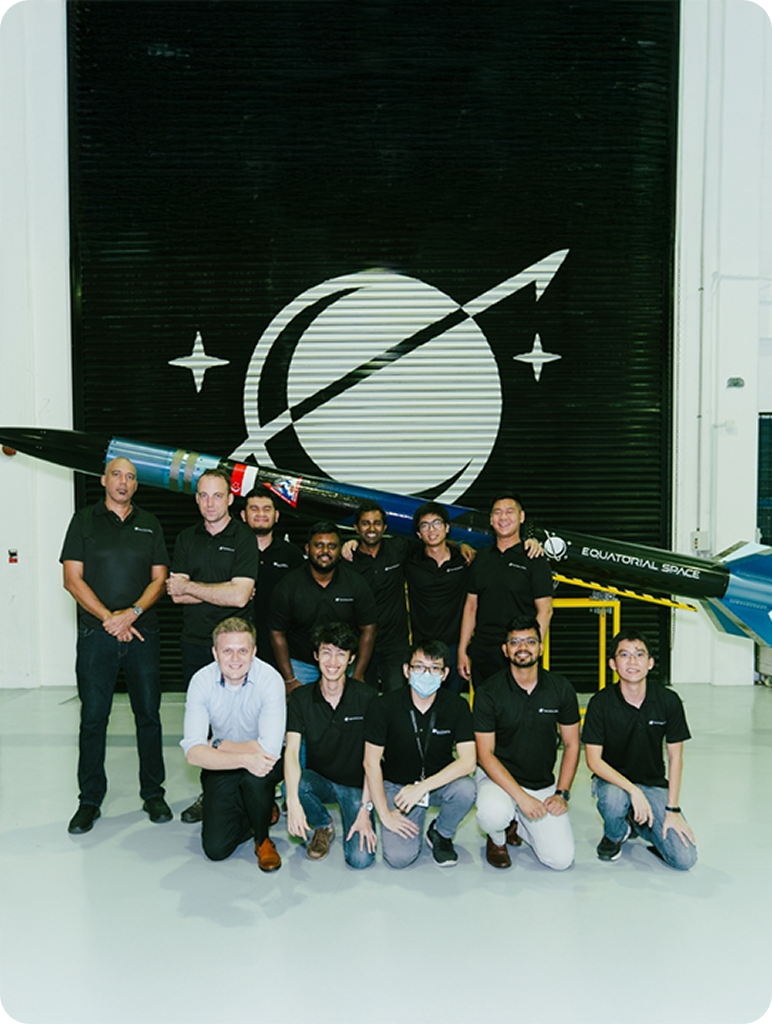
Tristan (first row, second from left) interned for more than a year as a Junior Engineer at Equatorial Space Systems, Singapore's first and only rocket company.
Tristan’s advice to future CDE students? “Figure out what you want to achieve in your three to four years here and find your crowd. Whether it’s academics, projects or extracurriculars, excellence is possible in all paths.”
CDE thrives on curiosity, says Tristan: “Rote memorisation doesn’t work here. You’ll need to ask the right questions; sometimes that’s more important than finding the right answer.”
Mentors, project management and jet-skiing in Miami
Ask Tristan who shaped him most at NUS, and he’ll say EDIC Instructor Mr Eugene Ee, his project supervisor and mentor. “He’s more than an instructor; he’s always there to guide and support us without micromanaging.” Eugene taught Tristan the power of ground-level leadership: advocate for your team, build rapport and take care of your people.
That ethos now drives Tristan’s project management approach, bringing talented individuals together in synergy. “Increasingly, I find joy in teamwork and managing projects; getting brilliant minds to collaborate and create something bigger than themselves and delivering a functioning prototype is the best feeling.”
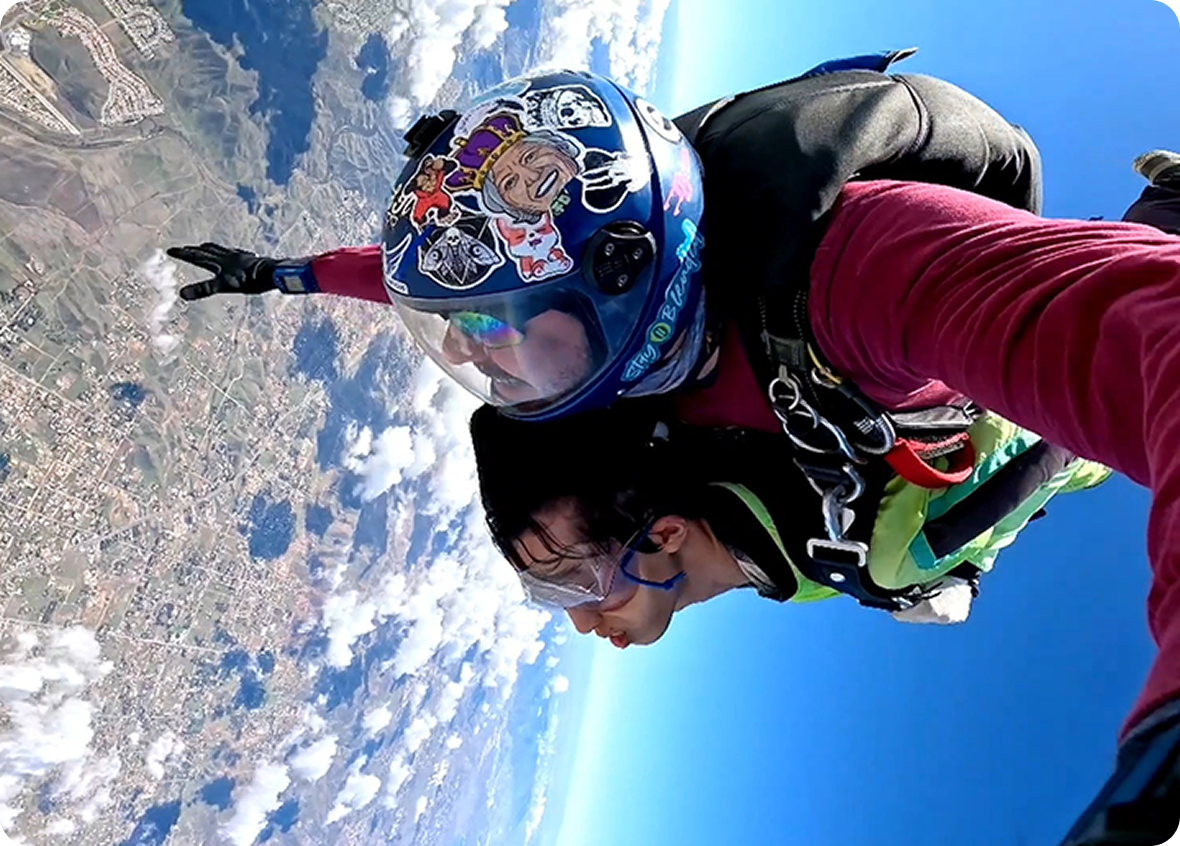
Tristan (bottom) skydiving over Los Angeles during his Student Exchange Programme!
Overseas on the NUS Student Exchange Programme (SEP) in Los Angeles (LA), Tristan’s life was a whirlwind of learning and adventure. On school days, Tristan completed Engineering courses in Fluid Dynamics, Control Systems, Dynamics, and AI at the University of Southern California. On the flip side, he also travelled to Washington, D.C. for the SATELLITE 2025 conference and exhibition, where he met a former NASA administrator and even flew a small four-seater plane over the California mountain range. “The turbulence was wild,” he laughs. Outside of school and networking, Tristan also visited the California Science Center, went skydiving in LA and even jet-skiing in Miami. “It was a blast, and I came back a decent self-taught cook too. I’ve picked up red wine steak, beer chicken stew… and a drive to elevate every dish once I have mastered the basics!”
On the map, and out to space!
As Singapore’s National Point of Contact for the Space Generation Advisory Council (SGAC) since 2024, Tristan helps young talent access industry opportunities, as well as drive awareness and interest in the local space ecosystem. “We’re a small island nation, but we have a thriving space sector,” he says.
Even as graduation is coming up at the end of 2026 for Tristan, the Galassia-5 team is also gearing up for their next big review, the Critical Design Review (CDR), where programme partners will review their hardware prototype. “We’ve started work on designing the communications subsystem, and the mechanical team will start production on the main satellite frame structure soon. After this review, we’ll have a pretty good indication of how the hardware that is flying up to space would look like, as well as a sense of how it would perform.”
Launching a childhood dream to orbit
If the stars align, Tristan’s childhood dreams may come true soon, as Galassia-5 is slated to launch in early 2027. The upcoming launch will also mark Singapore's first satellite mission to feature Edge AI technology in Space, using onboard AI algorithms for object detection.
“The launch of Galassia-5 into space will be the fulfilment of my childhood dream,” the engineer and space aficionado smiles. “It’ll also hopefully give confidence for our ecosystem to adopt edge AI and other innovations in the future.”