An unwavering commitment to saving lives and scoring goals
Muhammad Haziq bin Abdul Wahab
Year 5, NUS Yong Loo Lin School of Medicine
If at first you don’t succeed, try, try again
At 27, Muhammad Haziq bin Abdul Wahab is in his fifth year of NUS Medicine and a little older than many of his classmates. His journey wasn’t linear – he applied to NUS Medicine four times over four years before succeeding. When he was a Year 2 Pharmacy student at NUS, the offer letter from NUS Medicine came, and he planned a dramatic reveal to his parents: “I finally dropped the news an hour after receiving the letter, my parents were speechless and my mum teared up. So did I!” he recalls.
Although his time in NUS Pharmacy gave him a deep appreciation for allied health professionals, he felt compelled to keep applying to Medicine. When asked why he kept trying, Haziq shares: “I kept telling myself, if I don’t try, the answer will always be no.” His resilience and determination were also anchored by a strong attraction to the field: to him, it’s the perfect blend of science, critical thinking and human connection. He remembers how his family always returned to the same doctor: someone who knew their history, their struggles, their growth. “That is the kind of heartwarming bond I hope to build with my future patients, their children and even their children’s children,” he reflects.
From curiosity to calling
Growing up, Haziq was the kind of kid who couldn’t look away from a documentary. While his siblings were glued to cartoons, he was captivated by Animal Planet, MythBusters and How Stuff Works. The nature of life fascinated him, especially biology. It was the one science that truly clicked, sparking a quiet but persistent interest that would eventually lead him to Medicine.
Physics and Chemistry? Tougher terrain. But Haziq pulled through, driven by a deeper curiosity about how things worked. It wasn’t until junior college that the idea of pursuing Medicine began to crystallise. “Outreach roadshows came to my school, and my teachers nudged me toward the Medicine booth,” he recalls.
The doctors he spoke to told him something that stuck: if you’re genuinely interested in Medicine, studying it becomes easier. It’s not just about grades, it’s about heart. “As an outgoing people person, it’s very rewarding for me to help people. Medicine becomes a way for me to be a pillar of support to others, to think fast and deep, and to make a real difference,” he shares.
Lessons from the field
Sports taught Haziq just as many lessons as science did. Haziq’s love of floorball began at just nine, thanks to his older brother, who also played the sport. “[When I started] I was just playing for fun, but the adrenaline from competitions made me fall in love with sports.”
By secondary school, the rigorous training pushed him to grow in his skills and mental strength – he began competing fiercely and eventually represented Singapore in the Floorball League and Men’s National Team. “After so many years, it’s just part of my daily rhythm. The passion grew as I grew.”
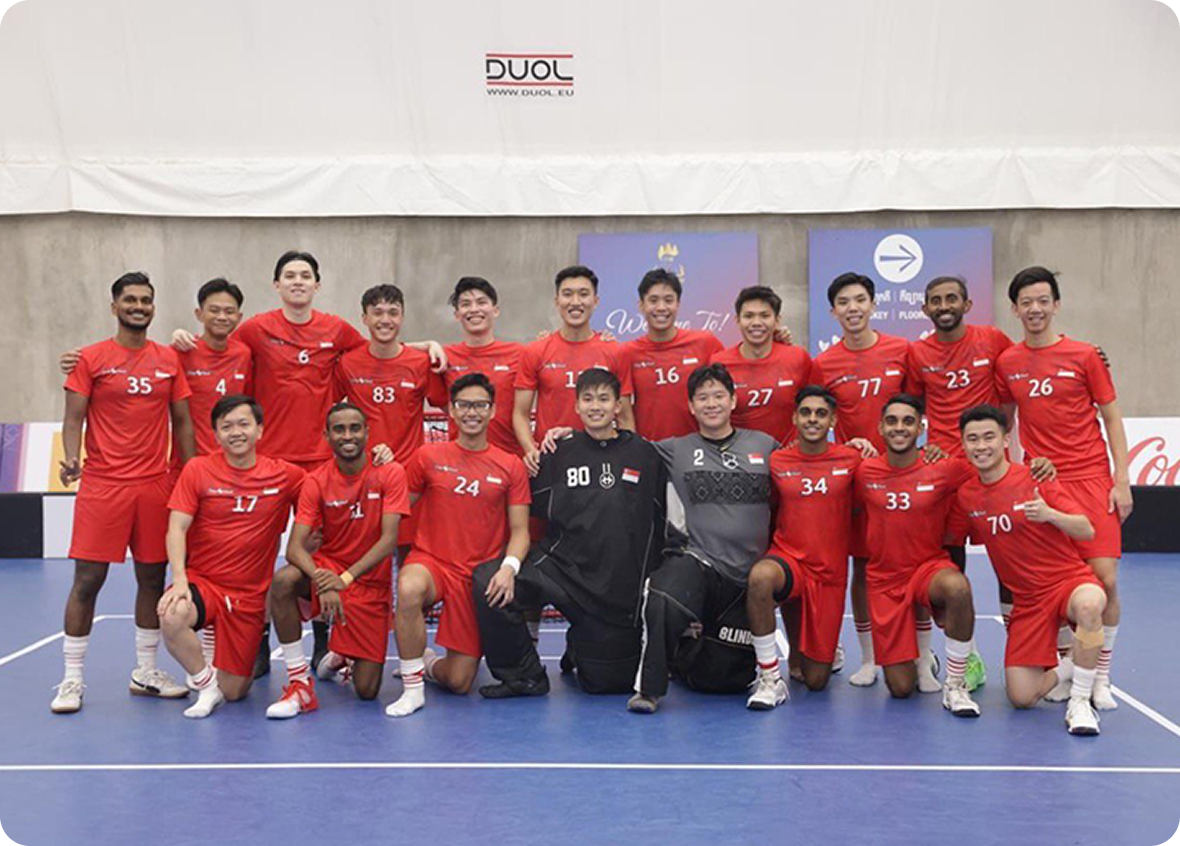
Haziq (kneeling, third from left) and the rest of the Singapore Men’s Floorball Team at the 2023 SEA Games in Cambodia, where they won a bronze medal.
His secondary school coach, Mr Amir, left a lasting mark. “He told us, ‘First be a son, a brother, a student — then an athlete.’ That stuck with me. If you can’t be a good son, everything else crumbles.” As the youngest of five siblings, now the only one at home, Haziq carries that wisdom close to heart.
The fine art of balance
Haziq sees clear parallels between sports and Medicine. “Sports are fun, but competition is next-level stress. You learn resilience: how to function even when things aren’t going your way.” His sanguine advice? “When I feel flustered, I accept it. Take a breath, step back, control what I can and forget what I can’t.” This measured outlook has often come in handy at NUS Medicine. For instance, when confronted with having to diagnose patients for the first time during a hospital posting, he quickly learned how to cope with the initial panic, and think clearly and calmly.
Balancing sports and studies wasn’t always easy. Seasons clashed, deadlines loomed and exhaustion crept in. But Haziq found his rhythm and learned how to handle the wax and wane of his competition seasons and examination periods. His golden rule? “Sleep and eat well, no matter how tired you are. A minimal six to seven hours of sleep is a must.”
Haziq also unwinds by engaging in hobbies that range from photography and board games to binge-watching cooking shows. “I love Gordon Ramsay’s Kitchen Nightmares and MasterChef. Cooking is intricate, and the end product is so satisfying.” He’s a foodie with dreams of exploring Southeast Asia’s culinary gems in Vietnam, Thailand and the Philippines next.
Finding his passion in practice
Now in Year 5, Haziq gravitates toward specialising in surgery. “I love working with my hands, performing procedures and being in the thick of action. Hand surgery, orthopaedics and obstetrics and gynaecology are top contenders, especially after stellar postings with inspiring mentors like Dr Arundhati Gosavi and Dr Abhiram Kanneganti, from NUH’s Department of Obstetrics & Gynaecology, Assistant Professor Andre Cheah from NUH’s Department of Hand & Reconstructive Microsurgery, and Adjunct Assistant Professor Remesh Kunnasegaran from Tan Tock Seng Hospital’s Department of Orthopaedic Surgery,” he explains. These experiences made him want to learn more, teach more and dive deeper.
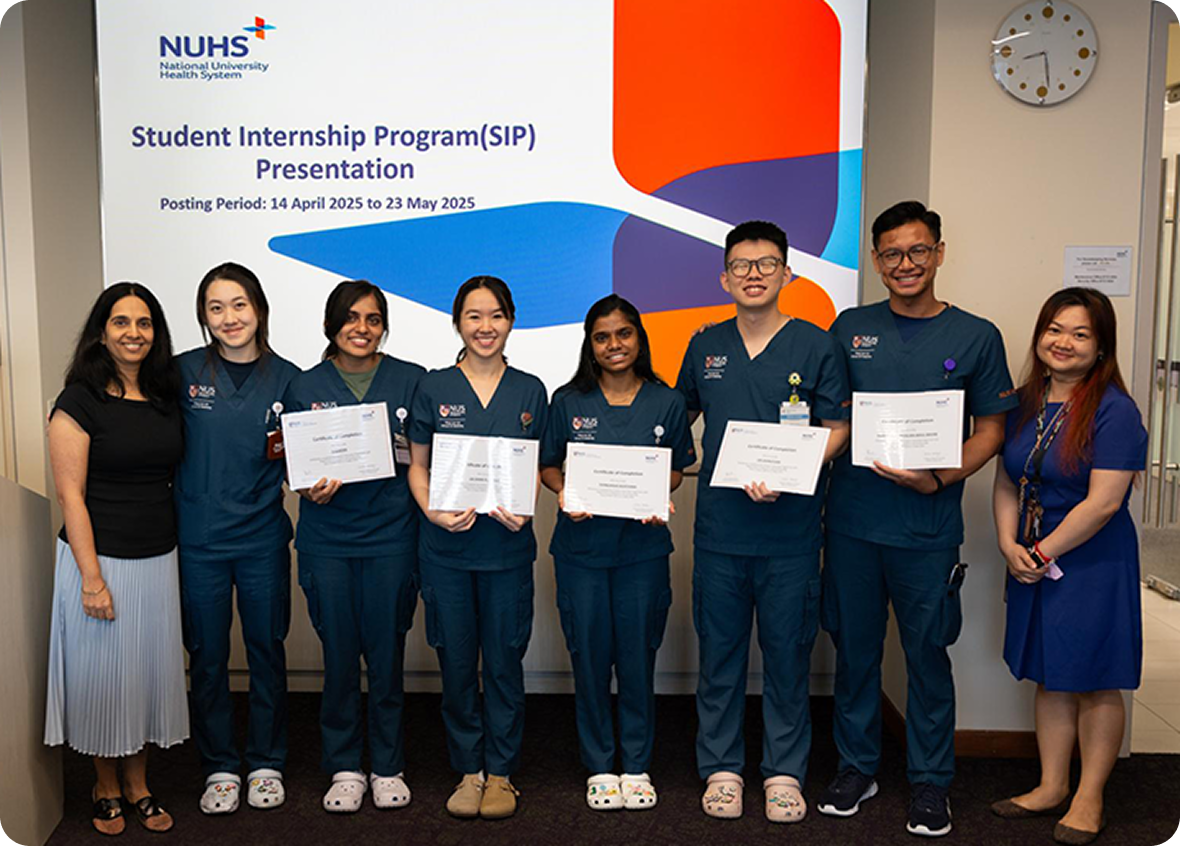
Haziq (second from right) and fellow NUS Medicine classmates with Dr Arundhati (extreme left) at the Student Internship Program Presentation, which came at the end of their clinical posting with NUH’s Department of Obstetrics & Gynaecology.
Learning beyond the lecture hall
Haziq credits NUS Medicine’s unique curriculum offerings for expanding his perspectives and honing his skillset. Classes like the Silent Mentor programme, offered by NUS Medicine’s Department of Anatomy, were invaluable to him. During the programme, students were taught to treat body donors or ‘silent mentors’ with the utmost respect. They also organised a yearly appreciation ceremony to show their gratitude to these silent mentors, who have imparted critical anatomical knowledge.
He also relished his experiences with the Common Curriculum for Health Professional Education, where students across NUS Medicine, Nursing, Dentistry, Pharmacy and the Saw Swee Hock School of Public Health take interdisciplinary classes together to enhance their interprofessional knowledge and collaborative skills. He particularly enjoyed the common curriculum’s Longitudinal Patient Experience class, where students carried out house visits to see and diagnose patients in a holistic manner. “These courses taught me to speak up, collaborate across disciplines and think critically,” he elaborates. Haziq also hopes to bridge gaps in Singapore’s healthcare system. “Each field has its own identity, but we’re all working toward the same goal. I want to promote better interdisciplinary teamwork – doctors, nurses, pharmacists, physios – we need to understand each other.”
Haziq was grateful that he managed to explore one of his hobbies, photography, through a Year 3 elective where Medicine students were free to design a course related to any topic of interest. Taking advantage of this flexibility, he and a few friends who shared an interest in photography decided to plan a self-directed photography course in Japan, ultimately travelling across Tokyo, Kyoto and Osaka. They found a private instructor, submitted portfolios and received critical feedback that helped them hone their skills. It was both a creative escape and a reminder that learning can happen anywhere.
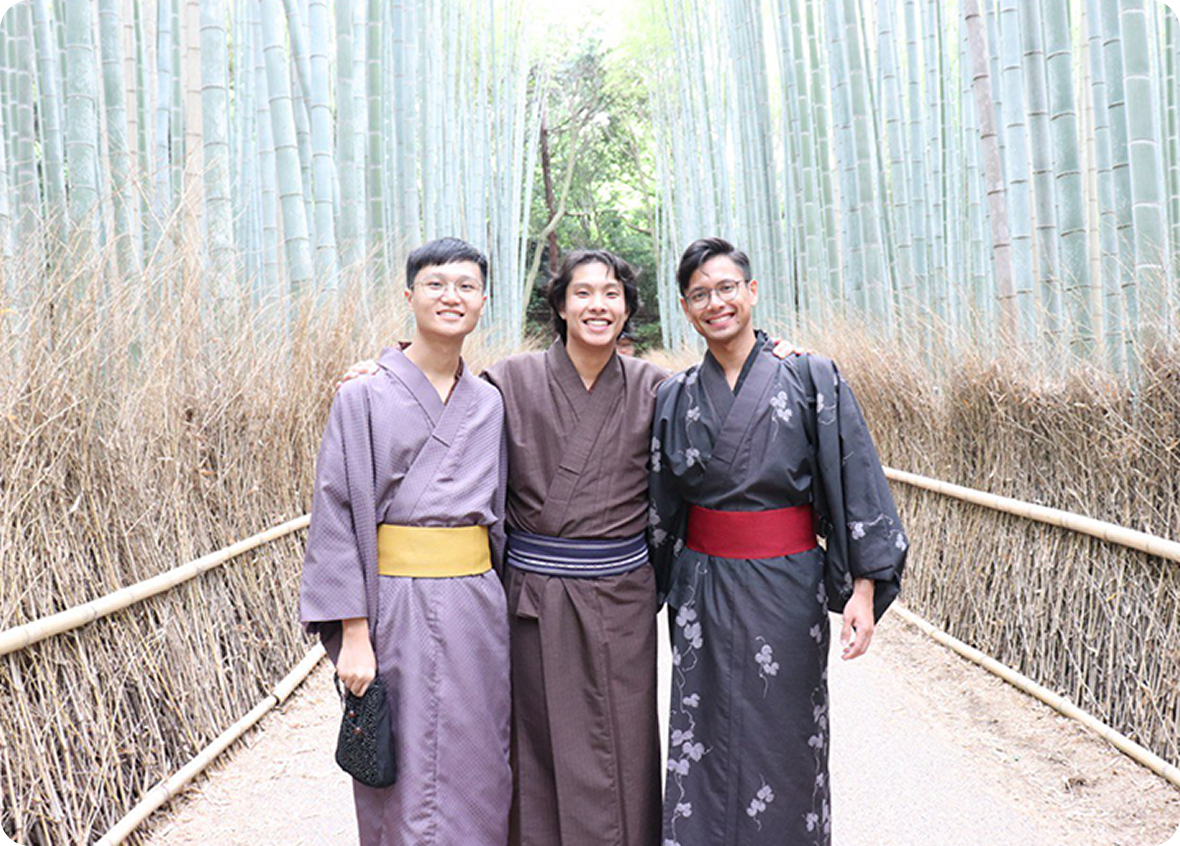
Haziq (right) enjoyed exploring Kyoto’s Arashimaya Bamboo Forest with fellow Medicine batchmates Ng Yayoi (left) and Wellington Wu (centre), all while practising their photography skills.
Of collaboration and camaraderie
When asked what people don’t know about doctors, Haziq pauses. “We actually have lives outside of medicine,” he laughs. “But we’re also vulnerable, we grapple with perfectionism, self-doubt, guilt over things we can’t control. It’s a tough balance.” He believes good doctors need both hard and soft skills: dexterity, stamina, tech-savviness and above all, empathy.
To those dreaming of NUS Medicine, Haziq offers this: “Stay resilient. Study hard. Don’t worry about doing everything, medicine is a lifelong learning process. Be okay with setbacks.” He describes the faculty culture as simultaneously rigorous and supportive: “It’s tough to get in, and the competition doesn’t stop. But the collaboration and camaraderie make it worth it.”
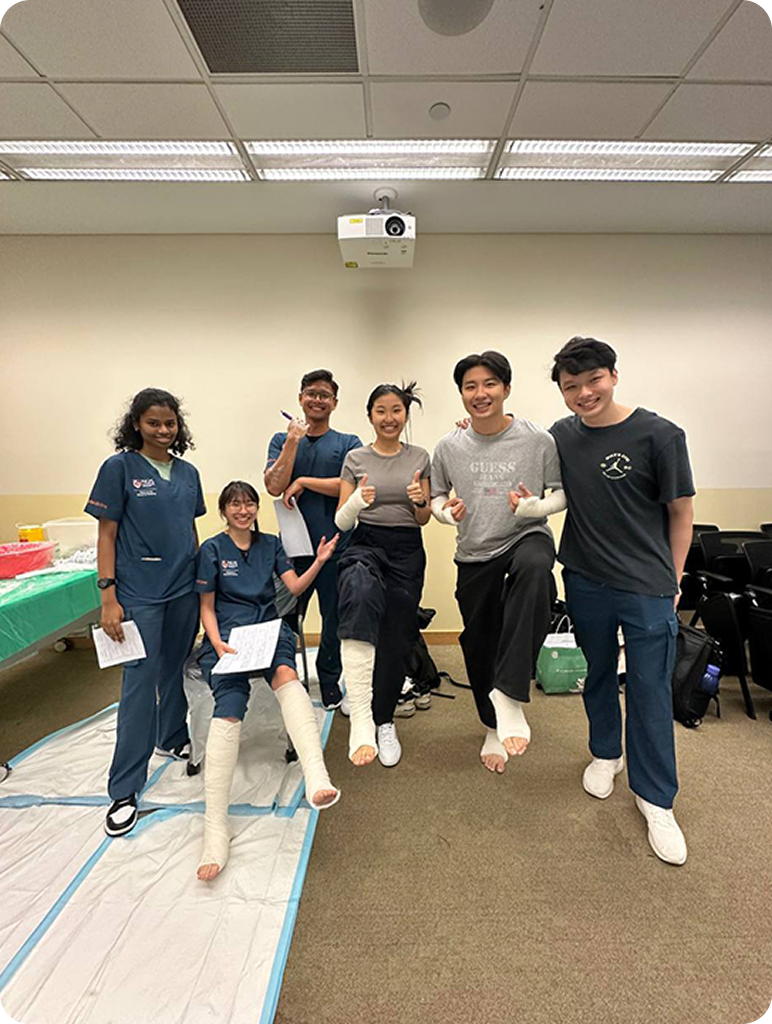
Haziq (third from left) and his fellow NUS Medicine coursemates always had fun in the midst of their busy days, such as during their Phase V Orthopaedics Workshop.
One experience that emblematised this camaraderie was the Senior-Teach-Junior Mentorship Programme, where older students volunteer to mentor their juniors. “Medicine involves a lot of self-directed learning, and seniors really stepped up to guide us. Their voluntary help gave us a framework to navigate our studies, it was reassuring and empowering,” Haziq recalls with warmth.
Passing the baton
When he isn’t in scrubs, Haziq can be found coaching teens in floorball, helping them grow not just as athletes, but as people. “I want them to express themselves, pursue their interests wholeheartedly, and work hard to achieve their goals.” But his passion isn’t just for coaching floorball – Haziq has a growing interest in clinical education. Although coaching floorball first sparked his love for teaching, he now dreams of joining the NUS Medicine faculty to mentor the next generation of doctors.
He reflects: “I was more than happy to teach sports when I was younger, as that was all I knew. But I never thought to teach subject knowledge until I got my clinical postings and was taught well myself… I want to make learning medicine more enjoyable and memorable for future students. Teaching is a way to give back.”