From notes to soundwaves: A Tonmeister’s quest
Michael Huang
Year 4, Yong Siew Toh Conservatory of Music
The musician behind the mix
If you ever meet Michael Huang Wei Cheng, don’t expect a simple introduction. “I always felt like saying I’m an Audio Arts & Sciences student paints an incomplete picture,” he admits. “It pigeonholes me. I do a lot more than just audio.” And he’s right. At 24, Michael is a pianist, photographer, video editor, recording producer and a Year 4 student at the NUS Yong Siew Toh Conservatory of Music (YST), where he’s majoring in Audio Arts & Sciences (AAS). Beyond titles, Michael is defined by curiosity, versatility, and a quiet determination to explore the world through music.
From piano keys to possibilities
Michael’s musical journey didn’t begin with a family legacy or early exposure. “No one in my extended family displayed any musical inclination,” he confesses. His father worked in engineering, his mother in IT. Yet, a few serendipitous encounters — with a piano shop owner and a music examiner who both seemed exceptionally fulfilled by their careers — convinced his parents that pursuing music could bring joy and a sustainable career to their son. “The bottom line is they just wanted me to be happy,” Michael reflects, “even if they may not have fully understood then what a career in music would entail.”
That journey began with piano lessons and eventually led him to the School of the Arts (SOTA), where he enrolled in the IB Career-Related Programme (IBCP) with a focus on piano performance. “Piano was the way in for me, the entry point into the larger world of music. Having a strong instrumental and musical foundation is very important and opens many doors. I would not be where I am today if not for the rigorous musical training back then.”
A turning point
During his National Service, Michael was volunteering with the Orchestra of the Music Makers (OMM), where he currently serves as Head of Artistic Development.
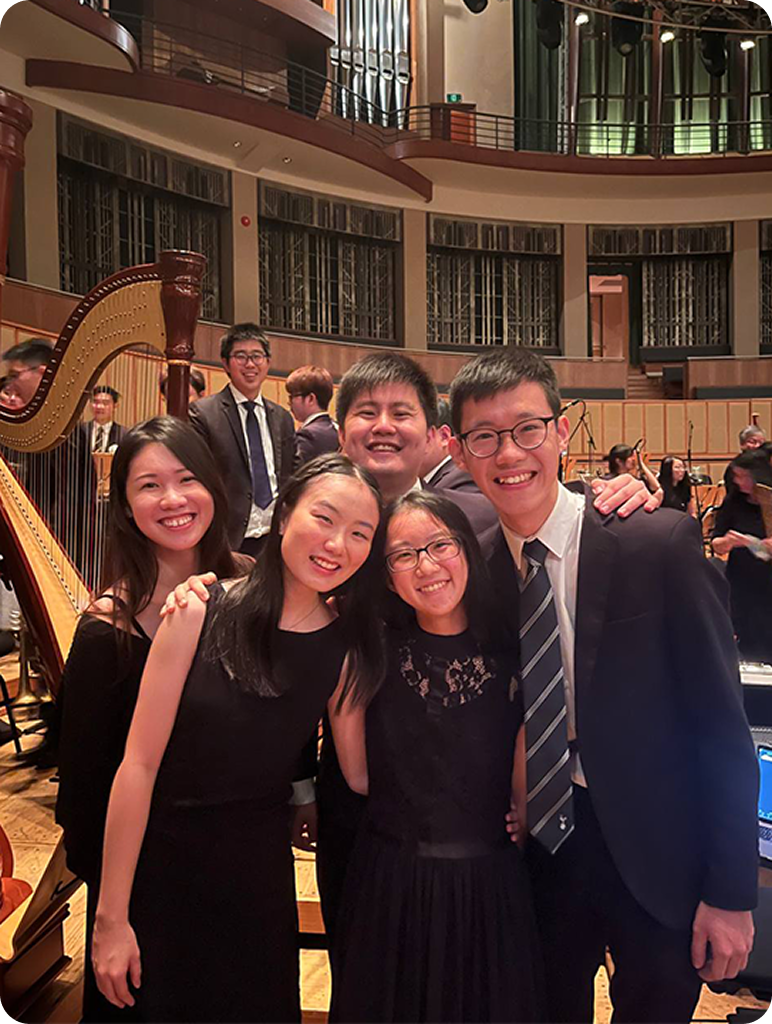
Michael (first from right) with his keyboard and harp sectionmates from the Orchestra of the Music Makers after a performance at the Esplanade in 2023.
Then the COVID-19 pandemic hit, and all of OMM’s usual activities had to be halted. However, that downtime quickly became a personal turning point in Michael’s artistic journey. With live performances halted, OMM pivoted to digital recordings of orchestral performances, supported by the National Arts Council’s Digital Presentation Grant. “We applied three times and recorded three performances between August 2020 and January 2021.”
Working closely with the recording teams they hired, Michael discovered a new role off the stage. “The video team needed a musician who could read scores and call out what was interesting to shoot for the director and camera operators. That was my entry into the recording world.” He had his first taste of a recording session and was hooked — not just by the tech, but by how he could contribute as a musician.
The guy who does audio stuff (and everything else)
Fast forward five years, and Michael has worn nearly every hat in the production world: Camera Operator, Audio Engineer, Editor, Video Director, even producing the extensive Wagner Ring Cycle Operas and serving as Head of Branding and Marketing for OMM. But the role he’s most passionate about? The Recording Producer.
“That was exactly what piqued my interest back in 2020,” he says. “Mr Dominik Streicher, who ran the recording sessions, would annotate which passages were done well, which weren’t, and revisit them during the recording session, in constant communication with the conductor. The post-production process was also an eye-opener. I was blown away by how much was technically possible in the editing room. He is now my supervisor, and the audio firm we worked with then, msm-productions (Singapore), is now the firm I intern at,” he smiles.
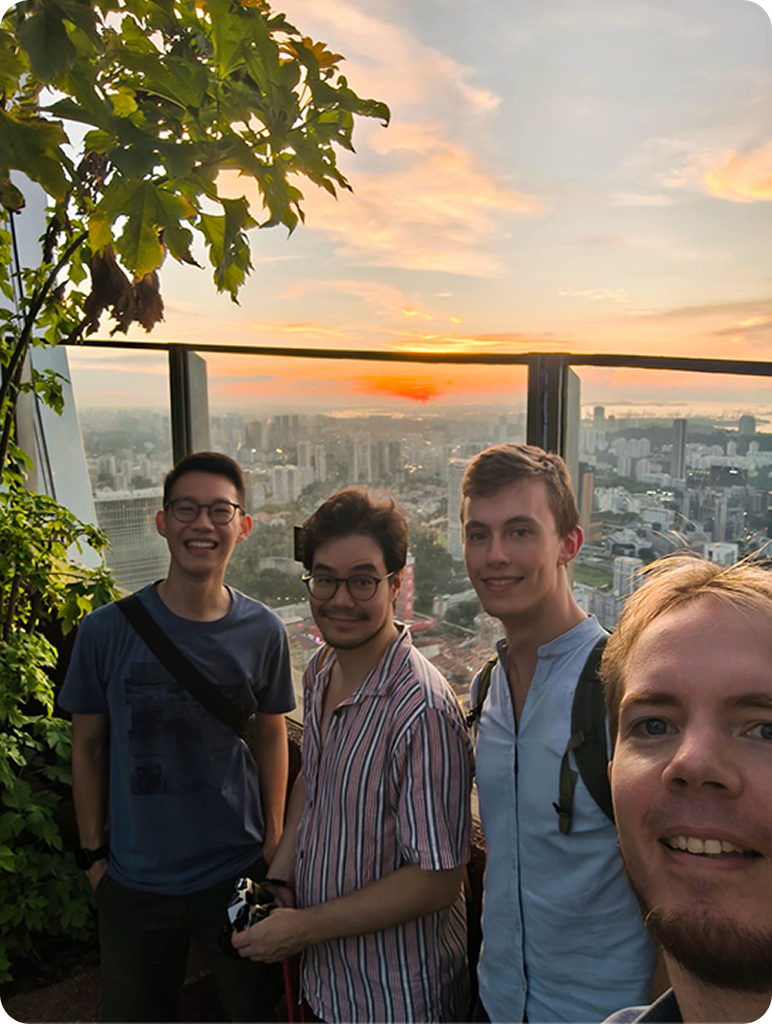
Michael (first from left) has found a second home as an intern at msm-productions (Singapore) alongside colleagues (from left to right) Martin Shi, Malte Schäfer and Dominik Streicher.
Michael’s artistic identity as a musician helps shape how he approaches audio and video. “When recording a concert or doing post-production, interpreting the music is critical. You’re not just pressing buttons, you’re telling a story. More accurately, you’re helping the performers tell their story, and being a musician yourself certainly helps.”
Building bridges
With his eyes opened to this new path, Michael enrolled in the AAS programme at YST. A typical day in AAS runs the spectrum from hands-on practical sessions to theory classes, including music studies courses taken by all YST undergraduates, emphasising not just technical skills but also deep musical expertise. He describes the AAS culture as “collaborative and welcoming,” and emphasises the importance of teamwork. “We are always working in teams. You can only get so far alone, at the end of the day, you need a good team to achieve great things.”
This culture extends beyond just AAS and to the wider YST community. “Even performing solo pieces usually involves an accompanist. Then there’s chamber music, and the larger orchestra — collaboration is a recurring theme.” To thrive in a programme like AAS, Michael says students should be independent, flexible, and problem solvers. “During productions, things don’t always go as planned. That’s when you’re really tested,” he cautions lightly.
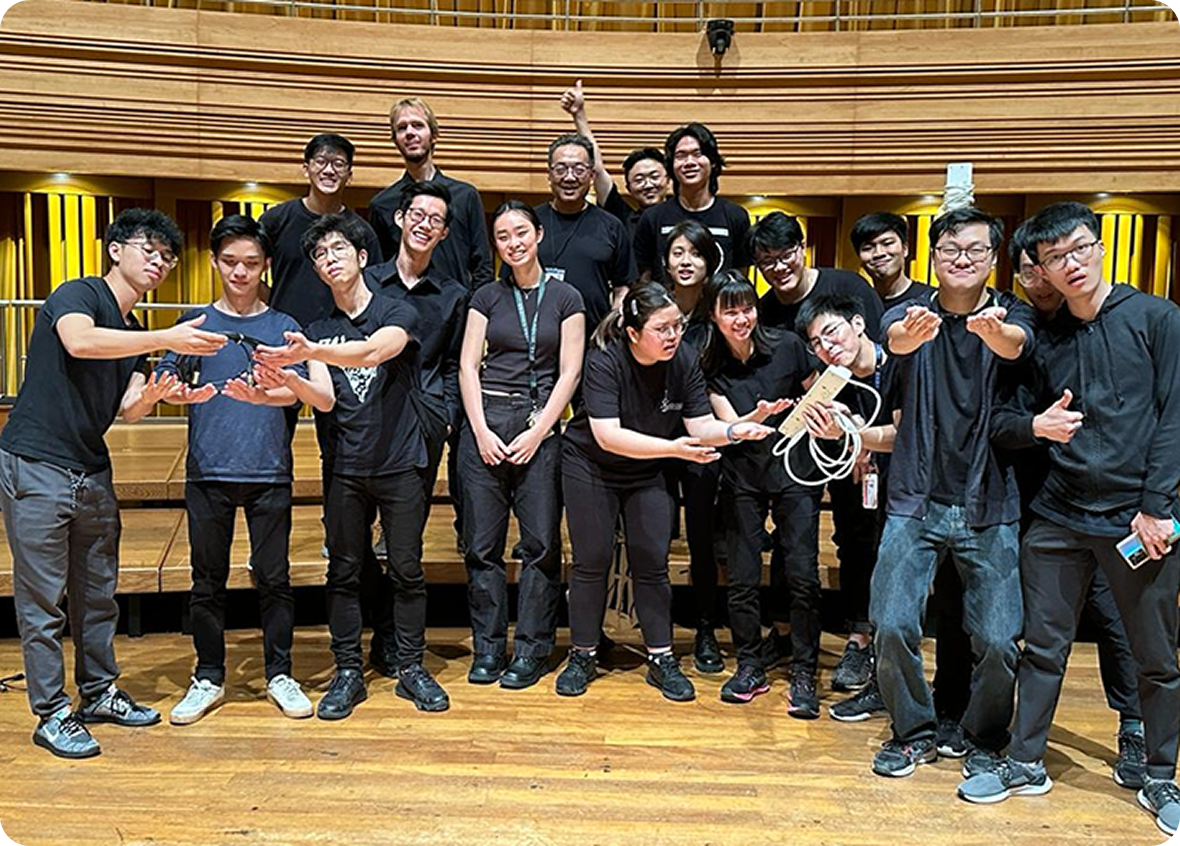
Michael (first row, fourth from left) worked closely with his fellow AAS students and lecturers at YST’s Southeast Asian Golden Age Symphony concert in 2023.
One of Michael’s favourite courses was MUA1159: A Pianist’s Toolbox in Year 2, which gave him the opportunity to explore performance-related courses outside of his major. “The class consisted of just the four of us; it was an overall fun course taught by a very skilled Professor Karst de Jong!” he enthuses. Michael also found MUA2163: Leading and Guiding through Music exceptionally meaningful. During the course, he worked with the nursing home United Medicare Centre and curated a special musical programme for their residents. “It left a lasting impression on me, seeing what a joyous impact our musical programme made on the elderly at the nursing home,” he reflects.
Beyond the soundboard
Michael’s creativity spills over into other media, such as photography. He has assisted YST with photographing concerts and even maintains an Instagram profile dedicated to his photography. He also enjoys hiking and learning languages. “Fun fact: I still speak German with my msm-productions colleagues; it’s a great way to keep up the progress I made during my overseas exchange in Vienna!” he grins.
With plenty on his plate, university life could have easily gotten overwhelming for Michael. One of the main ways he relaxed outside of the classroom was by enjoying the benefits of residential living. Michael spent two years living on campus at Tembusu College, juggling his studies with much-needed social downtime. “I was busy trying to get up to speed and working to catch up with technical expertise,” he says. “But I made time to hang out with mates, played games, stayed up late — I actually regret not doing even more of that.”
Vienna: The Tonmeister awakening
Besides the priceless experience of campus living, Michael is most grateful for the resources NUS provided, especially the opportunity to go on a Student Exchange Programme to Vienna’s Universität für Musik und darstellende Kunst Wien (mdw, or The University of Music and Performing Arts). “It was a taste of Tonmeister studies for two semesters — and it changed everything for me.”
Tonmeister studies is a specialised field of study that combines music, sound engineering and technology to train a “sound master” who is highly skilled in both the artistic and technical aspects of music recording and production. “Walking into that environment was surreal,” he says, reflecting upon how he felt singularly at home at mdw and being among fellow Tonmeisters. “Calling myself a Tonmeister feels closer to home than calling myself an audio engineer, it’s about being a musician first.”
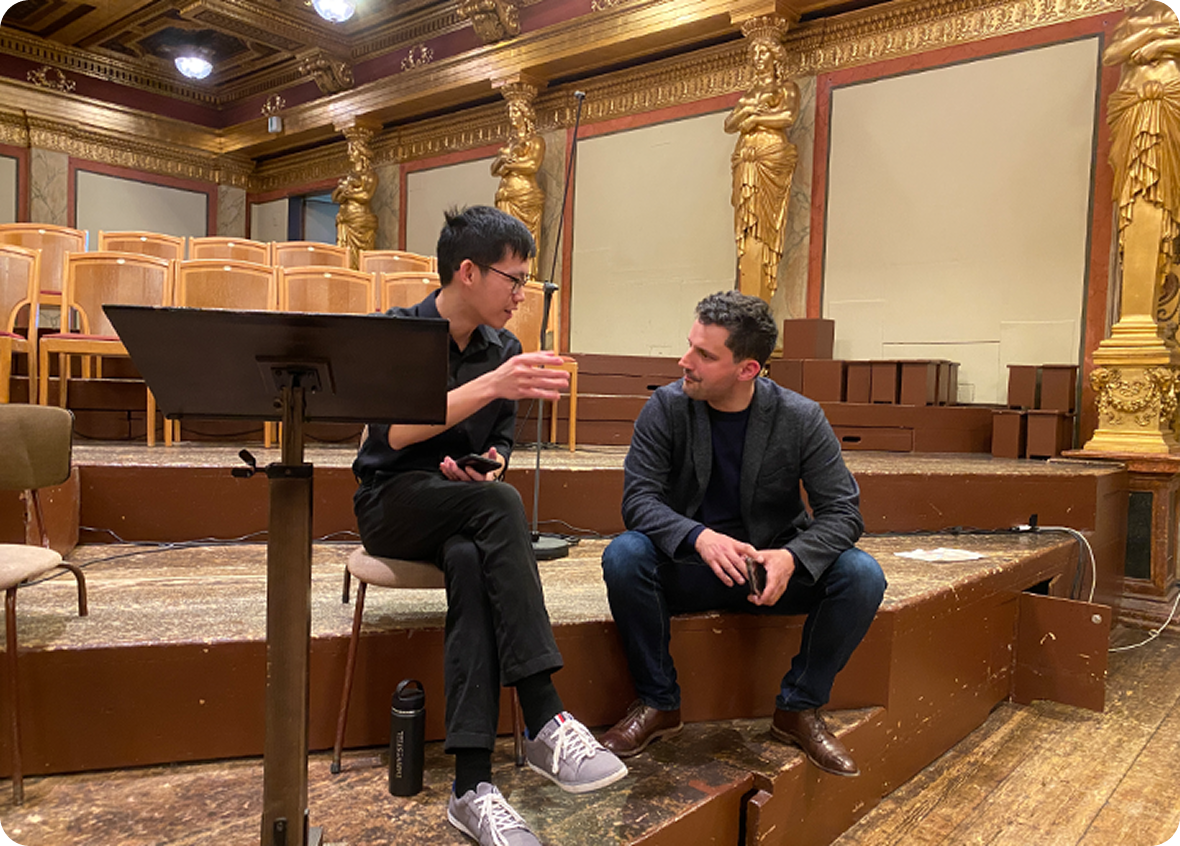
Michael (left) enjoyed discussions and casual rants with his mdw lecturer Mr Florian Rabl about different recording approaches and other Tonmeister intricacies.
Learning by doing
Michael quickly threw himself into the swing of things with enthusiasm. His professor Pauline Heister granted him access to facilities to organise independent recordings, booking halls, equipment, managing musicians and running sessions on his own. “I got to wear all the hats. It was challenging, but I had confidence I could do it.”
At mdw, Michael relished the freedom to shape his learning and designed his own study plan: “I had to figure out what made sense for my professional development.” He particularly enjoyed the course Music Production Analysis 05, which was taught by Grammy-nominated Mastering Engineer Christoph Stickel. “Getting that contact time with him weekly, a real industry professional, understanding his thought process and training our ears to really listen — I never imagined getting this kind of learning opportunity,” he recounts. While on his winter break, he even had the chance to be part of a Bavarian Radio CD production in Munich, where they recorded the Stretton Trio in two major piano trios and other miniatures for future release.
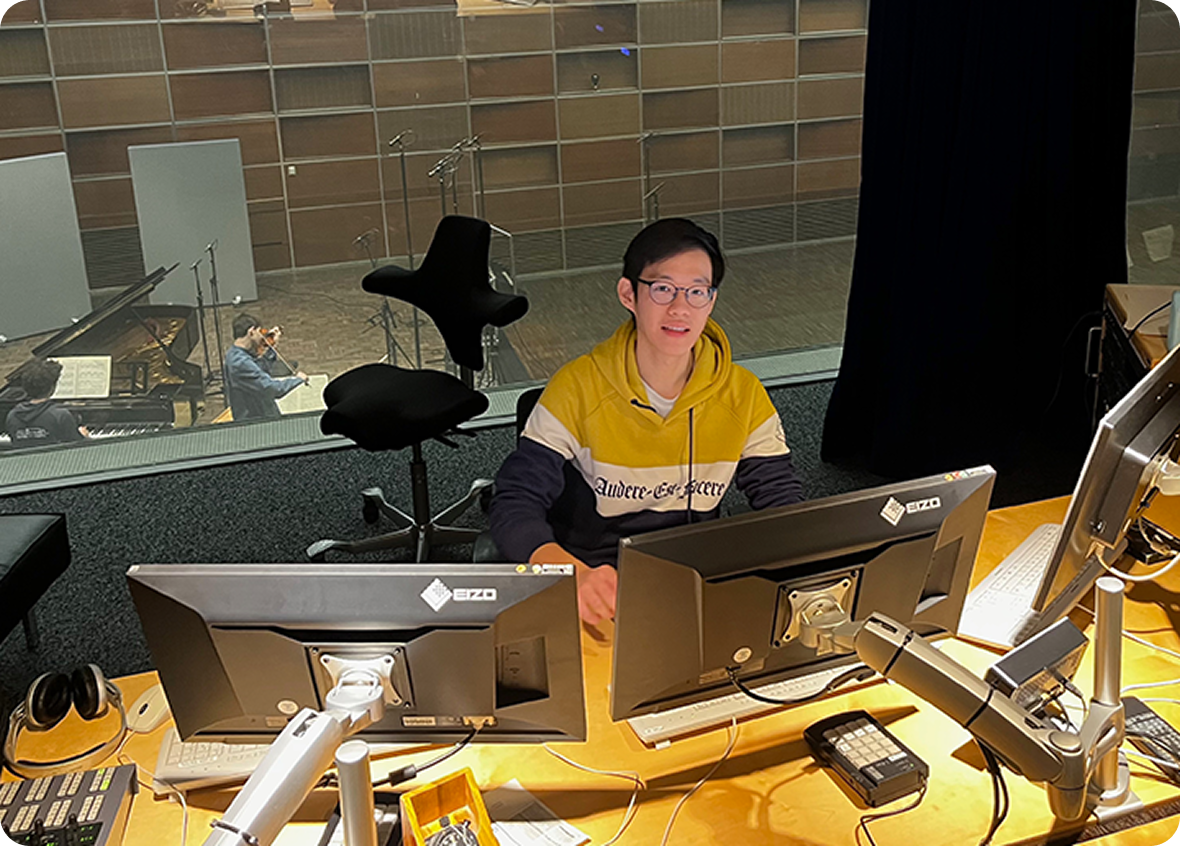
Michael relished the opportunities to collaborate with other musicians while on exchange in Europe. Here, he is hard at work as a tape operator in a CD recording session at the Bavarian Radio.
During his Vienna stint, Michael not only organised recordings and collaborated with musicians, but also watched a whopping 97 concerts in 9 months, egged on by Professor Heister, who encouraged him to develop his own artistic identity by attending more concerts. “I was already in Vienna, where there was a revolving door of world-class orchestras visiting and performing daily. So I thought, why not make full use of my time here?”
Noticing his complete immersion in the scene, one student told him: “It’s refreshing to have fellow Tonmeisters who are eager to be around and get their hands dirty.” That comment, highlighting his innate curiosity, stuck with Michael. “I didn’t understand why he was so thrilled to have me around. In fact, I sometimes worried about overstepping my boundaries as an exchange student by asking too many questions or doing too many things. But I realised I’m genuinely curious about how things are done and love getting involved, which was apparently a rare, and thankfully welcome, trait.”
The final note
Michael is passionate about breaking stereotypes. “People think ‘production folks’ are just technical. But for many of us, we’re musicians first. Musicians want to be understood, and we’re the ones on the other side of the wall making that happen.” He also challenges assumptions about conservatory students. “When people hear I study at YST, they ask, ‘You must be quite lonely, spending long hours alone in your practice room, right?’ But it’s so much more than just that. Music is also about collaboration, exchange and empathy, and I enjoy what I currently do exactly because it allows me to bring together all these facets.”
His aspirations post-graduation? To prove that music production can be a viable, vibrant career. “This job exists,” he affirms.
Michael hopes to continue the next chapter of his professional and musical development at msm-productions (Singapore). “While I have considered pursuing further studies in a Tonmeister programme to deepen my understanding in the field, my boss Mr Johannes Müller [Executive Director of msm-productions (Singapore)] assures me that I have already accumulated plenty of valuable knowledge over my past academic years, and the best way to further build on that and grow into the role is to simply start working and get up to speed. The future — with its ample opportunities for further studies — will take care of itself!” he laughs.