Close to 500 Executive and Administrative (E&A) staff gathered on 29 October 2025 for the inaugural NUS Learning & Development (L&D) Academy Learning Symposium, held at University Hall and streamed online. Titled “Unlocking Potential, Embracing Tomorrow,” the event celebrated lifelong learning, innovation and collaboration across NUS.

Participants had the opportunity to view the displayed projects at the exhibition gallery.
The Symposium featured keynote addresses, breakout sessions, fireside dialogues, and a project gallery showcasing workplace applications of data and AI. It opened with the Learning Awards Ceremony, recognising staff who exemplified the spirit of continuous learning through the Data Literacy Programme (DLP) and Artificial Intelligence Competency Programme (AICP).
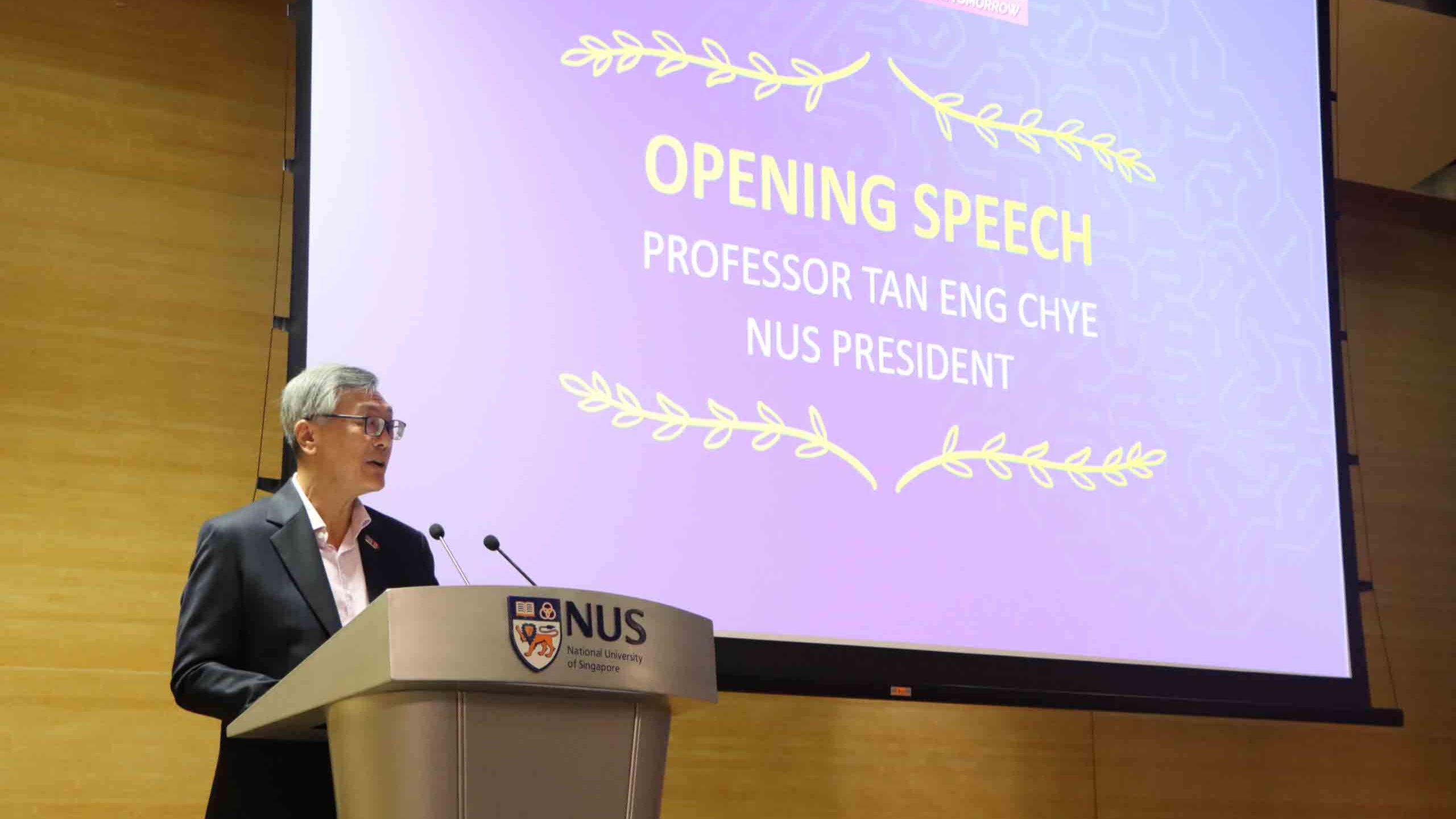
NUS President Professor Tan Eng Chye delivered the opening address at the inaugural NUS L&D Academy Learning Symposium.
In his opening address, NUS President Professor Tan Eng Chye reaffirmed the University’s commitment to Continuing Education and Training (CET) through stackable pathways, work-integrated experiences and data-informed, human-centred design. He shared that “this symposium builds on the foundation and spirit of a learning community – colleagues across NUS coming together to share, learn, and celebrate how far we have come in building a culture of lifelong learning right here in NUS.”
Prof Tan highlighted that NUS, as Singapore’s flagship university, plays a pivotal role not only in education but also in “reskilling and upskilling the Singapore workforce, supporting and enabling our alumni and the broader workforce to thrive and stay competitive in a world transformed by data and AI.”
He also outlined NUS’ three-pronged CET strategy: stackability and mobility, work-integrated learning, and data-informed, human-centred approaches – noting that these principles have shaped the L&D Academy’s flagship programmes, which have trained over 4,000 staff.
The newly introduced Skills Recognition Scheme also took the spotlight. Launching in mid-2026, the initiative will recognise staff who apply their learning at work and attain secondary job titles such as Associate Data Scientist and Data Scientist, with commensurate skills allowances “closing the loop between learning and performance, where skills are not just acquired, but valued and rewarded,” President Tan emphasised.
More than 180 E&A staff from the DLP and AICP Class of 2024–2025 were honoured for their achievements at an awards presentation ceremony. The Project Gallery at University Hall Atrium featured over 30 data and AI projects tackling challenges across NUS.
The Symposium continued with a captivating keynote by Mr Uli Hitzel, Principal AI Strategist at Naida and Executive Fellow at ACE. In his talk, “The Dance of Minds Between Humans and AI,” he described AI as a “dance partner” that amplifies human creativity, but only when we “stay in the driver’s seat.” His message on data discipline and human agency resonated strongly with participants.
Two parallel learning tracks followed, exploring the interplay between AI and human potential. In the “Navigating the Future with AI” track, Professor Koh Lian Pin, NUS Vice President (Sustainability and Resilience) and Chief Sustainability Scientist, discussed how AI can advance climate resilience and sustainability, while Dr Adrian Kuah, Director of NUS Futures Office, offered a thought-provoking perspective on how we can better navigate an increasingly complex world. Associate Professor Loy Hui-Chieh from the Department of Philosophy at the Faculty of Arts and Social Sciences then joined Mr Hitzel and Ms Wong Lim Ting, Assistant Manager from NUS L&D Academy, in a dialogue on AI ethics and accountability.
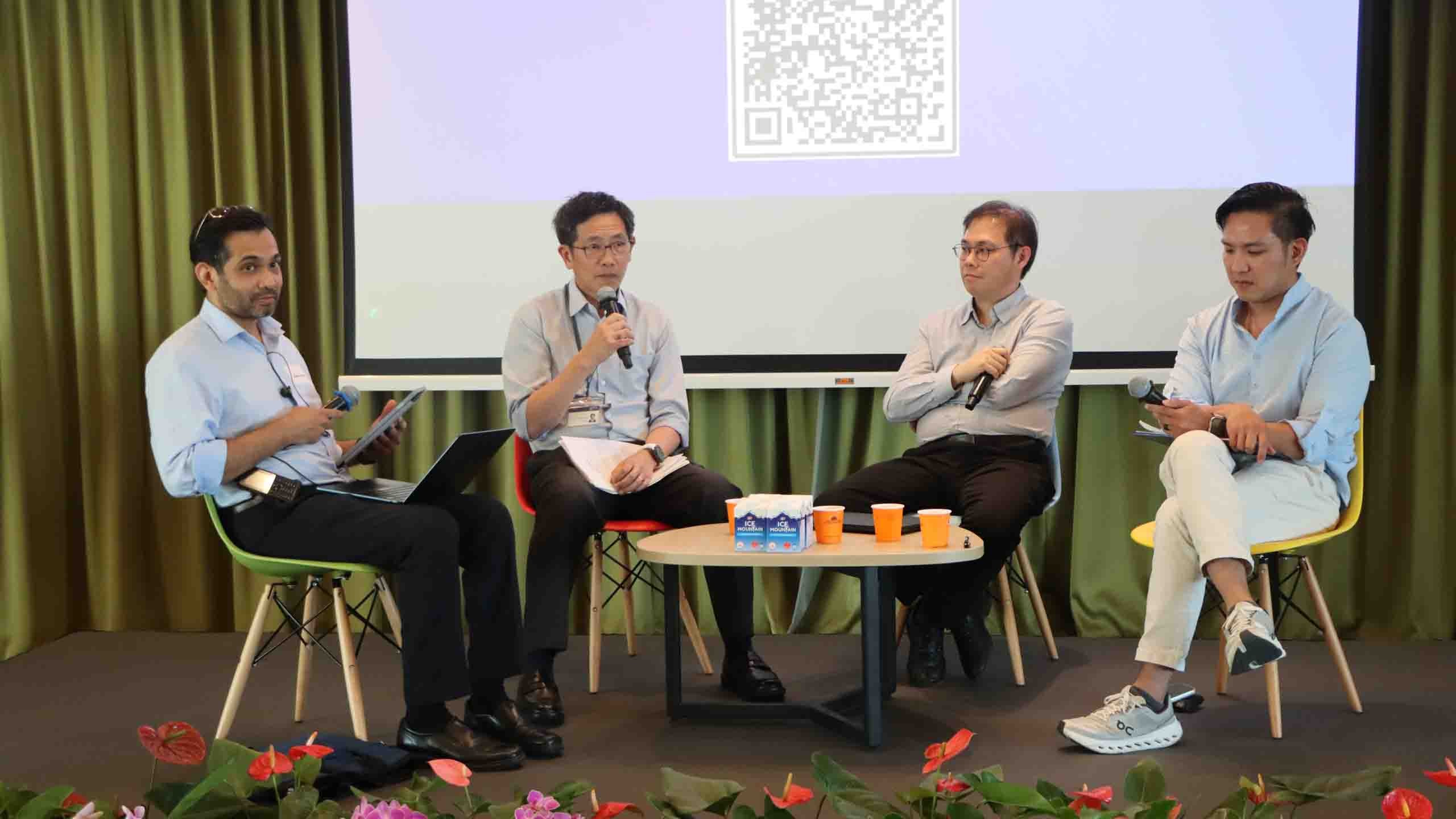
Fireside chat on ‘Future of Work: Ways to Live Well’ with Dr Ismail Hanif as moderator, and panellists Mr Tan Kian Woo, Assoc Prof Loy Hui-Chieh and Dr Andrew Tay (from left to right).
In “Unlocking Human Brilliance”, Mr Tan Kian Woo, Senior Vice President and Chief Financial Officer, spoke on trust and team building; Ms Ovidia Lim-Rajaram shared how empathy and authenticity remain vital in the age of AI; and Dr Andrew Tay, Chief Wellbeing Officer, offered science-based tips for wellbeing and performance.
The Symposium concluded with two concurrent fireside chats exploring the human side of the future of work. At the Auditorium, Mr Jonathan Sim, lecturer at the NUS L&D Academy and Fellow at the NUS Teaching Academy, moderated a conversation with Prof Koh, Dr Kuah and Ms Lim-Rajaram on ‘Future of Work: Ways to Work Well’. They spoke about purpose, balance and adaptability amid change. At Nexus, Dr Ismail Hanif led a dialogue on the same topic with Mr Tan, Dr Tay and Assoc Prof Loy, who reflected on how empathy, ethics and curiosity will continue to define leadership in a tech-driven world.Together, the sessions underscored a simple truth: amidst all the talk about AI and disruption, one’s capacity to think, adapt and stay curious is what truly matters. As one panellist reflected, “The future is not something that happens to us; it’s something we build together.”
In his closing remarks, Assoc Prof Tok Eng Soon, Associate Vice President and Head of NUS L&D Academy, emphasised that while technology continues to transform how we work, it is NUS’ people – their adaptability, creativity and willingness to learn, that will continue to drive the University forward.
From AI-powered sustainability to leadership, ethics and wellbeing, the L&D Academy Learning Symposium 2025 showcased the best of NUS’ lifelong learning culture: forward-looking, human-centred and deeply collaborative. The event closed on an inspiring note, reminding everyone that while technology may power the future, it is humanity that gives it purpose. By learning, adapting and leading with heart, NUS continues to show that the real intelligence shaping tomorrow is both human and artificial working hand in hand.
By NUS Learning & Development Academy, Office of Human Resources