



This site uses cookies
By clicking accept or continuing to use this site, you agree to our use of cookies. For more details about cookies and how to manage them, please see our Privacy Notice.


 Recommend Articles, Books & Other Materials for Purchase
Can’t find a resource you need in our libraries? Send us your request and we’ll source for it
 Intralibrary Loan
Request for a book to be sent to another library within NUS Libraries for collection
 Guides & Tools
Discover our many resources for research, learning and teaching - from how-to guides, to databases and other powerful tools!
 Research Starter-kit
Learn about research tools such as Proxy Bookmarklet, BrowZine, Citation Managers and FindIt! with Google Scholar
Singapore's hawker centres are more than just places to grab a meal. They serve as vital third spaces where communities gather to eat, connect, and bond. With over 100 hawker centres currently operating across Singapore, they have become part of the nation's essential social infrastructure. Yet, the ageing population of hawker vendors, rising costs, and increasing competition from other food establishments raise questions about the sustainability of the hawker trade. What ought to be prioritised when preserving hawker culture?
This research examines the complex interplay between form and function in the policies that define hawker centres. What fundamentally makes a hawker centre a hawker centre? Is it the affordability of its food, or the lower entry barriers for ordinary Singaporeans looking to run their own businesses? Or, is it the distinctive physical environment—open-air settings, communal seating, and compact stalls—that defines it?
Since their formation in the 1970s, hawker centres have been shaped by evolving official policies that grappled with these questions and shifting priorities, creating ambiguity about which aspects are essential to preserve.
Drawing on interviews with over 20 hawkers, from newcomers to multi-generational operators, this study reveals ongoing tensions between policy intentions and ground-level realities. While hawker centres were conceived to provide affordable food and viable employment opportunities to the masses, these foundational goals face mounting pressure with increasing operational challenges. Recent adaptations to hawker operations—including the appointment of third-party centre operators and the phasing out of rental subsidies—signal deeper shifts in the roles of hawkers: Are they providers of public good, or simply players in a commercial marketplace?
Without clear definitions of what constitutes the underlying purpose of hawker centres in the Singaporean context, stakeholders struggle to navigate competing demands of heritage preservation, affordability, and commercial feasibility. Findings from this research offer policy suggestions on how both form and function could be considered to preserve hawker centres' essential character while adapting to modern realities.
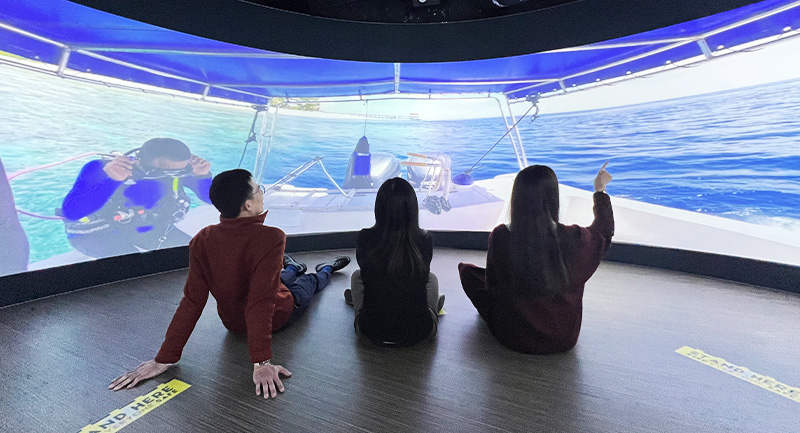
As part of this project, there will be a video screening and an exhibition at the 360imx, Central Library (Level 4).
The exhibition features the stories of the hawkers involved, as well as a data visualisation tracing the timeline of key hawker policy developments in Singapore.
The video, by Ethnographica Private Limited, was directed, narrated and edited by Sarah Huang Benjamin with research by Vivienne Wee. It formed part of the Singapore Heritage Society's “The Evolution of Singapore's Hawker Culture” research project, supported by the National Heritage Board.
The video screening and exhibition continues to run Mondays to Fridays, from 29 August to 30 September 2025. Below is the schedule.
| Time | What Will Be Showing |
| 9.00 am to 10.30 am | Video Screening |
| 10.30 am to 12.00 pm | Exhibition |
/chef-jenny-dorsey.png?sfvrsn=389a028f_1 "Chef Jenny Dorsey")
Chef Jenny Dorsey

All NUS staff and students are welcome.
Booking availability on a first-come, first-served basis.
