Medicine+Science Library will be closed on 28 February (Saturday) for a fire certification test.


-
Borrowing & Requests
Borrowing & Requests
 Recommend Articles, Books & Other Materials for Purchase
Can’t find a resource you need in our libraries? Send us your request and we’ll source for it
 Intralibrary Loan
Request for a book to be sent to another library within NUS Libraries for collection
-
Services & Help
Services & Help
 Guides & Tools
Discover our many resources for research, learning and teaching - from how-to guides, to databases and other powerful tools!
 Research Starter-kit
Learn about research tools such as Proxy Bookmarklet, BrowZine, Citation Managers and FindIt! with Google Scholar
-
Spaces
Spaces
-
Collections
Collections
- What's on


Statement by University Librarian on Relocation of Yale-NUS College Library Books
21-05-2025
In maintaining our library collection, excess books are routinely rehomed in other libraries or given away to faculty members and, at times, students. Books which are not taken up are then sent for recycling, in line with common library practices.
In our current exercise of relocating the books from the Yale-NUS College Library, the majority of the books has been rehomed within NUS Libraries.
In this instance, excess books were offered only to faculty members, and not students.
We understand later that many students are interested in having these books and we would have usually acceded to their requests. We did not do so on this occasion, and we apologise for the operational lapse.
In view of the strong interest from students, we are now organising a giveaway on campus so that the excess books can find a new home.
Going forward, we are reviewing our process and will take proactive steps to distribute excess books to the NUS community and the wider public so that they can benefit as many people as possible.
Associate Professor Natalie Pang
University Librarian, NUS Libraries
Further Clarifications by University Librarian Associate Professor Natalie Pang


Institutionally Paid OA for NUS Authors
NUS Libraries, School of Computing, and the Office of the Deputy President (Research & Technology) have worked together to enter into a 5-year open access agreement with the Association for Computing Machinery (ACM). For all submissions to ACM made between Jan 1, 2021 and Dec 31, 2025, NUS corresponding authors can publish OA at no cost to the author.

Library-Supported Free-to-Publish Model
NUS Libraries is now a supporting institution of the Open Library of Humanities (OLH) from Sep 2020 to Sep 2021. The OLH is an academic publishing platform that supports 22 fully OA academic journals from across the humanities disciplines. Unlike many OA publishers, the OLH does not charge any author fees. Instead, an international library consortium covers its operational costs.
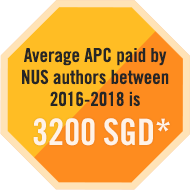
*Based on NUS Libraries’ internal analysis of compiled Web of Science data.


